

[From small to large groups] Drinking games recommended for college students

We’ve put together a list of games that seem perfect for livening up a drinking party—especially recommended for college students.
We’re focusing on ones you can start on the spot when inspiration strikes and that don’t require many props.
When drinking, even things that wouldn’t normally make you laugh can suddenly feel hilarious, so even super simple games you’ve played “a million times” can get everyone fired up! These are all games that both drinkers and non-drinkers can enjoy together in a lively atmosphere, so be sure to give them a try!
- Recommended for college students! Punishment game ideas that will make everyone laugh and hype things up
- Party games collection that get everyone excited in a big group
- Party Games That Spice Up Your House Drinks Night
- Games for two people to enjoy. A roundup of party games that liven up drinking gatherings.
- Punishment games that liven up drinking parties and banquets
- Punishment games that hype up a group date
- A fun penalty game recommended for men
- Get closer in no time, even with first-time meetings! Games that liven up welcome parties
- Drinking party crowd-pleasers: party and banquet games
- Simple mini-games that liven up a party
- A fun punishment game recommended for women
- A simple punishment game you can do anywhere without any props—even at school or outdoors.
- Simple but intense! A quick-and-easy penalty game that hypes everyone up
[From small to large groups] Drinking games recommended for college students (21–30)
Kazutori-dan

The game “Kazutori-dan” was played on the popular variety show Mecha-Mecha Iketeru!, which aired until 2018.
In this game, players say the name of an object or animal, and the next person must respond with the correct counter unit, with the number increasing each turn.
For example, if the previous prompt is ‘tofu,’ the answer would be ‘1 chō (one block),’ and if the next prompt is ‘rabbit,’ the answer would be ‘2 wa,’ and so on—giving the correct counter while increasing the number.
It’s fine if the same prompt continues; in that case, only the number increases.

U.S.A. game

The “U.S.A.
Game” is a game where you play while dancing to DA PUMP’s smash hit song “U.S.A.” You sing along to the chorus of “U.S.A.” and do the famous “Ii ne Dance” while answering common clichés related to a given topic.
Topics are given on the spot, and you have to answer without any time to think.
Start simple with the topic “America” and list American clichés, then move on to various topics like “college,” “drinking parties,” and so on.
If your answer isn’t a real cliché or you can’t come up with one, you’re out.
Beef Tongue Game

The brain-teasing Gyutan game is perfect for group play, where focus and memory are key.
Players sit in a circle and say “Gyu” out loud, then on the “tan” part, they clap without speaking.
Pay extra attention because the final “tan” comes in succession.
After one round, move to the second, third, and so on, increasing the number of final “tan” claps by one each time.
As the rounds progress, the number of “tan” claps increases, so remember the count and try not to make mistakes.
Once you get used to it, picking up the tempo can make it even more exciting.

Does an English conversation telephone game work?

Let’s try playing a game of telephone in English, where each person passes along the same phrase to the next! First, present an English sentence as the prompt.
It’s recommended to have an AI tool read it aloud rather than a person pronouncing it directly.
The first person listens to the sentence and passes it on to the next person.
If the last person can accurately state what the original English sentence was and provide its Japanese translation, the group succeeds.
You could also make the sentence a question and have the last person give an appropriate answer to that question.
It’s a fun communication game that will make you laugh while also testing everyone’s English skills.

Six patients and medicine

It presents the ultimate choice: help one critically ill patient or save five moderately ill patients.
There is only one dose of medicine; the critical patient needs the entire dose, whereas the moderate patients can all survive if it is divided among them.
The dilemma of valuing a single life versus prioritizing the many exposes one’s values.
Key discussion points include whether all lives are equal in weight or whether social roles should be considered.
It is important for the whole class to debate and work toward a single final decision, making this a thought-provoking theme that lets students experience the challenges of ethics and difficult choices.

Enjoy instantly! “Shingenchi Game”

Choose one person from the players to be the guesser.
The remaining members decide who will be the “epicenter,” then either stand in front of the guesser or form a circle with the guesser at the center.
At the start signal, the epicenter naturally strikes a pose—anything is fine, such as folding their arms, switching their pivot foot, or scratching their head.
The other members, with a slight delay, imitate the epicenter’s pose.
The guesser must observe who started the pose and identify the epicenter.

Improv Acting Showdown
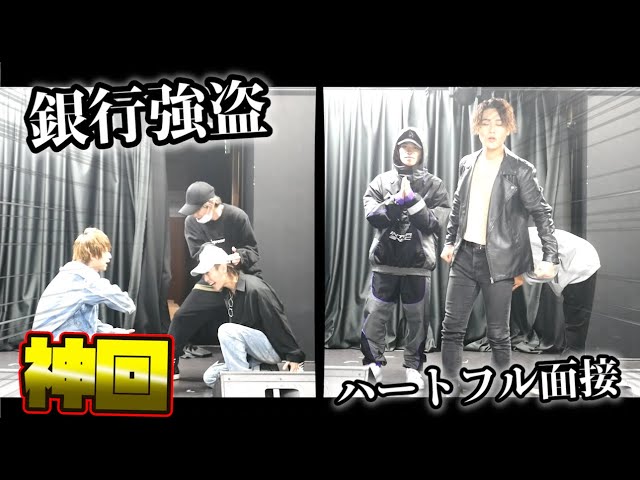
Decide on three elements—the setup, the punchline, and the constraint rules—tell the performers, and start the game! Since it’s all improvised, you can’t practice beforehand or agree on the flow with the group.
In other words, it’s a pretty challenging game where you have to reach the punchline while sticking to the setup and constraints, all without knowing how the others will play it.
Even the person who came up with the setup and punchline doesn’t know how things will unfold, so it’s a thrilling, exciting experience! Who knows—an unexpected masterpiece might be born!