


Last time, I introduced Alan Williams—one hapless fellow who, despite being blessed with the chance to land the Beatles, ended up letting them slip through his fingers.
In this article, let’s introduce another unfortunate person who let the Beatles slip away.
By the way, I introduced Alan Williams in this article.
Reference:The Hapless People Who Let Go of the Beatles — Allan Williams
- The Hapless People Who Let Go of the Beatles — Allan Williams
- No Beatles without Ringo Starr’s drums!
- The men who couldn’t become the Beatles: former drummer Pete Best
- Why does Paul McCartney come to Japan almost every year?
- The Beatles in their youth: jaw-dropping episodes from their struggling days
- John Lennon or Paul McCartney—who wrote that song?
- The hidden secrets in the Beatles’ chord progressions
- The Beatles’ Birthday Songs and Popular Tracks Ranking [2026]
- The men who couldn’t become the Beatles. Stuart Sutcliffe
- [1970s] Classic and hit songs of Japanese rock that blazed through the dawn era
- I want to try playing the piano! A roundup of Beatles songs recommended for beginners
- [Feeling Despair] Classic Showa-era Songs with Dark Lyrics
- [Shōwa-Era Heartbreak Songs] Carefully selected timeless love classics adored across generations!
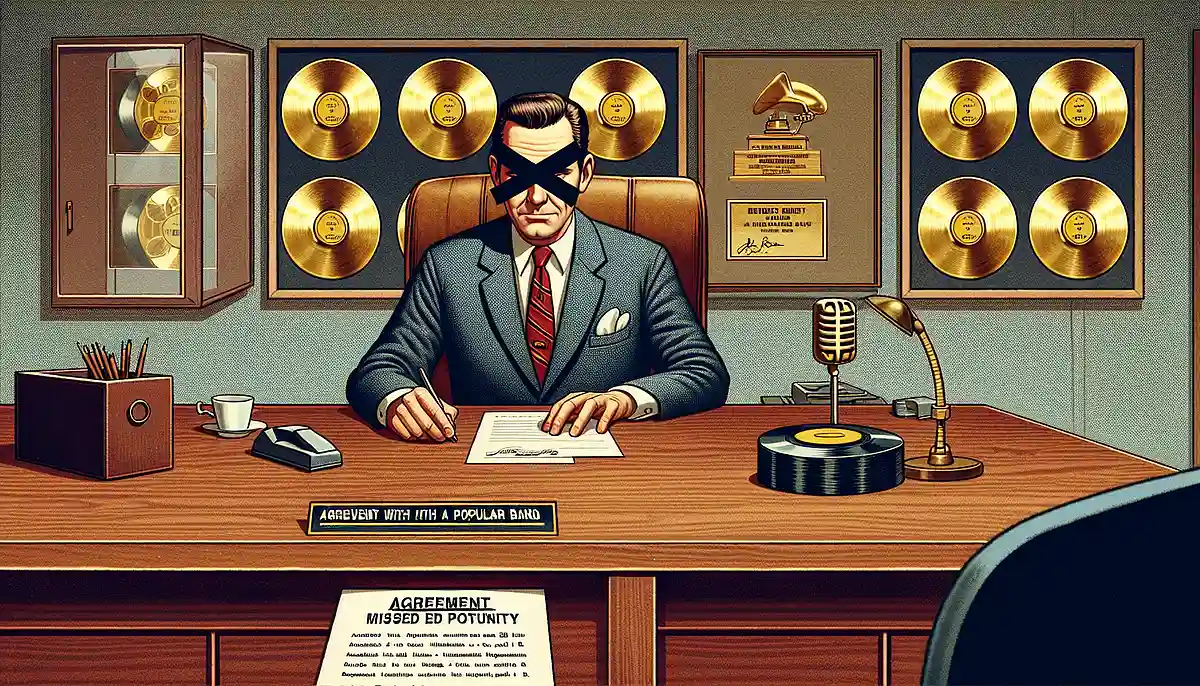
The Man Who Rejected The Beatles — Dick Rowe, Decca Records
I turned down the Beatles at their audition!!
The Beatles auditioned for Decca Records in London on January 1, 1962.
This was the first time they auditioned for a record company.
Before going into this audition, there was a disagreement between the Beatles and their manager, Brian Epstein.
The Beatles argued that they should go with a selection that brought out their original wild style, but Brian insisted they should choose tamer songs to please the record company, and in the end they went along with that.
Worst condition
Because the driver wasn’t very familiar with London’s geography and, on top of that, there was heavy snowfall, they arrived at Decca just before the audition began.
Also, because the amps and other gear they brought were so shoddy, the staff asked them to switch to Decca’s equipment, which offended them.
But in this case, the staff’s claim was actually the correct one...
Anyway, the amp they brought in was a small wooden one—feeble, unable to pick up sound properly, and full of noise—basically a piece of equipment that couldn’t even capture the audio needed for recording.
That aside, they played hard for an hour, performing 15 songs, including three original tracks.
Some of them were so nervous that they couldn't synchronize their playing or harmonies and even stopped mid-performance.
Therefore, although I felt the session hadn’t gone all that well, I was sure that Decca would still sign us.
The result is a fail!!
Guitar groups are a presence that will eventually disappear.
However, the result communicated a few weeks later was a failure.
At the time, Dick Rowe, who was the head of Decca’s A&R department for new artists, said to Brian"Guitar groups are on their way out, Mr. Epstein."I told them coldly.
These words will be etched into history for generations to come.
With this one remark, he would later in life,“The man who rejected the Beatles” (The man who rejected the Beatles)…which will earn me the undesirable title.
He went on to add, “The Beatles have no future in the world of show business. You’re doing well in Liverpool, so you’d be better off going back there.”
However, Brian is not to be outdone either.
"You're out of your mind. I'm convinced they'll become bigger than Elvis Presley," I retort through tears.
Well, I must say, this passion is quite something.
Later, this period of the Beatles was made into a film, and this exchange is depicted in one of its scenes.
Signed with another guitar group
In fact, even as they were saying this, Decca was signing a contract with another guitar group, Brian Poole & The Tremeloes.
Lowe’s subordinate, Smith, argued that they should sign both this group and the Beatles, but when Lowe told him to choose only one, he reluctantly picked the Tremeloes for the simple reason that they were from London, where the company was based.
Row hadn't even listened to the demo tape and simply took Smith at his word.
This is,It was one of the greatest mistakes in the history of music.It is said (that).
last timeAlan Williams, the former manager I mentioned, looked after the Beatles until they became fully-fledged professionals.
In hindsight, he was also the one who toughened them up during the Hamburg tour.
In that sense, Williams can still be credited with contributing to the Beatles, but there is absolutely no such room for Lowe.
Fortunately, however, Decca later panicked at the Beatles’ huge success and, through George Harrison’s introduction, ended up signing the Rolling Stones.
I guess you could say we managed to make the numbers add up somehow (lol).
Even the Beatles were feeling down.
Even they were quite discouraged by this unexpected result.
John Lennon lamented, “We’re finished now,” and, “We could have passed if we’d stuck to our own song choices.”
Paul McCartney complained, saying, “From what I hear on the tape, I don’t understand why we failed. Sure, it wasn’t that good, but the sound was interesting and original.”
And they warned Brian, saying, “If you had done it the way we insisted, we would have passed,” and, “From now on, don’t say a word about the music.”
Of course, Brian had no choice but to comply.
The goddess of fortune did not abandon us.
Parlophone became a savior god.
However—and this is where it gets interesting—the song selection would later win favor with George Martin of Parlophone Records under EMI, at whose audition they would eventually appear.
He says he became interested in them because they have a wide repertoire rather than being all about rock, which just goes to show how unpredictable the world can be.
Although they were rejected, taking the audition at Decca was by no means a waste.
Thanks to that, they were able to obtain an open-reel demo tape recorded with the latest equipment.
Brian, still refusing to give up, takes this tape around and negotiates with record companies all over London, but he gets turned down by everyone.
If your performance is at this level, they’ll just brush you off with, ‘You’d be better off staying in Liverpool and doing what you’ve been doing.’
So Decca wasn’t the only one who lacked foresight.
If anything, it’s Parlophone that deserves the credit for spotting them.
Indeed, even with Decca’s latest technology, there was nothing they could do about the poor quality of the source material.
If you set that aside and recognize their talent, you should rather praise that person.
Bob Boast, the manager of the HMV record store, advised Brian to transfer the tape onto a record so it could be played more easily.
Right away, he has it pressed onto a record at Bost’s shop.
Moreover, at that time the drummer was Pete Best, not Ringo Starr.
If we pass as things are, it will mean we debuted without Ringo.
Whether that was successful or not.
Because Pete's drumming was flat and heavy, and it lacked any sense of tension.
Even if I’d been lucky enough to make a major-label debut, I probably wouldn’t have been able to keep up with the other three for long.
Recording engineer Jim Foy listened to the record and was impressed; surprised to find three original songs on it, he contacted Sid Coleman at Ardmore & Beechwood, a music publishing company and subsidiary of EMI.
Coleman liked the performance and proposed publishing it, but Brian’s goal was record debut above all else.
Thereupon, Coleman introduced George Martin, who was the head of the talent development department at Parlophone Records (a subsidiary of EMI) and a producer.
Martin listened to this tape and became interested in the Beatles.
You never know what will turn out to be a blessing in this world.
Rather, it was Brian’s desperate efforts that grabbed hold of the door to good fortune.
Dick Rowe is kicking himself.
You can just keep kicking until you die.
After the Beatles became successful, John heard a friend say, "Dick Rowe must be kicking himself for not signing the Beatles," and he snapped back, "He can keep kicking himself till he dies."
And when they happened to run into Smith on the sidewalk in London, they all greeted him by straightening their index and middle fingers and touching them to their foreheads.
Something like, “How about that? We showed you all, didn’t we?”
The difficulty of recognizing talent
Recognizing the talent of newcomers is difficult even for professionals—or rather, precisely because they are professionals, they may judge based on preconceptions and experience, and thus fail to discern true ability.
Even that legendary band, QUEEN, was harshly criticized by reviewers when they debuted, with comments like “They sound like outdated glam rock.”
Glam rock is a genre exemplified by artists like David Bowie and T. Rex that was popular in the early 1970s.
However, it was Japanese female fans who first noticed their charm.
After breaking through in Japan, they were eventually recognized in the UK and the US, rising to become world-renowned artists.
The lesson from Decca’s huge blunder—failing to recognize the Beatles’ talent—went unheeded yet again.