

[For Kids] Play Piano with One Finger! Recommended Songs Collection

Playing the piano is demanding and difficult—you’re asked to use both hands and your feet on the pedals, which gets pretty complex.
But that’s only because such instructions are written in the sheet music.
It’s perfectly fine to play the piano with one hand, or even with a single finger! One of the piano’s advantages is that even just playing the melody with one finger lets you enjoy a bit of the piece’s charm.
In this article, we introduce recommended songs that “can be played with one finger,” aimed at young children so they can start by simply having fun with the piano.
Of course, adults who want to give the piano a try are welcome to use this as a guide as well.
And if you have some piano experience, it can be great fun for parent and child to play a duet—have your child play the melody while you provide the accompaniment!
- Beginner Piano: Carefully Selected Easy and Famous Pieces You Can Play with One Octave
- [Disney] Playable even if you’ve just learned Do-Re-Mi! A selection of iconic songs from beloved Disney animations
- [For Beginners] Recommended Ghibli Masterpieces You’ll Want to Play on the Piano
- Even beginners can play them easily on the piano! A curated selection of popular and latest J-POP songs.
- [Piano Pieces] Easy for Children to Play! A Roundup of Simple Classical Works
- [Anisong] Easy for Piano Beginners! Recommended Practice Pieces
- Disney Classics on Piano: A Curated Selection of Easy Pieces, Perfect for Recitals
- Recommended for piano beginners! 10 sheet music picks that adults can enjoy too
- [Children's Piano Sheet Music] Packed with Familiar Tunes! Introducing Recommended Series
- [Children’s Song] Easy Even for Piano Beginners! Introducing Nursery Rhymes with Simple Chords
- [For Beginners] Enjoy Parent-Child Piano Duets! Recommended Songs Introduced
- [Easy to Play Even If You're Not Good with Both Hands!] Simple piano pieces for absolute beginners. Recommended piano songs.
- [Piano Etudes] Recommended for Beginners! A Curated Selection of Easy, Playable Pieces
[For Kids] Play the Piano with One Finger! Recommended Songs (21–30)
Children all over the worldNakagawa Hirotaka

I’d like to introduce a song by Hirotaka Nakagawa, who has created many pieces for children.
This song is about how the sky and the sea laugh and cry along when children around the world laugh and cry.
With its gentle melody and lyrics, it’s a wonderful piece that gives children dreams and hope.
It’s even included in elementary school music textbooks.
One of the great things about the piano is that you can appreciate the charm of the piece just by playing the melody with one finger.
Pay attention to the dotted-eighth and sixteenth-note rhythm.
Why not sing and play it together with the children? I’m sure you’ll have a lovely time.
Toy Cha-Cha-ChaKoshibe Nobuyoshi

“Toy Cha-Cha-Cha,” which moves back and forth from middle C up to the C an octave higher, has a friendly, easy-to-remember melody, yet it also includes chromatic passages that use black keys—something not often seen in pieces found in beginner-level books.
For children tackling their first piece that uses black keys, it might feel like a fun little level-up! As they compare how the sounds differ from the white keys, they can enjoy the charm of how the notes move and have fun playing along.

Merry Christmas, Mr. LawrenceSakamoto Ryuichi
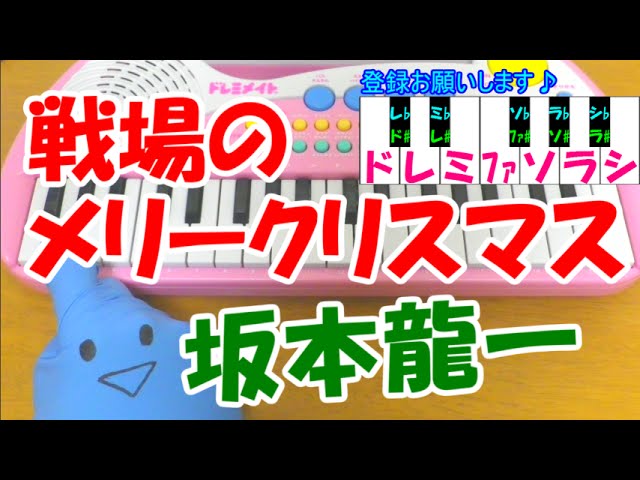
Merry Christmas, Mr.
Lawrence, the signature piece by Ryuichi Sakamoto—one of Japan’s most renowned composers who left behind many works—is a masterpiece beloved across generations.
Many adults even start practicing piano with the goal of being able to play this song.
Its repeated, simple, and wistful melody is very striking.
Because it uses many repetitions of the same motif, it’s also relatively easy to memorize.
If you first organize the score—thinking, for example, “this phrase and that phrase use the same notes”—and then begin practicing, you’ll likely be able to play through the entire piece more smoothly.
strollHisaishi Joe

How about trying to play on the piano the theme song from a Studio Ghibli film, composed by one of Japan’s leading composers? Known for its bright and cheerful melody, this piece is hugely popular with children.
Its lyrics capture the joy of taking a walk, and the rhythmic style leaves a strong impression.
It was released in 1988 as part of the film’s soundtrack.
It has also been used in educational settings and has been included in elementary school music textbooks since 1996.
One advantage of the piano is that you can appreciate the charm of the piece even by playing the melody with a single finger.
To start, give it a try just for fun.
If you have some piano experience, playing a duet with your child can be a delightful option!
DoraemonHoshino Gen

Gen Hoshino’s “Doraemon,” which drew attention as the theme song for the film Doraemon: Nobita’s Treasure Island, is a memorable track that combines a uniquely observed take on Doraemon’s world with Hoshino’s characteristically poppy, lighthearted melody.
Because it repeats many of the same phrases and doesn’t have a very wide vocal range, it should be approachable even with one finger! First, practice slowly while paying close attention to the distinctive rhythm.
Rather than trying to read the rhythm, it may be easier to capture it by humming along and playing to the song.
MinuetChristian Petzold

Let me introduce a piece by Christian Petzold, one of the representative composers of the Baroque era in Germany.
Petzold’s best-known work is an elegant dance in triple meter that was long misattributed to Bach but is in fact by Petzold.
It features a simple, beautiful melody and is a great choice for beginners at the piano.
The trick is to start at a slow tempo and gradually speed up.
Since it’s in 3/4 time, it helps to practice while counting “1, 2, 3” to keep the rhythm.
This piece is perfect not only for those interested in Baroque music but also as an introduction to classical music, so why not add it to your repertoire?
Jingle BellsJames Pierpont

If your child wants to show friends and family their piano playing at Christmas, the classic Christmas song Jingle Bells is highly recommended.
The main theme can be played using just the five notes from C to G, so even with one finger there’s little movement and it’s easy to play smoothly.
Since it’s a well-known Christmas song, the rhythm should also be easy to grasp.
Have them hum along as they play, or sing next to them, and let them match the melody to that.