

A collection of hilarious questions that will liven up the conversation and might help you learn more about the other person


Spending time with friends asking “What if…?” questions can lead to unexpected discoveries and lots of laughs, right? But coming up with good questions is surprisingly hard.
Even when you rack your brain, they tend to end up sounding kind of generic.
In this article, we’ll share plenty of hilarious, high-energy what-if questions and prompts that help you reminisce together.
Depending on your answers, you might even strengthen your bonds.
If you want to make your conversations even more fun, be sure to check it out!
- [Talk] Interesting! Hilarious! A Collection of Silly Questions
- A collection of questions that will liven up conversations with friends. Talk themes to deepen your bond.
- "What if..." questions are fascinating! Unique prompts that spark lively conversations
- [Talk Theme] Liven up the drinking party! A roundup of funny questions
- A collection of questions to liven up phone calls with someone you like or are interested in
- [Let’s Get Closer] A Collection of Engaging Questions for Self-Introductions
- A quiz that reveals your partner’s views on love and life. Recommended for couples.
- [Conversation Skills] Get the Crowd Going! A Collection of Talk Theme Ideas
- [Ultimate Either-Or] A great conversation starter and a chance to get to know each other!
- [Personality Test] Fun and Entertaining! Carefully Selected Tests That Everyone Can Enjoy Together
- Fun two-player games recommended that you can play using conversation only
- [Lovey-Dovey] Couple’s Challenge! Question Game Roundup
- With friends or couples! A set of questions perfect for penalty games
What-if scenarios / Memories (11–20)
Do you want to be immortal or not?
Immortality refers to a state in which one neither ages nor dies, but would you want to be immortal, or not? People have long said that immortality is a human dream, but there’s also the saying that life is beautiful precisely because it is finite.
When I think about how, even if I were immortal, my loved ones would eventually pass away when their time comes, it feels a bit lonely.
That said, perhaps those who wish to be immortal harbor a corresponding level of ambition in their hearts…
It’s a question that makes you want to dig deeper into the reasons behind your answer.

Which work would you like to see a sequel of?

Among the many works that exist in the world, each of us has pieces that are etched in our hearts—and some of those are the ones whose sequels we can’t help but wonder about.
How about sharing the works for which you especially long for a sequel, and reflecting on what you love about them? There are many forms this anticipation can take: stories that reached a happy ending but make you want to see what lies beyond, or ones that were cut off mid-story.
You could also branch out from the theme of “works you want a sequel to” and consider the flip side: works that might actually be better without a sequel.

Which would you rather work at: a job with low pay but good relationships, or a job with high pay but terrible relationships?
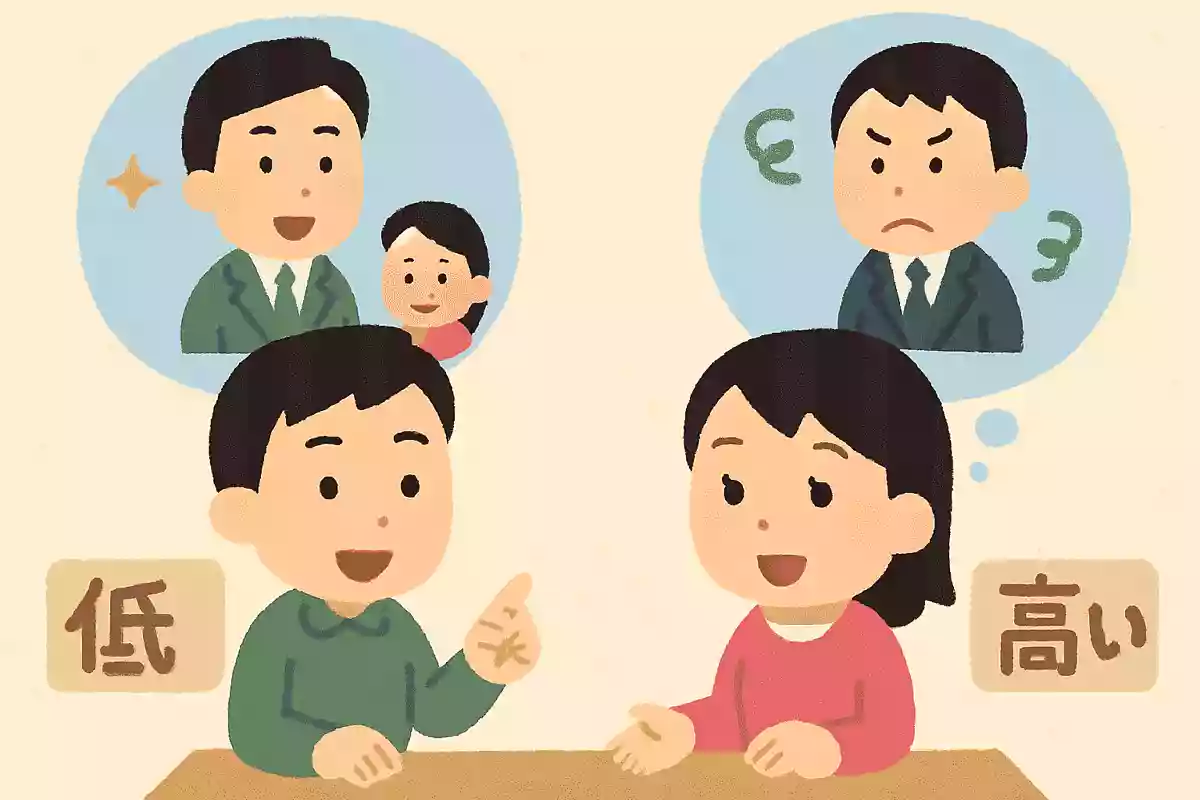
When it comes to choosing a job, “salary” and “relationships” are often cited as key factors.
Ideally, both would be great, but this question asks what you prioritize when you can only have one.
Are you the type who can endure poor relationships for a higher salary, or would you rather live healthily in a good workplace environment even if the pay is low? It reveals each person’s approach to work.
Starting with extreme examples as an ultimate question and then discussing what balance feels ideal could make for an engaging conversation.
If you were to enter a karaoke singing contest, what would you sing?

Even if you’ve had chances to sing at karaoke and the like, few people have experience performing in front of an audience.
This is a question about what you would sing if you had the opportunity to showcase your singing in front of an audience—say, by entering a singing contest.
Would you choose something you’re used to singing, or a song that more people know? Let’s think about selecting songs that fit the occasion.
It also sounds fun for everyone to imagine how the crowd would react and how hyped the performance would get.
What subject did you like when you were a child?
Different people tend to have different strengths and weaknesses in the various subjects they studied at school.
This activity asks you to guess which subjects someone was good at and which ones they liked, so you can sense differences in their personalities.
Since being good at a subject doesn’t always match liking it, the prediction can be tricky when there’s a gap.
Using that as a starting point, it’s also a great idea to shift the conversation to topics about the subjects themselves—like what aspects they enjoyed.
It might be a chance to look back on the time when you were learning.
What would you do if zombies appeared?

Zombie movies and TV shows are always popular, but what would you do if zombies actually appeared? Even a far-fetched conversation topic like this might come in handy in an emergency! It might take a bit of courage to bring it up in everyday conversation, but it’s perfect for situations like a drinking party when the mood is a little elevated.
At gatherings, there’s almost always that moment when you run out of things to talk about.
At times like that, a wildly unexpected topic like this could be enough to keep the conversation lively.
What would you do if zombies showed up in Japan? Do you have a plan? Where would you run…? It might start off half-joking, but before long it could turn into a serious discussion! Give it a try for inspiration.

What-if/Memory (21–30)
If you could be invisible for just one day, what would you do?

Psychic powers are a staple element in stories, and many people have probably imagined abilities they admire.
Among such powers, let’s focus on the ability to become invisible and try to predict what someone would want to do with it.
It could be exciting to consider this not only from the questioner’s personality but also to see how close it is to what the respondent wants to do.
You could also segue into topics like other possible uses, making it a fun conversation starter as well.