

Immersive Ghibli Classics! Recommended BGM for Work and Study

Have you ever had the experience where, the moment you hear a Ghibli theme song, iconic scenes immediately flash through your mind? Those warm melodies that stay close to the heart are truly indispensable to Ghibli films! In this article, we’ve gathered Ghibli tracks that color everyday life—perfect as background music for work and study.
Each and every one is a masterpiece that naturally sinks deep into your heart.
Savor the world of Ghibli down to the last detail! Now, let’s dive in!
- Songs of Studio Ghibli: List of Theme Songs, Insert Songs, and BGM from Ghibli Music
- [Ghibli’s Famous Songs Medley] The soothing world of Studio Ghibli that resonates with the heart
- [Ghibli] Popular BGM. Enjoy the world of Ghibli through music!
- [Disney BGM] Just listening will boost your mood! A collection of Disney classics
- [Ghibli] Timeless Ghibli Classics in Classical Arrangements: The charm of Ghibli music performed with live instruments
- [2026] Recommended for work and study! A collection of cool and stylish BGM
- [Emotional BGM] Carefully selected masterpieces and popular tracks recommended for work and study!
- BGM from anime with absolutely divine music! Highly popular anime songs
- [Disney] Popular BGM: Enjoy Disney through music!
- [Japanese-style BGM] Beautiful tones woven from Japanese tradition
- Gets you pumped! A curated selection of popular and classic Japanese songs perfect as background music for work
- Songs from Kiki's Delivery Service. Anime theme and insert songs. Ghibli classics.
- Boost your focus with background music for work! Popular and recommended tracks for jobs and exam study.
Iconic Ghibli tracks that create immersion! Recommended as BGM for work and study (1–10)
Ghibli Piano Medley

Why is the sound of insects quietly resonating on a summer night so soothing to the heart? This “Summer Night Piano Medley: Good Night, Ghibli” pairs gently warming Ghibli melodies to create a blissful time for relaxation.
Alongside songs from Spirited Away and Whisper of the Heart, carefully selected numbers spanning Ponyo, Castle in the Sky, Porco Rosso, and The Cat Returns are all deeply satisfying to listen to, slowly sinking into your heart.

Ghibli rain to listen to when you’re tired

Why not soothe your heart with “Ghibli Rain to Listen to When You’re Tired,” performed by pianist Kou Miura, who turns feelings into sound? The set features six pieces, including “One Summer’s Day,” “Merry-Go-Round of Life,” “Carrying You,” and “The Path of the Wind.” Each track has a gentle timbre, offering a relaxation effect like listening to the sound of rain.
It’s a perfect Ghibli medley for quiet moments at home or when you want to drift into a comfortable sleep.
It also works well as unobtrusive background music, making it an ideal companion for reading.

Dragon BoyHisaishi Joe

This is “The Dragon Boy” from Studio Ghibli’s hugely famous film Spirited Away.
The “dragon” in “The Dragon Boy” refers to Haku, and the piece is used in the scene where Haku and Chihiro meet and then leave the bathhouse.
In the film, the New Japan Philharmonic Orchestra performs it: after a mysterious timbre created by layered harp and piano, the horn carries a flowing line, and the woodwinds stack in parallel fourths to evoke a traditional Japanese atmosphere.
This performance is a longer version than the one in the movie, making “The Dragon Boy” even more powerful.

Ghibli’s masterpieces that create immersion! Recommended as BGM for work and study (11–20)
Path of the WindHisaishi Joe
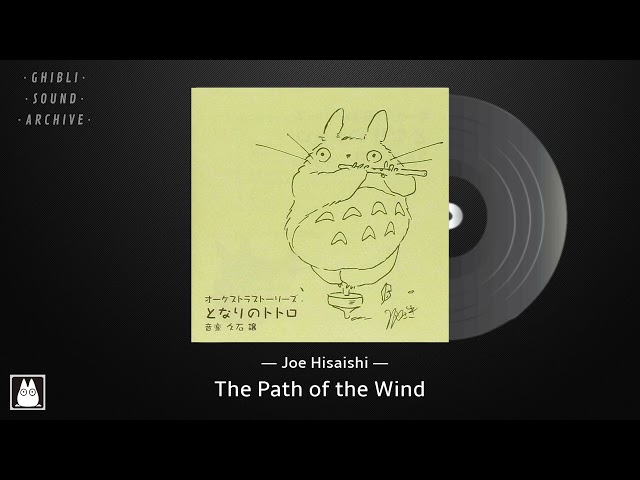
The indispensable classic “The Path of the Wind” from Studio Ghibli’s beloved masterpiece My Neighbor Totoro is performed here by an orchestra.
This piece is included in “Orchestra Stories: My Neighbor Totoro,” in which composer Joe Hisaishi restructured music from My Neighbor Totoro to be enjoyed with narration.
While the original track featured an electronic sound influenced by the minimalism that inspired Hisaishi at the time, this version becomes a grand orchestral arrangement that brings out the beauty of live instruments.
Ask me why (A Mother’s Thoughts)Hisaishi Joe

This is the theme song from Studio Ghibli’s feature-length animated film, The Boy and the Heron, which can be considered the culmination of director Hayao Miyazaki’s work.
It is played only three times in important scenes from the opening to the late part of the film, performed tenderly on solo piano without any arrangements or variations for other instruments, making it clear how much the composer, Joe Hisaishi, cherishes this piece.
In this city in AsiaNEW!Jōjō Taihūn

Doesn’t just hearing the melody make you feel nostalgic? Released as a single in July 1994, it was tied in as the theme song for Isao Takahata’s film Pom Poko.
It’s included on albums such as Kaze no Matsuri ~CARNAVAL~.
This track is packed with a multilayered charm, where the bustling, exotic atmosphere of the city intersects with reflections on the nature we’re losing.
Its rich, eclectic rhythms and gentle vocals seem to naturally slip into your heart.
When you’re stuck with work or studying, listening to it can give you a refreshing reset!
Anna (Piano Arrangement)Muramatsu Takatsugu

Hiromasa Yonebayashi of Studio Ghibli adapted Joan G.
Robinson’s children’s novel “When Marnie Was There” into an animated film, and the piece “Anna” that plays in the movie is presented in a piano version.
It is memorably featured by the orchestra in scenes such as when Anna and Setsu are preparing lunch, and when Marnie and Anna say goodbye, but in the piano solo it feels more delicate and heartrending, conveying Anna’s emotions very well.
The sheet music has also been published, so if you play the piano, it might be nice to perform it while recalling the scenes from the film.