



Let me introduce you to the works of Yosui Inoue, a heavyweight of the J-pop world and a defining artist of the Showa era.
Speaking of Yosui Inoue, he has many famous songs such as “Shonen Jidai” (A Boy’s Summer), “Riverside Hotel,” and “Yume no Naka e” (Into a Dream).
In particular, many people may have sung “Shonen Jidai” during elementary school music class.
Inoue, whose music is deeply ingrained in the Japanese music scene, was apparently a well-known Beatles fanatic in his student days, and some of his songs show that influence.
Incidentally, his real name is the same as his stage name, “Yosui,” but it’s read as “Akimi.” He changed the reading to “Yosui” for his stage name, reportedly to create a strong impact to rival Takuro Yoshida—his contemporary and sort of rival—whose name “Takuro” had a striking ring to it.
- Top Inoue Yosui Songs Ranking [2026]
- Karaoke Popular Songs Ranking of Yosui Inoue [2026]
- [Karaoke] A roundup of easy-to-sing songs by Yosui Inoue
- Yosui Inoue CM Songs and Popular Songs Ranking [2026]
- Inoue Yosui’s classic and popular songs
- Kiyoshiro Imawano’s classic and popular songs
- A special feature on Mariya Takeuchi’s best songs: a must-hear collection of masterpieces for both longtime fans and first-time listeners.
- Miyuki Nakajima’s Masterpieces: A Showcase of the Timeless Gems That Defined an Era
- [Rock Singer] Shogo Hamada’s Easy-to-Sing Karaoke Songs!
- Classic songs about boys. Recommended popular tracks.
- How many do you know? Timeless youth songs released in the Showa era
- A roundup of classic Showa-era kayō songs: a comprehensive introduction to timeless tracks loved across generations.
- Showa-era love songs: A roundup of timeless love songs cherished across generations
Inoue Yosui’s classic and popular songs (1–10)
Cherry Blossom March PromenadeInoue Yosui

This is a classic Showa-era song included on the landmark album Ice World, which became Japan’s first million-seller.
Released in December 1973 as the album’s tenth track, this piece stands out with a uniquely distinctive presence.
The lyrics were written by Kunio Hase, and the arrangement was by Masaru Hoshi—one notable feature is that the words were not penned by Yosui Inoue himself.
The title may evoke a gentle spring stroll, but as the song progresses, its unfolding sense of “madness” and “heat” is startling.
The spoken-word-like passages, reminiscent of poetry reading, are also a highlight that connects to later modes of expression.
When you want to feel the unease lurking within spring’s pleasant warmth, or to immerse yourself in the atmosphere of the era through the album as a whole, why not give it a careful listen?
Make-up ShadowInoue Yosui

A number that lets you sink into a chic, mysterious mood, imbued with the air of the city at night.
Inoue Yosui’s uniquely languid yet sensual voice draws you into a world that evokes the push and pull of adult romance.
Even just listening makes you want to sway—its light, stylish sound is a standout feature.
Released as a single in July 1993, the song became a major hit as the theme for the drama “Subarashiki Kana Jinsei” (What a Wonderful Life).
Its sophisticated arrangement won the Arranger’s Award at the 35th Japan Record Awards.
Why not savor it again on a night with someone special, or during a quiet moment all to yourself?
goddessInoue Yosui
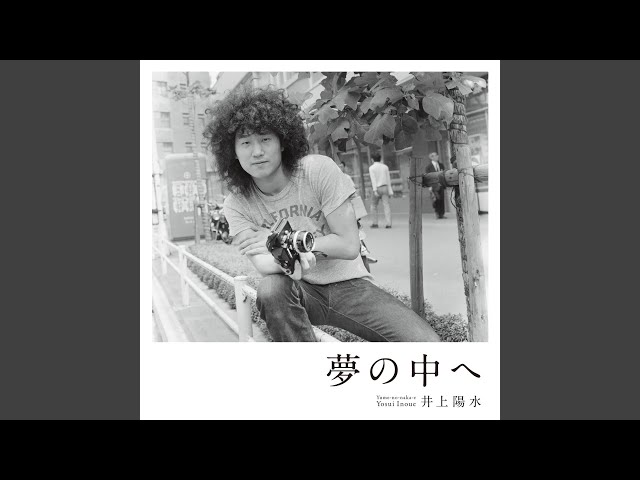
It’s a work that feels very much like Yosui Inoue—gentle and warm-eyed.
Even while handling a grand theme, it’s striking how it’s written in intimate language, as if speaking to someone close.
It may be a hymn to the precious things found in everyday life and in unassuming scenes on a journey—those irreplaceable presences.
This piece was written as the opening theme for NHK’s travel program “Buratamori,” and was later included on the cover album “UNITED COVER 2.” If you listen at the start of a trip, it will surely make you anticipate wonderful encounters.
Noh Kojima’s Unrequited LoveInoue Yosui

This song, included on Yosui Inoue’s 1972 release Yosui II: Sentimental, is titled Nokonoshima no Kataomoi.
Nokonoshima is a remote island floating in Hakata Bay, famous for its flowers.
The island, known as a floral destination, conjures images of lush, beautiful nature.
It’s a love song that feels quintessentially Yosui Inoue—laid-back and unhurried, evoking a gentle sense of time.
The tender feelings for a cherished person come through softly, making you hope that this unrequited love will be fulfilled.

Happy BirthdayInoue Yosui

It’s a quite, quite old birthday song by Yosui Inoue.
Despite its distinctive, somewhat enigmatic lyrics and catchy melody, which came out nearly 40 years ago, it still doesn’t feel very dated when you listen to it now.
Perhaps that’s why Yosui Inoue has been able to remain a hit-maker for so long.
Come to the sea.Inoue Yosui

A summer-and-sea-themed number by Yosui Inoue, sung as if speaking, with his uniquely steady low register.
His voice has strong presence, yet it mysteriously gives off a soft, melting sweetness.
It might be especially captivating when performed by someone with a lower voice, don’t you think?
Wine Red HeartInoue Yosui

It was released as a song by Anzenchitai, but Yosui Inoue later covered it himself.
During a period when Anzenchitai was struggling to produce hits, the producer reportedly suggested asking Inoue to compose the music; however, in the end, the band’s vocalist Tamaki handled the composition.
The lyrics were written by Yosui Inoue.
The track was produced right in autumn, and it feels as if it captures the season dyed in a “wine red” hue.
