

[For Seniors] Recommended Wall Decorations and Crafts for January


We’d like to introduce wall decorations that are perfect for January, the month when we welcome a brand-new year!
We’ve gathered auspicious New Year–themed pieces as well as works that let you feel the season of January.
Many January decorations feature vibrant colors that will brighten up your space.
We offer a wide range: items you shape by hand, projects with simple steps, and pieces that require fine finger work.
New Year’s decorations often feature traditional Japanese motifs such as shimenawa and shishimai.
Some older adults may find themselves reminiscing as they create.
Why not enjoy making them while sharing stories and memories?
- Lucky Daruma: Craft ideas for decorating January wall displays for seniors
- [For Seniors] Let’s Make New Year Decorations by Hand! A Collection of Easy Ideas Using Everyday Materials
- [For Seniors] January Craft Ideas: Boost Your Luck with New Year Decorations and Good-Luck Charms
- For Seniors: Auspicious Handmade Zodiac Ornament Craft Ideas
- For seniors: Snowman crafts to brighten January wall displays—fun ideas using origami, paper plates, and papercutting.
- [For Seniors] Decorate your January wall with rabbits! Packed with ideas like snowball fights, New Year’s festivities, and rice cake pounding
- Recommended winter wall decorations for seniors: heartwarming ideas
- [For Seniors] January Craft Ideas for Day Service Activities
- For seniors: Year-round ideas for wall decorations
- [For Seniors] Recommended Origami for January
- [For Seniors] Heartwarming and Cozy: Perfect Wall Decoration Ideas for Winter in Care Facilities
- [For Seniors] January Activities and Recreation Games
- For Seniors: Wall Decorations to Brighten Up February — Festive Ideas for Setsubun, Valentine’s Day, Plum Blossoms, and More
[For Seniors] Recommended Wall Decorations and Crafts for January (71–80)
Snowman Stencil

With a clear plastic file, you can easily enjoy stenciling.
First, cut the file open so it becomes a single sheet.
Then cut out a snowman shape or use a craft punch to cut snowflakes to create your stencil sheet.
Once the sheet is ready, place it over drawing paper and secure it, then dab on paint with a sponge.
After the paint dries, add a bucket hat, a carrot nose, and branch arms made from construction paper, and draw the face with a pen to finish!

Wobbling daruma

You probably often see stationary daruma dolls, but wobbling ones are quite rare, aren’t they? This time, we’re introducing a daruma you can make with a paper plate and construction paper.
It looks lovely as a New Year’s decoration for your room and is also recommended as a wall decoration for New Year’s parties.
The process is simple—just cut the construction paper and stick it onto the paper plate—so it’s perfect for craft activities with seniors.
Craft activities help improve concentration and can even aid in preventing dementia.
Let’s all have fun making uniquely charming daruma dolls together.

Japanese-style hanging decoration for New Year

As a slightly more intricate craft idea, here’s a New Year’s Japanese-style hanging decoration.
This one uses origami to make yakko-dako kites and cranes.
A yakko-dako is a kite shaped like a person in a kimono with arms outstretched—you often see them around New Year’s.
You can also try making other Japanese motifs in origami, such as plum blossoms and folding fans.
If the fine work involved in making the yakko-dako is difficult, prepare the parts in advance and provide support as needed.
Create the pieces with origami, cut small parts with a craft knife, arrange them, and you’re done.
Hang it in your room to enjoy the look of them flying.

[For Seniors] Recommended Wall Decorations and Crafts for January (81–90)
maneki-neko (beckoning cat)

How about creating lots of lucky maneki-neko and decorating a wall with them for a bright and cute display? Maneki-neko aren’t only for New Year’s; they’re also seen as symbols that bring good fortune and connections, and are displayed in shops and homes.
Of course, it’s great when staff make and put them up, but it would also be wonderful for participants to create and display maneki-neko in whatever style they like! Prepare identical cat-shaped bases, then have people draw the faces, let them hold origami gold coins, and encourage everyone to make their own unique maneki-neko!

Shichifuku Daruma (Seven Lucky Gods Daruma)

Here’s an idea for a colorful and cute wall decoration featuring seven daruma in different colors.
The seven colors represent the Seven Lucky Gods.
Because the daruma are three-dimensional, they look impressive as wall decorations.
Fold a rectangular sheet of colored construction paper in half, make slits, shape it, and form the roundness of the daruma.
Round off or trim the corners, attach white paper, and draw the face.
You can vary the expressions for each daruma and add decorations around them, such as sea bream, a lucky mallet, and plum blossoms.
Using gold origami makes it feel more New Year–like and even more festive.
red-and-white Daruma

Would you like to make red-and-white daruma dolls to brighten up your celebration wall? Prepare two balls made by crumpling paper, then cover each from the top with red and white origami paper and glue them on.
Attach a paper face and patterns made from yellow origami, and you’re done.
You can make a large daruma to display, or create small ones and arrange them to form characters like “祝” (congratulations) or “おめでとう” (best wishes).
In addition to red and white, making a gold daruma will also look festive.
They’re easy to make, so give it a try!
Plum blossom decoration
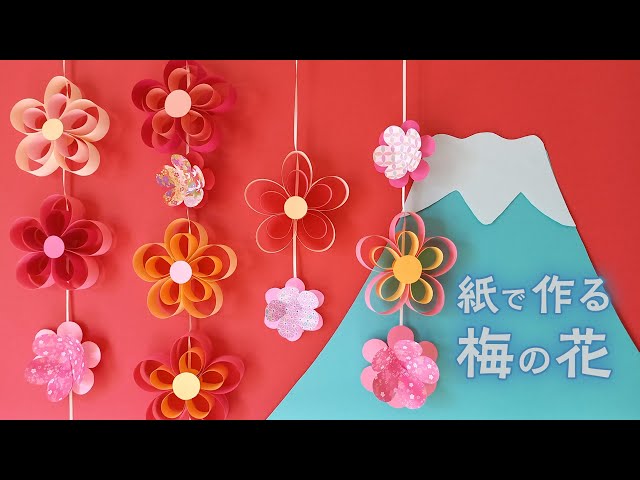
Let’s make some stylish, pop-inspired plum blossom decorations! They’re perfect for January wall displays or hanging ornaments.
Why not enjoy a seasonal craft activity with older adults? You can create two types: simple plum blossoms made by rolling paper strips and stapling them, and 3D plum blossoms made by interlocking two flower-shaped paper cutouts.
Combine both types and string them together for a hanging decoration, or display a single piece like an objet d’art to instantly brighten the room.
You can also have fun customizing them by changing the origami patterns or sizes—feel free to use this as a reference!
