

A special feature on classic and hit songs by bands that were active in the 1980s


Speaking of the 1980s—especially the latter half—it was a time when many rock bands that would later rise to prominence made their debuts, laying the groundwork for the band boom that swept the early ’90s.
This time, we’ll introduce some classic songs by bands that were active in the ’80s.
If you watch footage of them from back then without having experienced it in real time, you might be surprised by their fashion and hairstyles.
But including their flamboyant “rock fashion,” please enjoy the sounds of the 1980s that led to the golden age of Japanese rock.
- Nostalgic yet fresh!? Classic masterpieces of Japanese rock from the 1970s and 1980s
- Debut song of a Japanese band from the 80s
- Classic and hit songs by nostalgic Japanese bands from the 1990s
- 1980s: Legendary Western Rock Bands’ Classic and Hit Songs
- Classic and hit Japanese pop songs from the nostalgic 80s
- [Nostalgic Classics] Hit Japanese Love Songs from the 1980s
- Debut song of an 80s visual-kei band
- Masterpieces and hit songs of 80s Japanese pop (kayōkyoku)
- A collection of nostalgic Japanese hit songs from the 1980s that still linger in our ears
- Top Male Singer-Songwriter Hits of the 1980s: Ranking [2026]
- [2026] Cool Japanese Rock Bands: From Rising Talents to Veteran Acts
- Cool songs from the Showa era. Masterpieces from Showa that shine with sensuality, passion, and rugged charm.
- Classic nostalgic summer hits from the ’80s. A roundup of summer songs.
Classic and Hit Songs by Bands from the 1980s (21–30)
VIRGINITYREBECCA

REBECCA debuted in 1984.
Their signature songs include “Friends” and “MOON.” In their early years, REBECCA had many tracks with very bittersweet lyrics and melodies, and “VIRGINITY” was one of them.
The lyrics were written by an external writer, not NOKKO.
Among fans, it’s known as a song based on a true story.
The meaning of the lyrics is quite suggestive.
In the night sky after the rainRC sakuseshon

A quintessential anthem of the ’80s, etched into people’s hearts.
RC Succession’s rock ’n’ roll sound pairs perfectly with Kiyoshiro Imawano’s distinctive vocals.
Released in January 1981, this track became the catalyst for the band’s breakthrough.
Marked by youthful impulse and lyrics rich in metaphor, it overflows with energetic appeal.
Through the relationship between a car and a person, the lyrics express love and emotion, inviting a variety of interpretations from listeners.
Like a night sky after the rain, it’s a song that feels both refreshing and powerful.
Perfect for a driving soundtrack or for lifting your spirits!
Featured Classics & Hit Songs by Bands from the 1980s (31–40)
Wax MuseumSeikima II

A signature song by the metal band Seikima-II, formed in 1982 with the concept of spreading Satanism through music.
Their visuals and lyrical content tend to stand out first, leading many to see them as an eccentric novelty act, but the song is actually meticulously structured—for example, using twin lead guitar riffs as accents within a heavy, ponderous rhythm.
With high-level musicianship and a carefully crafted worldbuilding, it’s one of those tracks that, despite being a metal number that rarely takes root in Japan, has nonetheless become widely recognized by many listeners.

crimsonX JAPAN
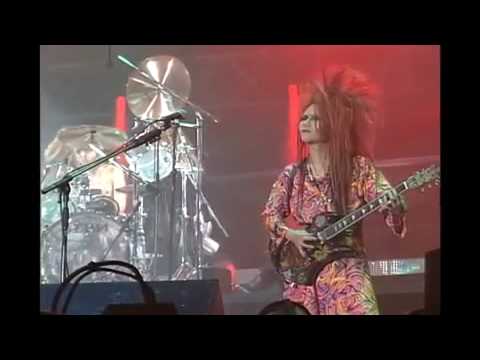
This is the third single overall by the five-member rock band X Japan, who took the J-pop scene by storm in the 1980s—when the hard rock genre was not widely recognized in Japan—with their flamboyant visuals and aggressive metal sound.
Even as their major-label debut single, its sound boldly foregrounded the intense musicality of their indie days, stunning many listeners.
More than just fast or heavy, its flowing, beautiful melodies—reminiscent of classical music—are truly one-of-a-kind, making it an indispensable signature song when talking about X Japan.
It’s a timeless track that helped broadly introduce the metal genre, which has never fully taken root in Japan, to a wider audience.
Private HeroineREBECCA

This is a signature song by REBECCA, a band that was active in the late 1980s.
The lyrics, which portray the pain of heartbreak and the struggles of love, are particularly memorable.
NOKKO’s lively vocals and the danceable melody are very appealing.
It was included on the album REBECCA IV ~Maybe Tomorrow~, released in November 1985, which became a million-seller.
If you experienced that era in real time, you can probably still hum it today.
With its cool performance and vocals, this is a great chance to give it another listen.
On Lucian HillRED WARRIORS

The legendary band RED WARRIORS led by Diamond Yukai.
They were really cool back then, and they’re still cool even now! Their biggest hit, “On Russian Hill,” remains a beloved number to this day, even being covered live by GLAY.
I can’t even become a stray dog.THE STREET SLIDERS

THE STREET SLIDERS debuted in 1983.
In a sense, they’re a single-minded band whose unwavering, bluesy stance is really cool.
“Taciturn” is the perfect word for them.
Their signature songs include “Arittake no Coin” and “Norainu ni Sae Narenai.”