

【2026】A Roundup of Japanese Bassists: From Big Names to Rising Stars


When you hear “Japanese bassists,” which players come to mind? The bass is sometimes described as the unsung hero, but it’s the core of a band’s sound, and a great bassist’s groove has the power to move listeners.
In this article, we’ve carefully selected bassists ranging from legendary figures to promising newcomers from the next generation.
Be sure to check them out—you might just discover a talent you didn’t know about!
- [Selected by the pros!] 10 great bassists from the jazz fusion world
- [J-Pop/Rock] A roundup of bands with cool singing bassists
- [Low End] A Collection of Japanese Songs Featuring Standout Bass Solos [2026]
- [Low End] A collection of Japanese songs with high-difficulty bass parts [Cool]
- Packed with slap groove vibes! A collection of songs with cool bass
- Love at first sight with a bass girl! The female bassist of a popular band
- 【2026】A Roundup of Japanese Bassists: From Big Names to Rising Stars
- [2026] Easy J-Pop and Japanese Rock Songs Recommended for Beginner Bassists
- A compilation of bassists who use StingRays
- Popular Band Rankings [2026]
- Western songs with cool bass lines: classic and popular tracks recommended for bassists
- Recent songs sung by male vocalists in Japanese music [2026]
- [2026] Recommended Japanese Fusion Bands Summary
[2026] Japanese Bassists Roundup: From Big Names to Rising Stars (61–70)
As many times as you likeNakamura Masato

He’s the bassist from DREAMS COME TRUE that everyone knows.
Because Miwa Yoshida’s presence as the vocalist is so strong, people tend to remember him simply as “the bassist from DCT,” and he even jokes about it himself.
But he’s far from just any bassist—he handles most of the composing and arranging for DREAMS COME TRUE.
SYSTEMATICUeda Takeshi

Takeshi Ueda, the central figure of THE MAD CAPSULE MARKETS—the pioneering band of mixture rock in Japan—is surely one bassist who cannot be overlooked.
In the 1990s, he was quick to establish a style that incorporated programming and rap into rock, delivering a heavy and aggressive playing approach within the band.
Many fans were electrified by his fiercely distorted bass tone and the barrage of aggressive phrases he unleashed.
Since 2008, he has also been active with his solo project, AA=.

Waking UpMitsuru Sudo
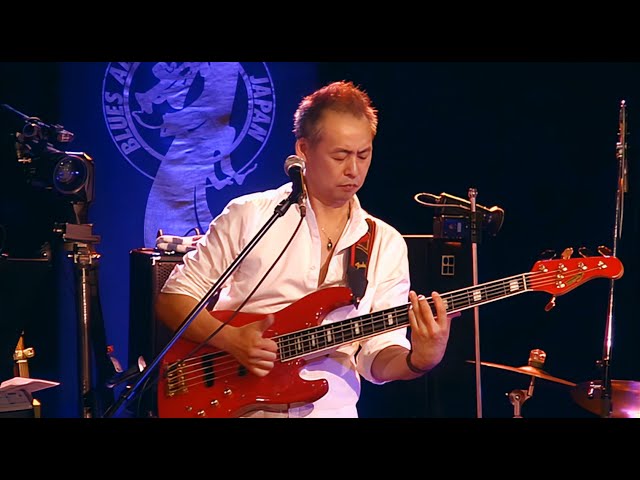
Mitsuru Sutoh is a bassist from Yamagata Prefecture, known not only for his tenure with T-SQUARE but also as a member of TRIX.
He first came to music through folk guitar before switching to bass, steadily building his chops as a bassist through activities such as playing in the light music club at Tokyo Gakugei University.
His main instrument is a MOON five-string Jazz Bass, and it’s notable that he rarely uses processing-type effects.
His playing style represents classic fusion: a technical fingerstyle approach that actively incorporates slap, delivering speed, precision, and color to the music.

MASAKI

As he himself has said—competing with guitarists famed for their speed by playing the bass even faster—his technical yet impeccably precise performances, using all ten fingers of both hands to the fullest, are truly breathtaking.
He has also authored multiple bass instruction books and is said to have many students.
Ju-ken

A studio musician in high demand among rock artists.
His tough, striking fashion is memorable, but he’s also a hard worker; there’s even a story that, as a support for Tomoyasu Hotei, he mastered slap technique on an upright bass—an instrument he’d never played before—in a short time for a live performance with Brian Setzer.
His driving rock bass is definitely something to learn from.
PunchersMr.Okure

He, who is an indispensable character in Yoshimoto Shinkigeki, also played bass in a band called the Punchers.
He had a stock gag where he was the only one who played out of time, and it seems that’s where his stage name Okure—meaning “delay”—came from.
Dance in the palm (of one’s hand)Fujiwara Misaki

Misaki Fujiwara is the bassist for Sokoninaru, a band formed in Osaka in 2011.
The group is known for its complex compositions that incorporate prog and math rock, and her performances of a wide range of phrases are particularly striking.
On YouTube, under the title “Sokoninaru Light Music Club,” they upload videos of the band covering various songs, where you can fully appreciate her outstandingly high level of musicianship.