

Recommendation of Wa-Jazz: A Masterpiece of Japanese Jazz—One Must-Listen Album

If you’re not particularly interested in jazz as a genre, you might just think of it as music from abroad.
In fact, here in Japan, we’ve produced many world-class players, and countless remarkable classic albums have been released.
This time, we’re presenting a selection of essential “Wa-Jazz” masterpieces by Japanese musicians.
While focusing on timeless classics from the ’60s and ’70s, the lineup also turns its attention to works released in the ’90s and 2000s.
Please enjoy jazz music with a distinctly Japanese flavor—something a little different from overseas jazz!
- Great for karaoke too! Jazz classics you’ll want to sing at least once
- Recommended Japanese jazz bands — from classic legends to rising young groups
- [2026] A Collection of Classic Japanese Ballads with a Jazz Flavor
- Masterpieces of Japanese fusion—From nostalgic classics to recent recommendations—
- Jazz commercial songs. Popular commercial songs.
- Ranking of Popular Jazz Songs
- Jazz Piano Masterpieces: From Classic Essentials to Contemporary Favorites
- Classic swing jazz tunes. Recommended popular songs.
- [Autumn Jazz] Classic and Popular Jazz Songs to Enjoy in the Fall
- Today's Jazz: Tunes for today! A selection of timeless classics and contemporary jazz
- Introduction! A collection of recommended masterpieces and standard numbers for jazz beginners
- A roundup of famous jazz standards featured in the hugely popular jazz manga BLUE GIANT
- Start here first! Classic jazz-rock masterpieces. Recommended popular tracks.
Recommendations for Wa-Jazz: Masterpieces of Japanese Jazz – One Must-Listen Pick (41–50)
Nice ShotWatanabe Sadao
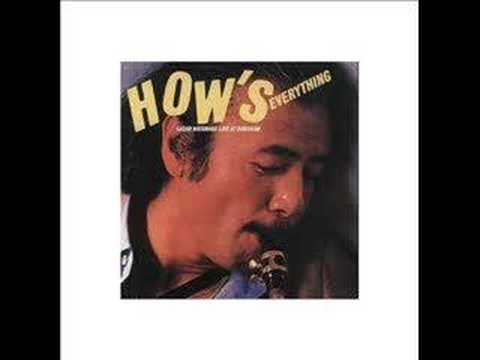
This is a signature piece by Sadao Watanabe, a saxophonist and flutist.
While it features a hard-edged beat in the direct lineage of acid jazz, it achieves a high level of musical quality—often cited as a classic—thanks to the saxophone’s remarkable freedom, which breaks through any sense of recurrence.
Recommendation of Wa-Jazz: Masterpieces of Japanese Jazz – One Must-Listen Pick (51–60)
Liquid FingersWatanabe Kazumi

Released in 1980, this fusion album was a major hit from Kazumi Watanabe, who had made a sensational debut as a teenage guitar prodigy with overwhelming technique when he released his first album in 1971 at just 17 years old.
The album, memorable for its striking, uniformly bright yellow jacket, bears the enigmatic title “To Chi Ka.” It is said to have been taken from the name of Watanabe’s beloved dog, written as “図知華.” Co-produced with vibraphonist Mike Mainieri, the album features effortlessly fluid performances with top-tier international players like Michael Brecker and Marcus Miller—excellence that hardly needs elaboration today.
All tracks were composed by Watanabe, including “Unicorn,” which was used in a commercial for Hitachi’s audio brand Lo-D.
The record showcases not only his technical prowess as a guitar virtuoso but also his gift for melody as a composer.
It’s a work with broad appeal—perfect not only for jazz and fusion enthusiasts but also for fans of rock, pop, and soul.
Enjoy its welcoming, genre-spanning openness!

StardustMisora Hibari

Hibari Misora is one of the greatest singers in Japanese music history.
As the queen of Showa-era pop and a beloved national icon, her voice is something every Japanese person has heard somewhere, and most people—even younger listeners—have at least a vague familiarity with her famous hits.
Yet it may be a lesser-known fact, unless you’re fairly well-versed, that Hibari didn’t only sing kayōkyoku; she also loved performing jazz numbers.
The two jazz albums she recorded during her lifetime stand as proof of her genuine affection for jazz, and they’re indispensable for anyone digging into the world of Wa-jazz.
The work featured here is Hibari Sings Jazz: In Memory of Nat King Cole, released in 1965.
As the title indicates, it’s a tribute to the great singer Nat King Cole, and the very fact that Hibari released a tribute album to another vocalist makes this an especially precious record.
Beyond her phenomenal vocal prowess, the expressive brilliance on display—something that could only arise from deep love and understanding of jazz—is essential listening for both jazz fans and kayōkyoku enthusiasts.
Theme MustacheTakeshi Inomata & Sound L.T.D

This is a famous piece by jazz drummer Takeshi Inomata—born in Hyogo Prefecture and still active today as the head of a drum academy—performed as a duo.
With its eccentric tonal colors and frequent key changes, the composition delivers a strongly trippy jazz experience.
The lively keyboard, propelled by Inomata’s outstanding shuffle drumming, elevates the music to a work that will be remembered in the annals of Japanese music.
Love stories happen suddenlySOLO-DUO

Love Story Suddenly by the male-female vocal duo “SOLO-DUO,” featuring Gira Zirka and Ayumu Yahaba.
Gira’s English lyrics—her translation of Kazumasa Oda’s classic hit—ride over a band arrangement, making for some seriously cool jazz.
They’ve also released CDs, so if you’re into Japanese jazz, this is a must-check!
SwaneeHarunobu Hara to Shaapusu & Furattsu

On June 21, 2021, Nobuo Hara—an encyclopedic figure in the history of Japanese jazz—passed away at the age of 94.
Immersed in music from childhood, Hara joined the Imperial Japanese Navy Band during the war and spent those years as a naval bandsman.
After the war, he embarked on a path as a jazz musician.
Leading his own band, Sharps and Flats, he performed alongside renowned artists from Japan and abroad, excelling both as a bandleader and as a composer.
His contributions to postwar Japanese music history are immeasurable.
The release introduced here, Jazz Festival no Sharps & Flats ’68–’70, is a 2013 compilation featuring live recordings from a period when Nobuo Hara and Sharps & Flats were at the height of their powers.
In addition to previously unreleased material, it includes rare recordings that had never been issued on vinyl, such as from the All-Japan Jazz Festival ’70—making it an essential listen for jazz fans.
Please enjoy the pinnacle of Japan’s proud big-band tradition in a high-quality playback environment!
BeeYamashita Yōsuke

Making full use of unconventional techniques such as elbow-strike piano playing, Yosuke Yamashita took the scene by storm as a pioneer of Japan’s free jazz world.
Beyond free jazz, Yamashita has also thrived in collaborations with orchestras and taiko drummers, and as a composer and essayist—truly one of the great figures whose name is etched into the history of Japanese jazz.
Capturing a ferocious live performance by the Yosuke Yamashita Trio at the height of their powers in 1975 in Germany, Chiasma is a shockingly intense album that I would call a priceless firsthand document of the free jazz era of the 1970s.
Yamashita’s piano rampages freely as if released from every constraint of music theory and common sense, alongside Takeo Moriyama’s drums and Akira Sakata’s alto sax.
For listeners unaccustomed to such adventurous performance, it may sound like nothing but noise, with no sense of what’s going on.
But when you hear the thunderous applause from the discerning overseas audience captured at the end of the track, you’ll understand the astonishment with which these sounds were received.
It’s a performance that seems to liberate the listener’s soul, so I recommend engaging with it with your whole mind and body.