

![[Childcare] Letter and word games: Introducing fun activities using hiragana](https://i.ytimg.com/vi/l8DlpI86TVE/sddefault.jpg)

Incorporating hiragana and characters into play has very positive effects on children’s growth, such as nurturing their vocabulary and expressive abilities and promoting the development of their communication and thinking skills.
It would be wonderful if everyone could deepen their interest in letters and words while having fun through a variety of games.
So this time, we’re introducing wordplay and hiragana play ideas recommended for children.
We’ve gathered a wide range of hiragana activities—from games that require no preparation and can be started anywhere right away, to activities that involve moving the body and cooperating with friends.
There are also handmade toys that let kids learn letters with excitement, so be sure to check them out.
- [Childcare] Wordplay and game ideas everyone can enjoy together
- Word games you can enjoy with your kids. Let’s learn through play with words!
- A popular hiragana toy. Learn while you play!
- [Childcare] Learn Numbers Through Play! Ideas to Use in Early Childhood Education
- [Childcare / Physical Play] Fun Activities to Get Moving
- [Childcare] Play Right Now! Recommended No-Prep Games
- Useful for childcare! Today’s recommended recreational activities, including fingerplay and games!
- Parent–child interactive play. Fun activities popular in childcare settings and at parent–child observation days.
- [Picture Books] Savor the fun of words: A special feature on recommended onomatopoeia picture books
- Popular hand games and hand game songs for toddlers and children! Full of ideas for childcare/early childhood education.
- Indoor Games for Small Groups: Exciting Recreational Activities
- Ideas for indoor activities and group games that 5-year-olds like
- Let's play with a big group! A collection of fun children's recreational activities
[Childcare] Letter and word play: Fun games using hiragana (1–10)
Word-Collecting Game
If you want to get kids interested in letters, how about a word-collecting game? It’s a great activity for building vocabulary, and all you need is paper and a pen! Make cards with a single hiragana character on each, and play by asking questions like, “What words start with ‘ka’?” To build the habit of thinking, it’s important not to rush them or offer hints too quickly—wait patiently for your child to answer.
Also, writing down the words your child comes up with helps visualize them and connect what they hear with written characters.

Shiritori Cards

Many children have probably played shiritori, where you take the last word spoken by the previous person and connect it to the next word.
Shiritori cards are a card game that uses this shiritori.
First, prepare cards with various pictures whose names do not end with the syllable “n.” Turn only one card face up and start the game with all the remaining cards face down.
Look for a card whose picture’s name starts with the last character of the face-up card’s picture name, forming a shiritori chain.
If you succeed, you get to keep the previously face-up card; if you fail, turn the card you flipped back face down and pass the turn to the next player.
Work together with your friends to keep the shiritori chain going with the cards!

Word Search Game

The Word Hunt game is an activity where you look for a target word using cards of the 50 Japanese syllables.
Try choosing a word like “okashi” (sweets), “himawari” (sunflower), or “yōchien” (kindergarten), and have everyone find the letters one by one for fun! You can tailor the theme to your child’s age and development—incorporate shiritori (a word-chain game) to decide the next word, or turn it into a points-based game.
It’s great for learning while having fun, whether searching for letters, arranging them, or racing to find them quickly.
If you prepare a set of 50-syllable cards in advance, they’ll be useful for at-home time, as well as for activities in daycare or kindergarten.
Rearrangement Quiz
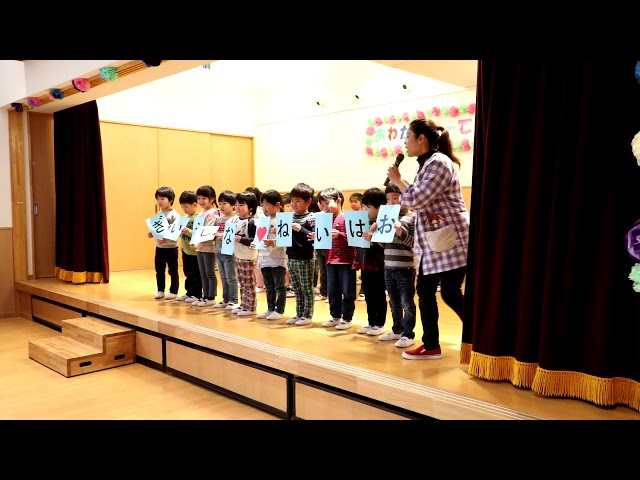
How about enjoying a little entertainment by turning letter rearrangement into a quiz? Each person holds a sheet of poster paper with one large hiragana character, and everyone lines up in a way that doesn’t reveal what word it is.
The rest of the group then tries to guess the word.
Naturally, fewer letters make it easy, and more letters make it harder, so increasing the number of letters little by little makes it more exciting.
Setting a time limit for answers can add some suspense and boost everyone’s motivation, too.

aiueo board

It’s OK to start at any age! This is an “A-I-U-E-O Board” that lets kids naturally get familiar with the 50 Japanese sounds.
Even if you want your child to debut with hiragana, many moms and dads wonder where to begin.
For those parents, we recommend a DIY “A-I-U-E-O Board.” Just line up magnets with hiragana stickers on a whiteboard you can buy at a 100-yen shop, decorate it with colorful pipe cleaners, and you’re done! By leaving some space at the bottom of the whiteboard, your child can freely arrange words and play.
Creating an atmosphere that your child finds fun is important too!
Word play game

This is a word game that children can play cooperatively with friends at kindergarten or daycare.
Divide the children into several teams and have each team set a target word.
Arrange the Japanese syllabary (gojūon) around the room or gym, and the teams build their chosen word from those characters.
It helps children read and remember hiragana while putting their teamwork to the test.
A key point is that you can assign characters to each child so they move into position, or they can work it out together by discussing.
Try incorporating prompts like “words with a spring theme” into your childcare activities.

Who am I? game

A “Who am I?” game where you listen to the clues and guess what the person is pretending to be.
First, the teacher pretends to be something.
Then, to help the children guess what it is, the teacher gives clues little by little.
For example, let’s say the teacher pretends to be an elephant.
They would give clues like, “I am an animal,” and “I have a very long trunk.” By listening to the clues and wondering, “What could it be?”, children develop their imagination.
Since the goal is to have them listen to the words and think, please avoid using gestures as much as possible.