

[Childcare] Fun Rhythm Play! Recommended Games and Hand-Clapping/Hand-Play for Kids

Rhythm play—moving the body in time with rhythms, songs, and music—is said to nurture not only a sense of rhythm, but also expressiveness, social skills, and physical ability.
It is one of the essential activities for healthy child development.
With that in mind, here are some recommended rhythm-based activities that can be enjoyed in nursery schools and kindergartens.
From gymnastics, eurhythmics, hand games, and group games to quick activities you can do in spare moments and more in-depth, focused ones, there’s a wide range of play that will spark children’s curiosity.
Get moving with your whole body and enjoy these activities together with the children!
- Recommended songs for eurhythmics. Let's enjoy music using our bodies!
- Pretend play in Eurhythmics! Fun music education for children
- [Childcare / Physical Play] Fun Activities to Get Moving
- Have fun on rainy days with eurhythmics! Enjoyable music education for children
- Indoor Games for Small Groups: Exciting Recreational Activities
- Useful for childcare! Today’s recommended recreational activities, including fingerplay and games!
- [Music Play] Children’s Recreational Music: Rec Songs You Can Sing and Play
- [For Kids] Indoor Fun! Large-Group Recreational Activities and Games
- Let’s pretend to be sea creatures with Eurhythmics! Fun music education for children
- [Kindergarten/Daycare] Games and Performances for Fun Events
- Parent–child interactive play. Fun activities popular in childcare settings and at parent–child observation days.
- Eurhythmics to help you internalize musical notes. Let’s play with chestnuts and fallen leaves!
- [Childcare] Recommended for little kids! A fun round song that makes you want to sing!
[Childcare] Fun Rhythm Play! Recommended Games and Hand-Clapping/Hand-Play for Kids (11–20)
If you’re happy and you know it, clap your hands

With its upbeat, cheerful melody and playful choreography that matches the lyrics, “If You’re Happy and You Know It” is always a favorite among children.
Once they’re used to the basic dance, try exploring different variations.
Add moves even in parts that don’t say “If you’re happy, then ___,” or have the kids come up with their own ideas for the blanks.
For example, tapping their shoulders or giving a wink—these charming gestures from the children are sure to delight caregivers as well.

Rhythm Play

Let’s enjoy a “rhythm play” that will get your body moving naturally! Tap your knees twice—ton, ton—and then clap your hands once in front of your chest—pan.
To the rhythm of “ton-ton-pan,” the leader changes the “pan” part and names a body part.
For example, “ton-ton head,” “ton-ton butt,” etc.
Everyone else taps their knees twice and then touches the body part the leader names.
Try to keep up with the rhythm without falling behind! As a fun variation, the leader can say an animal name like “ton-ton monkey!” and everyone can imitate its sound, such as “ton-ton ook-kee!” That would be entertaining too.

Mimic Rhythm Play

Here’s a follow-the-leader rhythm activity you can enjoy while copying movements.
As you hum the rhythm, the teacher demonstrates by clapping hands and gently tapping their own head or arms.
After watching the teacher’s example, the children play along with the rhythm by copying the movements they’ve learned.
During this time, the teacher should also move together with the children to serve as a model.
Younger children can participate within their abilities.
Older children, once they’re used to it, should try making their expressions bigger and more exaggerated.
Have fun by adjusting the tempo as you go.

Cup rhythm game
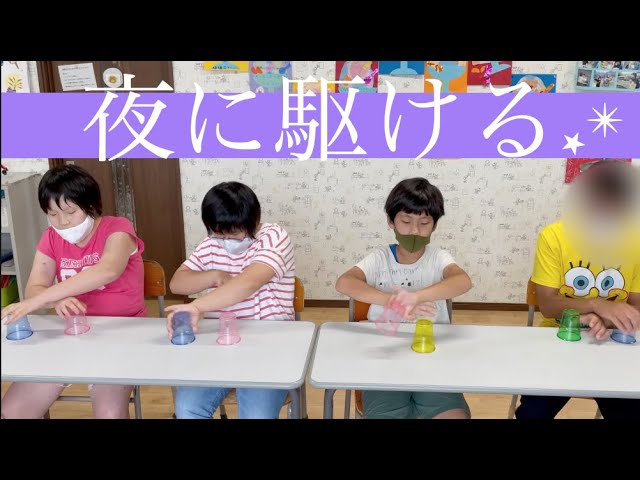
Here’s an idea where children enjoy a musical game called “Cups” using cups to the popular YOASOBI song Yoru ni Kakeru.
Clap your hands, tap the cup tap-tap, set it on the table, and give it a spin! It creates a fun time full of smiles and rhythm at the after-school day service.
The moves are simple, but when the sounds and claps line up, the sense of unity is perfect.
Children with disabilities can join at their own pace too! With a bit of creativity, any child can enjoy it.
Even the adults watching will get excited and want to try it themselves.
All you need are paper or plastic cups, so it’s easy to introduce—give it a try!

Cleaning Eurhythmics

Let’s make use of handkerchiefs and organza fabric! Here are some ideas for “cleaning-themed eurhythmics.” Eurhythmics is an educational method that combines music and movement, and it’s said to be especially effective in early childhood.
This time, let’s play with a cleaning theme through cleaning eurhythmics.
By using handkerchiefs, children can move their hands and arms in time with the music.
A nice benefit is that they can develop a sense of force control and rhythm while having fun.
Using light, soft materials also makes them easier for children to handle!
Mimic Animal Rock-Paper-Scissors

Here’s a game called “Copycat Animal Rock-Paper-Scissors” that helps children of different ages interact and become friends.
At the cue, “Copycat animal, rock-paper-scissors—go!” everyone strikes an animal pose.
If both partners choose the same animal pose, they earn 1 point; if they choose different poses, they spin around once on the spot.
It’s recommended that teachers and children decide the set of animal poses in advance.
You may see older children teaching the animal poses to younger ones.
Come up with lots of pose variations and have fun!
[Childcare] Fun Rhythm Play! Recommended Games and Hand-Clapping/Action Songs for Kids (21–30)
Head, Shoulders, Knees—pon!

Have fun touching your own body with “Head, Shoulders, Knees—Clap.” It’s sung to the melody of the English nursery rhyme “London Bridge Is Falling Down.” As you sing, do hand motions by touching the body parts mentioned in the lyrics.
If it’s “head,” touch your head; for eyes or nose, pointing is fine too.
After touching your knees, clap once.
First, let your child watch the moves, then have them imitate you, or gently guide their hands and move together.
It’s also a great chance for them to learn the names of their body parts and discover what each place is called.
