

Short Korean quotes that resonate with the heart: words that can change your life.

Words have a mysterious power to move people’s hearts.
In particular, many Korean sayings are simple yet carry profound meaning.
Within brief phrases are condensed truths of life, emotions that pierce the heart, and elements of uniquely Korean culture.
In this article, we introduce short yet resonant Korean quotes.
You may discover a line that speaks to your heart.
- Short quotes that resonate with the heart. Words that reach you effortlessly.
- Positive quotes that pierce the heart. The power of short words to change a life.
- Short quotes that reach your heart in an instant. Words to encourage you right now.
- A collection of quotes to make your motto—brief words from great figures that can change your life
- You might even find your motto—short phrases that leave a lasting impression.
- Short, piercing quotes from manga! A collection of one-liners that can change your life
- Beautiful words that resonate with the heart! A single phrase you'll want to give to someone without thinking
- That one line is sure to jolt you! Short but cool words
- Keep your favorite words close. A short collection of quotes that comfort the heart.
- Short precisely because it sticks in your heart: witty, chuckle-worthy one-liners and quotes
- Become positive with four-character idioms that resonate with the heart! Common yet deeply meaningful words.
- Short, heart-stirring words of encouragement! Courageous quotes that push you to take a step toward tomorrow.
- A single self-encouraging phrase that resonates with a downcast heart. Short quotes that can lift you up right now.
Short Korean quotes that resonate with the heart. Words that can change your life (1–10)
중요한 것은 속도가 아니라 방향이다.

A famous saying in Japanese that’s important when moving things forward is: “What matters is not speed, but direction.” People tend to prioritize speed to some extent, and especially in work, we’re often pushed to go faster for the sake of productivity.
However, no matter how quickly you work, it’s meaningless if you’re headed in the wrong direction—and it’s inefficient, too.
This message reminds us that speed only has value when there’s a clear vision and direction to guide it.

최고보다는 늘 최선을 다하라.
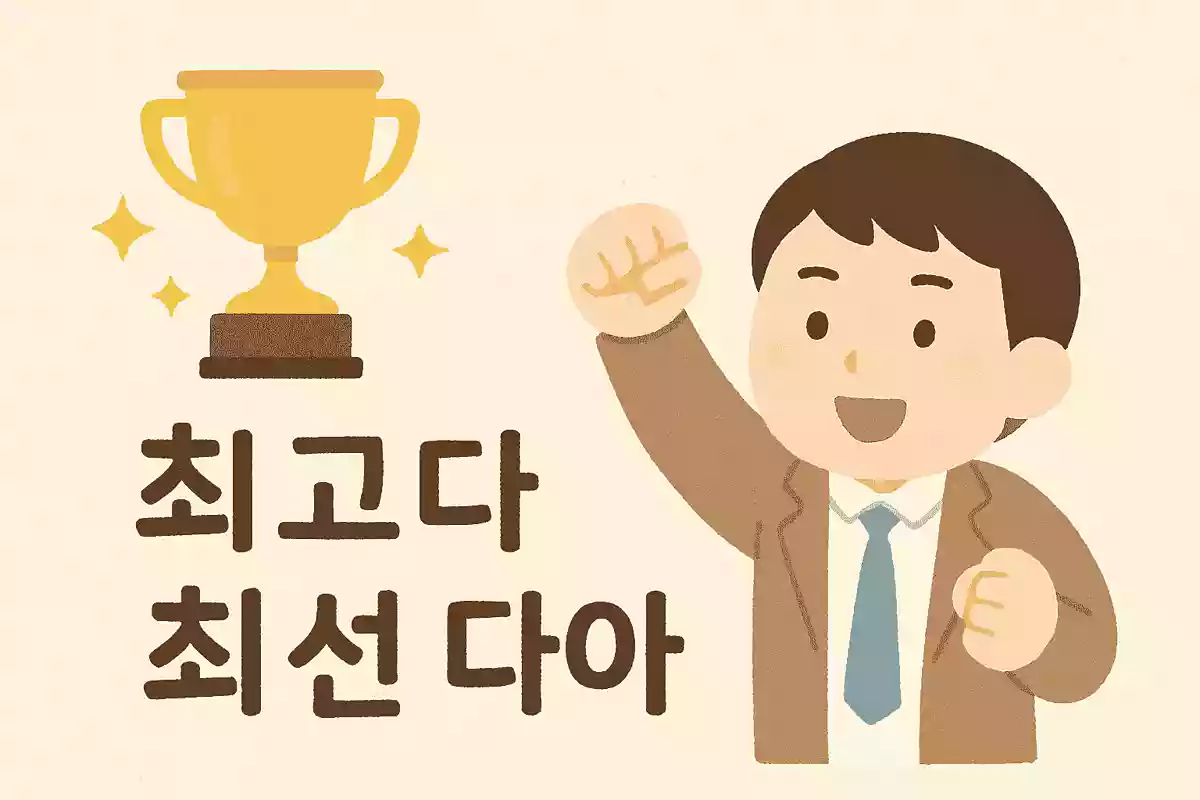
The phrase “XX-first” has become trendy.
You see it in the news and online almost every day, but if you don’t know what exactly the “first” refers to, the real intent doesn’t quite come across, does it? Maybe it’s used so often because it sounds pleasant to the ear.
Take “children-first,” for example: rather than giving kids the best education as defined by adults, shouldn’t it mean thinking all the way through what the best education is for the children themselves and providing that? It may sound a bit self-serving, but if we dig deeper into this expression used in Korea as well, I wonder if it might actually help clarify what constitutes good or bad approaches.
What do you think?
포기하는 것은 선택이지 운명이 아니다.
Those who are on the verge of wanting to run away might feel a jolt reading this.
The Japanese saying that means “Giving up is a choice, not fate” sternly admonishes people who try to blame others and quit.
Whether it’s a dream or a goal, when people are about to give up, they tend to justify it by citing something beyond their control—like their environment or abilities—and tell themselves “it can’t be helped.” However, the message teaches that the one who ultimately decides whether to give up is you yourself.
Short Korean quotes that touch the heart. Words that can change your life (11–20)
피할 수 없는 고통이라면 즐겨라.

It sounds like a cool phrase you might hear in a pop song.
“I really hate school exams,” “Pointless company meetings are agony…” — depending on your situation, the kinds of pain differ.
I wonder if this idea of “If the pain is unavoidable, enjoy it” is a minority view in Japan, where enduring hardship is often considered a virtue.
With that mindset, you might even get through Korea’s famously tough mandatory military service without being tense, saying, “Gwenchana-yo, it’s okay.” Of course, it’s an encouraging phrase for Japanese people too!
인생은 뭐든 해봐야 알지.
Shinjiro Torii, the founder of the beverage company Suntory, is famous for the phrase “Give it a try—if you don’t try, you won’t know,” which you often see on calligraphy boards and hanging scrolls.
If someone like Mr.
Torii were your boss, everyone would probably work with real vitality.
By the way, the company name Suntory is a coined word combining “sun,” the source of life, and “Torii,” his own name.
The Korean saying also connects to Torii’s spirit of “give it a try,” doesn’t it? It’s a curious phrase that makes you feel emboldened.
How did you interpret it?
즐기는 자가 노력하는 자를 이긴다.Seo Jang-hoon

Seo Jang-hoon, a former professional basketball player who is now active mainly on variety shows, is a popular TV personality.
His famous quote, rendered in Japanese as “Those who enjoy themselves defeat those who work hard,” may be a message born from his experience as an athlete.
Of course, working hard to win is a given, but whether you do it begrudgingly or with enjoyment can change the results.
This quote teaches us that it’s important to first adopt a positive attitude toward what you’re trying to do.
사랑이 싶으면 외로움도 싶다.Chikyouko
Chikyo Cho, an artist who studied painting at a university in Tokyo and went on to become one of South Korea’s leading female painters.
Her famous saying, rendered in Japanese as “The deeper the love, the deeper the loneliness,” can be applied not only to romance but to many forms of love.
When we lose someone or something we love—no matter the form—we’re seized by a sense of loss, as if a hole has opened in our hearts.
The deeper the love, the greater the loneliness, sorrow, and pain become.
It’s a sentimental quote that makes you want to savor the happiness you have right now.