

![[Jazz Guitar Basics] It’s not just about chord tones! The second position of the major scale is important too](https://media.ragnet.co.jp/img/1200__jpg__https://www.studiorag.com/files/2018/10/IMG_6580.webp)

Many beginners in jazz guitar may be struggling with their improvisational solos not improving.
For you, I’d like to explain how to learn scales that you can use in jazz improvisation.
- Introduction! A collection of recommended masterpieces and standard numbers for jazz beginners
- [Saxophone] Recommended practice songs for saxophone beginners: Famous tunes you’ll want to try playing
- [Beginner] Start with this song! A collection of practice tunes for jazz beginners
- A must-see for beginner composers! A roundup of classic chord progressions
- [Challenge] Practice Songs for Beginner Electric Guitar Players
- [2026] Practice Songs for Metal Beginners: Learn the Basics of Metal Guitar!
- [Piano] Piano Accompaniment Patterns | A selection of arrangements useful for adding accompaniment and for piano-vocal performance
- This is the song you should work on over winter break to improve your guitar skills!
- [Rapid Progress Over Winter Break] A roundup of recommended practice songs for acoustic guitar beginners!
- Level up over summer break! Practice songs recommended for guitarists
- [Guitar] Easy Chord Progressions! A Compilation of Recommended Japanese Songs for Singing and Playing
- Playable with easy chords! A collection of practice songs for acoustic guitar beginners
- [Chosen by a jazz guitarist] 10 guitarists recommended by Katsuhide Wakui
I practiced chord tones, but my improvised solos aren’t improving!
When you look into how to play improvised solos in jazz, you’ll often come across advice like, “To clearly convey the harmony along the chord progression, make sure to thoroughly learn your chord tones.”
You may also come across claims like, “You can play such a cool solo using just chord tones!”
Because the belief that “jazz is all about chord tones” is so entrenched, people often practice chord tones based on commonly seen advice like this, only to find that they still can’t play good solos.
Why is it that you can’t play a good solo using only chord tones?Since the chord tones are spaced by thirds except between the 7th and the root, playing them in sequence tends to produce a lot of harmonic movement, making it harder to achieve a melodic sound.。
Also, because there are only four notes within one octave,If you play them in sequence, the pitch quickly reaches the top (or bottom), and above all, the limited number of usable notes makes it difficult.。
So what should we do? The answer is simple:You just need to play the scale.That's why.
If you think about it calmly,Most of the jazz music we usually hear includes not only chord tones but also scale tones.That's why.
Which scale should I use?
We won’t be explaining what scales are in the first place here—please look that up on your own. Instead, we’ll talk about which scales you should use to play improvised solos in jazz.
In jazz standard tunesThe II–V–I progression (also known as the two-five-one progression) appears frequently.And, this isIn a major key, it's "IIm7–V7–IM7."、In a minor key, it's iim7(b5)–V7–im7.That’s how it will proceed.
If you’re not sure what things like “IIm7” are, try looking up diatonic chords.
The “IIm7–V7–IM7” used in major keys
Here, we explain the scales that can be used over a II–V–I progression in a major key.
The scale that corresponds to IIm7 is the Dorian scale, the scale that corresponds to V7 is the Mixolydian scale, and the scale that corresponds to IM7 is the Ionian scale (i.e., the major scale).It is as follows, and when adjusted to match the key of B♭ for the jazz standard “Autumn Leaves,” it becomes the following.
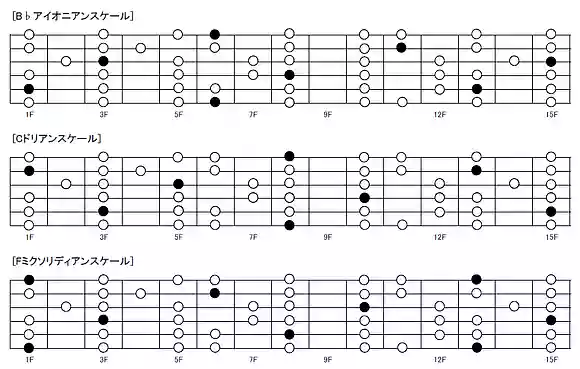
If you look at the above,I think you can see that the sequence of sounds is exactly the same; only the position of the dots is different.。
In other words, with the II–V–I progression, if you learn one type of sequence of notes, you can play the corresponding scale.
Why does the name of the scale change even though the sequence of notes is the same? For details, please look up the Church Modes, but to put it simply, it's similar to the relationship between the major scale and the minor scale.
[Advanced] Do I not need to memorize the church mode scales?
In other words, while it’s clear that in a major key the tonic of the major scale is most important for melodies and such, and in a minor key the tonic of the minor scale is most important, each church mode also has its own characteristic chord progressions and melodies. Within those, you need to use notes with an awareness of the Dorian scale, Mixolydian scale, and so on.
Actually, this isn’t very important in jazz standards,Except for some songs (such as 'So What'), clearly defined church mode progressions hardly ever appear.。
In other words, names like the Dorian scale and Mixolydian scale don’t actually come from the church modes; they’re merely convenient labels indicating which note you’re using as the starting note of the scale.
So does that mean you don’t need to memorize these (conventional) church mode scales to play jazz? Not exactly.By memorizing these scales—each a sequence of the same set of notes—as distinct scales, you’ll be able to instantly switch between them over each chord.。
For example, in the jazz standard tune The Days of Wine and Roses, there’s a section where Gm7 lasts for two measures followed by B♭m7 for two measures. In this section, because of the modulation, both chords are treated as IIm7, and the corresponding scales are the G Dorian scale and the B♭ Dorian scale.
At this point, if you remember the Dorian scale as “start playing from the second note of the Ionian scale,” you’ll incur a loss because for Gm7 you have to recall the F Ionian scale, and for B♭m7 you have to recall the A♭ Ionian scale.
Also, it will naturally be easier to play if you remember the root of each chord and the starting note of the scale you use as the same note.
In this way, when it comes to playing an improvised jazz solo,It is very important to memorize the scale corresponding to each code.。
Let's learn the major scale in second position
That said, if you’ve just started learning jazz and try to memorize a bunch of scales right away, I think you’ll end up giving up in the end.
Therefore,First, let’s start by firmly memorizing the second position shape of the major scale.。
This position is the same position as what is probably the most famous minor pentatonic position in the world.
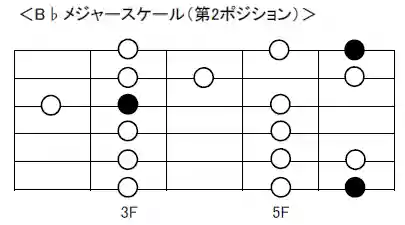
The major scale and the Ionian scale are the same scale, so when referred to in the church modes framework, this is called the Ionian scale.
Even if you’re someone who’s not good at memorizing scales, make sure to remember this!
As a procedure for memorization,First, while looking at this scale diagram, repeat playing from the bottom to the top and from the top to the bottom.。
After that, you repeat the process of continuously rising or continuously falling from any point.
At this time, do not skip any notes or play them oddly; be sure to play them in order.
This will also be relevant later when practicing ad-lib (improvised) solos.
Next, transpose the scale and practice so that this shape is clearly visible wherever you move it on the fretboard—for example, by moving the root on the first string to the 8th fret (C major scale) or to the 11th fret (E-flat major scale).
By repeating this, when you return to the original key, the shape of the scale will become clearer.
Also, practicing to recall the shape of the scale by visualizing the fretboard in your head without looking at the guitar neck is highly effective.
As this practice develops, you will be able to practice improvisation solos in your head.
Let's practice along with the accompaniment.
Once you’ve learned the second position of the major scale to some extent, try practicing along with a backing track of Cm7–F7–B♭M7. It’s fine to refer to the scale chart as you play.
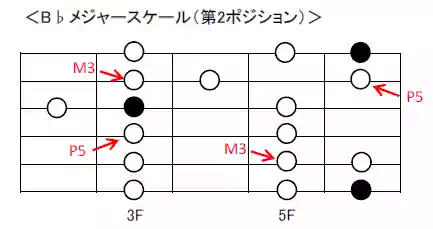
What becomes important here is,Play the scale tones in order. When you move to B♭M7, sustain tones like the major 3rd, perfect 5th, and the root to bring out the B♭M7 sound, and make sure to resolve properly to IM7.It is.
Conversely, for the Cm7–F7 section, you don’t need to be too conscious of the chord quality at this point.
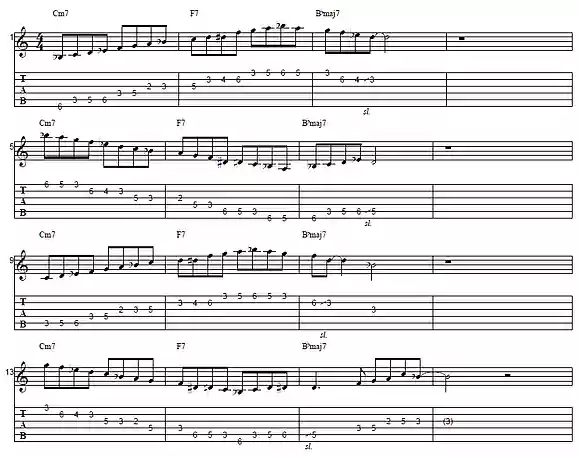
Accompaniment BPM = 120https://drive.google.com/open?id=1fk-b8vxGYcYqMYu7Ak82MBSQLW4G2vPv
Accompaniment BPM = 200https://drive.google.com/open?id=1eZ8Z_tupnkHnOyYXstX0A0m5Y3cVdXeh
Performance example BPM = 120https://drive.google.com/open?id=1Qs-tvb7Nwt4uJTsxssDl0sOkHCzeEaTv
Performance example BPM = 200https://drive.google.com/open?id=1Ov1vOiP9Hr_HxKVObKLcfegRMABfOD_d
When you actually try playing it, you may feel it's a bit lacking, but you'll notice it doesn't sound off-key.
At this point, to avoid accidentally sustaining an avoid note (a note that clashes by a semitone with a chord tone), a safe approach is to keep the line moving and avoid holding notes too long over the Cm7–F7 section.
Also, at this time, be careful that the rhythm doesn’t swing too much and turn into a shuffle beat.
I won't explain the difference between shuffle and swing here, but if it's going to turn into a shuffle, it's better to play it straight (without a swing feel).
Let's be mindful of the chord progression.
Once you’ve gotten used to moving through the scale along with the accompaniment, the next step is to start paying some attention to the chord progression.
Below is a diagram of the C Dorian scale. Over the Cm7–F7 section, be mindful of the tonic of the Dorian scale by, for example, starting from the marked C note. When it moves to B♭M7, switch your mindset to the aforementioned B♭ major scale.
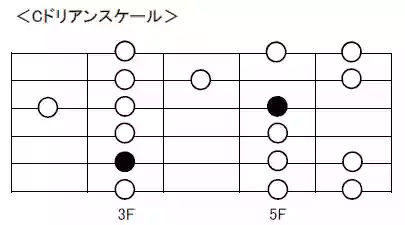
In other words, by simplifying the progression Cm7–F7–B♭M7, it’s being interpreted as something like Cm7 → B♭M7.
In fact, in a major-key II–V–I progression, the dominant feel of the V7 is weak, so interpreting it as IIm7 → IM7 as above is perfectly acceptable.
Let's try using a code tone as well.
Up to now, I’ve written as if code tone didn’t matter much, but of course code tone is important too.
However, in terms of practice order, I think it’s easier to get out of the state of not knowing what to play at all if you first learn scales solidly and then learn chord tones properly to broaden your phrasing.
Within the major scale’s 2nd position, each chord tone is located at the positions shown below.
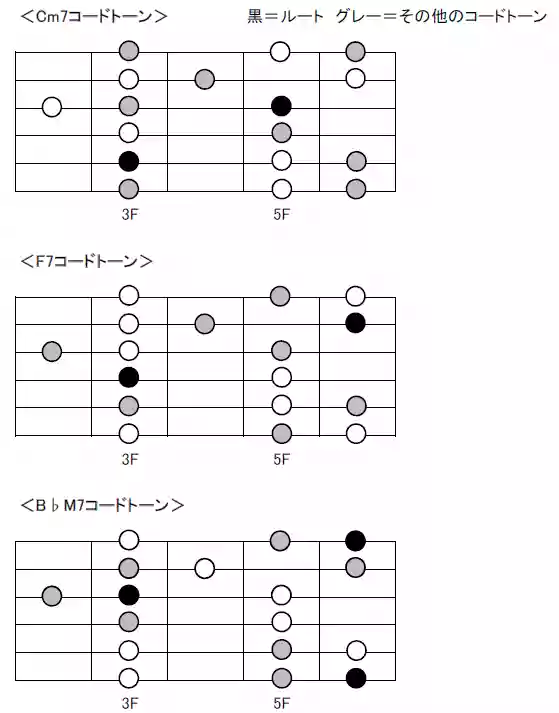
Since it can be quite difficult to follow each chord tone across three different chords, simplifying the progression here to Cm7 → B♭M7 will make it easier.
Specifically, one approach is to start by playing the chord tones of Cm7, connect them into the scale, and when you resolve to B♭M7, play the chord tones of B♭M7.
To be able to play more (better)
Once you’ve gotten comfortable soloing along with the accompaniment in the key of B-flat, start practicing in other keys as well.
If you repeat this until you can play it in any key, you won’t have trouble with II–V progressions in major keys.
After that, by adding passing notes within the scale to create chromatic motion—and by being able to do the same in other positions—you’ll gradually gain more and more freedom in your playing.
Memorizing scales can be a hassle, but I think your motivation will last if you feel it connects to actual performance, so please give it a try and practice.