


Mencius, a philosopher active in 4th-century BCE China, left many famous sayings born of his deep insight and understanding of human nature.
Advocating the theory of innate goodness—that human nature is fundamentally good—Mencius taught the proper way to live as a human being.
His words still resonate with us today as we navigate modern life.
When you are troubled or uncertain, or when you feel you may lose sight of your path, please remember this article.
You will surely encounter words that become a source of support for your heart.
- Keep your favorite words close. A short collection of quotes that comfort the heart.
- If you know them, they’ll surely guide your life! Important words to etch into your heart
- Life’s guideposts illuminated by sayings from the Analects: Confucius’s teachings that move the heart.
- Even a single word can save your heart! Uplifting, happy words that make you feel positive
- Famous quotes that became life hits, left by Confucius, the founder of Confucianism.
- Cherish each and every day! Let your life shine with profoundly moving, supreme quotes.
- [Heart-Touching] Quotes That Keep You Going Anytime! Fiery Words That Push You Forward
- Remember these when you're unsure at work: short, powerful quotes and sayings that hit home.
- A prescription for a weary heart! What comforting words can support and reassure you?
- Famous quotes everyone knows, including words from great figures and characters
- Heartfelt! Inspiring Quotes Left by Great Figures of Japan
- Fuel for tomorrow! Change your life with words that fire you up.
- Famous quotes by philosophers around the world, originating in ancient Greece
Enriching Sayings of Mencius: A Collection of Life-Guiding Words (1–10)
If you believe everything in books, it is better to have no books at all.Mencius
The famous saying “If you believe everything written in the Book of Documents, you’d be better off without the Book of Documents” warns of the risk of trusting all information you encounter.
Especially in today’s social media society, where text from experts and laypeople appears on screen in the same font, it’s easy to fall into the illusion that everything is true.
This quote emphasizes the need to take personal responsibility and use one’s own judgment to choose what is correct from a mix of good and bad information.

Live with concern; die in peace.Mencius

The saying “Live in worry, die in ease” means that worries and troubles are necessary for living, and that soaking in a life of comfort leads to ruin.
We learn humility and caution precisely because we face worries and anxieties, but if we live too peacefully, we miss the chance to gain those lessons.
Though the words may sound counterintuitive at first, they contain a teaching that rings true.
When worries and anxieties arise, this quote reminds us to see them as opportunities for growth.
A person’s moral virtue, wisdom, skill, and knowledge always reside amid illness.Mencius
The famous saying, which means that the wisdom needed to live is gained precisely in adversity, goes: “A person’s virtue, insight, skills, and knowledge always reside in hardship.” The phrase “virtue, insight, skills, and knowledge” refers to remarkable wisdom and superior resourcefulness, expressing the idea that adversity is what helps people grow.
Indeed, if we simply keep walking without encountering any problems, we discover nothing new, and when we eventually face a major obstacle, we may find neither the drive nor a good plan to overcome it.
It’s fair to call this a quote that teaches us that a crisis is an opportunity.
It is because one does not act, not because one cannot.Mencius
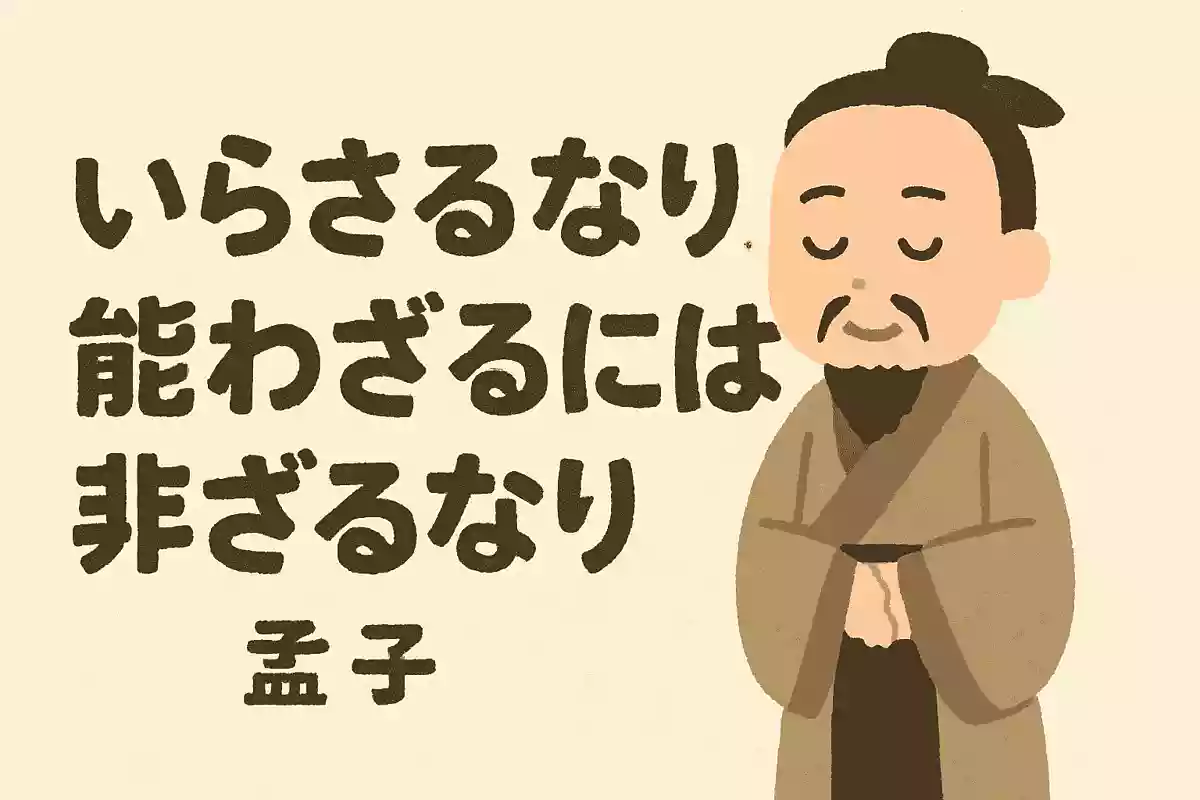
The famous saying “Nasazaru nari, kanawazaru ni wa arazaru nari” means that being unable to do something comes from not doing it, not from lacking ability.
If you start out comparing yourself to others and feel a difference in ability, you set your own limits right then and there, and your motivation won’t rise.
For those struggling in real time—whether in a club activity or at work—this message can truly be a source of courage.
It’s a quote that gives you a push, telling you that as long as you find the will, anyone can do anything.
If there is something you do not achieve after acting, always turn back and seek the cause within yourself.Mencius
Mencius was a Confucian scholar of China’s Warring States period who, while inheriting Confucius’s teachings, developed his own distinctive thought.
His words teach that when our actions fail to produce the results we hoped for, we should seek the cause not in external factors but within ourselves.
They embody the belief that if one does not neglect effort and walks the right path, one will certainly grow and achieve better outcomes.
This idea still emphasizes today the importance of self-correction, showing that a constant willingness to reassess oneself is indispensable for attaining success.
Even when the desired results are not achieved, reflecting on and improving one’s actions and efforts is precisely what leads to the next stage of growth—an enduring maxim that makes this clear.

There has never been one who, while being crooked himself, was able to make others straight.Mencius
A famous saying that means there has never been a case of someone correcting others while acting crookedly themselves: “There has never yet been a person who, while bending himself, could straighten others.” Put simply, it means: “If you want to set others right, correct yourself first.” Especially when in a position of authority, we tend to put our own faults aside and try to change those below us.
This saying teaches that changing yourself first—and showing that change—leads to changing others.
I constantly cultivate my vast, noble vital spirit.Mencius
A famous saying that means “I cultivate a spirit unshaken by any hardship” is: “I am skilled at nurturing my vast, all-pervading qi.” Here, “vast qi” (浩然の気) refers to the vital energy that permeates the boundless world—the source of life and vitality—and, within the doctrine of the goodness of human nature, it signifies the “good that exists in the world.” It teaches that by doing what is right, you will cultivate this qi within yourself and possess unwavering courage.
It is a maxim that speaks to human morality and to the virtuous cycle that arises in life when one continues to do good.