

[Children’s Song] Easy Even for Piano Beginners! Introducing Nursery Rhymes with Simple Chords


Familiar nursery rhymes that everyone sang at least once in childhood.
With simple melodies, easy-to-remember lyrics, and straightforward chords, nursery rhymes are perfect for piano beginners to practice! So this time, we’re introducing easy, playable nursery rhymes recommended for children who have just started piano lessons and adults who are beginning to learn on their own.
We’ve selected songs that meet the following conditions: a relatively narrow range, few notes in the melody, and simple chords.
Give them a try!
- [For Kids] Play Piano with One Finger! Recommended Songs Collection
- [Piano Etudes] Recommended for Beginners! A Curated Selection of Easy, Playable Pieces
- How to play piano accompaniment using simple chords
- Beginner Piano: Carefully Selected Easy and Famous Pieces You Can Play with One Octave
- [With Piano Sheet Music] Easy to Play! Introducing Free Performance Videos of Children’s Songs and School Songs
- Get pumped with kids’ favorite songs! A memorable collection of classics that will make you want to sing along
- Piano is easy! A selection of sheet music that beginners can play with both hands
- [For Piano Beginners] Play Right Now with Free Sheet Music! A Roundup of Recommended Practice Pieces
- Ranking of Popular Children's Songs [2026]
- [For 3-year-olds] Songs to sing at nursery schools and kindergartens! Popular and recommended songs
- [Christmas Songs] Christmas songs to sing with children
- [Piano Pieces] Easy for Children to Play! A Roundup of Simple Classical Works
- A must-see for anyone who wants to try piano-and-vocal performances through code! From nostalgic oldies to the latest hits, all introduced at once.
[Children’s Songs] Easy for Piano Beginners to Play! Introducing Simple-Chord Nursery Rhymes (1–10)
Ogre PantsLuigi Denza

“Oni no Pantsu” (The Ogre’s Underpants) is a classic hand-play song often sung in nursery schools and kindergartens around Setsubun, and it’s also world-famous as a Neapolitan popular song.
Its original tune is “Funiculì, Funiculà,” composed in 1880 to celebrate the opening of the Mount Vesuvius funicular.
In Japan, the song is loved for its unique lyrics depicting an ogre wearing tiger-skin clothing.
The key to performing it is to play with a lively, staccato touch that matches the bold melody! The left hand keeps a march-like rhythm, making it perfect for practicing steady tempo.
The chord progression is simple yet powerful, offering plenty of satisfaction even for beginners at the piano.
Press the keys firmly all the way down and play with confidence.
Light of FirefliesSukottorando min’yō
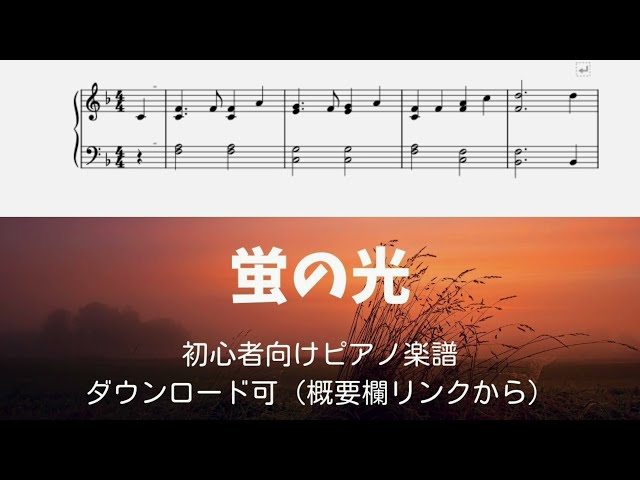
A Scottish folk song well known in Japan as the melody played at graduation ceremonies and when shops close.
Since its publication in the November 1881 issue of the Elementary School Song Collection, First Volume, it has been deeply etched in the hearts of the Japanese as a song that celebrates the end of learning and the start of a new journey.
Its simple pentatonic-based melody, with easy fingerings and memorable phrases, makes it ideal for beginners as a piano practice piece.
The relaxed 4/4 rhythm and gentle chord progression are perfect for settling in at the keyboard.
Start by letting the right-hand melody sing smoothly; once you’re comfortable, add the left-hand accompaniment to create a tender harmony.
By playing with feeling, you’ll find even greater joy in the piano.
tea pickingMonbushō shōka

This piece from the Ministry of Education’s song collection—also widely loved as a hand-play song—features an easy-to-remember, simple melody and rhythm, making it perfect for beginners just starting piano! Since it was included in an elementary school textbook published in March 1912, this song has continued to depict the tea-picking scenes of the 88th night of spring, and in 2007 it was selected for the “100 Best Japanese Songs.” With a narrow vocal range and minimal finger movement, it’s ideal not only as a practice piece for small children, but also for adult learners who want to enjoy performing while feeling Japan’s beautiful changing seasons.
Experiencing the joy of playing this nostalgic melody—one that everyone has heard at least once—will surely boost your motivation for daily practice!
[Children’s Songs] Easy Even for Piano Beginners! Introducing Nursery Rhymes with Simple Chords (11–20)
If you’re happy and you know it, clap your hands

It’s a classic play song for moving your hands and feet that everyone has enjoyed at least once.
Released in May 1964 as a single by Kyu Sakamoto, it spread throughout Japan.
In 2007, it was selected by the Agency for Cultural Affairs as one of the “100 Best Japanese Songs,” and it continues to be loved to this day.
The piece features many repeated short phrases and a very simple chord progression.
To start, try practicing by playing the melody with your right hand and holding whole-note chords with your left.
Once you get used to it, challenge yourself with fun arrangements—add handclap rhythms to match the lyrics, or use staccato to bring out a light, lively feel.
little foxDoitsu min’yō

“Little Fox,” based on a German folk song that depicts charming animals through the changing seasons, has been beloved in school settings ever since it appeared in music textbooks in May 1947.
The scenes—like tidying up in the mountains or in a burrow—are adorable and perfect for playing while picturing the imagery.
The melody features many repeated short phrases and a comfortable range, making it ideal as a practice piece for beginners on the piano.
The chord progression is also very simple, so start with one hand at a time, then, as you get used to it, add the left-hand bass and step up to playing with both hands.
If you can express changes in the scene—like brightness or cold—through sound, your performance will be even more delightful!
Medaka no GakkōNakata Yoshinao

This piece is memorable for its lyrics that liken small fish gliding smoothly through the river to schoolchildren, painting a cheerful picture of school life.
Since it first aired on NHK Radio in April 1951, it has been loved for many years.
The distinctive onomatopoeic sounds in the lyrics can be brought out on the piano with light staccato and a bouncy rhythm, enhancing the charm of the piece.
The melody stays within an easy vocal range, and the chord progression centers on primary triads, making it approachable even for beginners at the piano.
Start by practicing each hand separately; once you’re comfortable, add a lively accompaniment and use your tone to evoke the river’s sparkling surface.
Where are you from?

Antagata Dokosa, long cherished as a traditional handball song, is a nursery rhyme known for its unique call-and-response structure and bouncy rhythm.
With its few melodic notes and simple chord progressions, it’s perfect as a practice piece for those just beginning piano.
Interestingly, this piece is also known for having been adopted in 1992 as the approach melody played at Kumamoto City tram stops, coinciding with the installation of a tanuki statue.
There’s something special about playing a melody rooted in the community yourself.
Riding the rhythm and playing lightly should also help your finger movements become smoother.
Why not follow the score and savor the nostalgic world of this handball song on the piano?