

[For Beginners] I Want to Play These on Piano! Recommended Anime Songs Compilation

For those who practice piano and love anime songs—there are probably many of you who have thought, “I’d love to try playing them at least once.” Since anime songs tend to have very clear melodies, it’s easy to understand what melody you should play in your head, and it’s also a strength that you can imagine how the next section will develop.
Of course, playing anime songs—originally not piano pieces—straight on the piano can be challenging, but here we’ve selected famous anime songs old and new, focusing on pieces that definitely have beginner-friendly sheet music available.
Playing your favorite anime songs will make you love the piano even more and boost your motivation!
- [Anisong] Easy for Piano Beginners! Recommended Practice Pieces
- [For Beginners] Recommended Ghibli Masterpieces You’ll Want to Play on the Piano
- Anime songs popular among elementary school students. Theme songs and insert songs from trending anime.
- Even beginners can play them easily on the piano! A curated selection of popular and latest J-POP songs.
- [Piano Beginners] J-POP That Looks Hard but Is Surprisingly Playable [2026]
- [For Piano Beginners] Play Right Now with Free Sheet Music! A Roundup of Recommended Practice Pieces
- [Piano × Vocaloid] A selection of recommended songs that are easy for beginners to play
- [Disney] Playable even if you’ve just learned Do-Re-Mi! A selection of iconic songs from beloved Disney animations
- [Piano Etudes] Recommended for Beginners! A Curated Selection of Easy, Playable Pieces
- [Latest & Greatest] A Special Feature on Anime Songs Recommended for Teens
- [Piano × J‑Pop] A curated selection of the coolest new hits and anime songs that’ll look great when you play them
- [Collection of Epic Songs] A compilation of cool anime songs chosen by anime fans
- [Beginner Piano Sheet Music] A selection of easy arrangements of the latest hit songs
[For Beginners] I Want to Play These on Piano! Recommended Anime Songs (21–30)
Arrietty’s SongCecile Corbel

Many people have surely been captivated by Cécile Corbel’s translucent voice and the magical sound of her harp! The theme song from the film “The Secret World of Arrietty” features a beautiful melody and a relaxed tempo, making it easy to perform.
The work is also known for winning the Tokyo Anime Award for Music in 2011.
The lyrics seem to embody the earnest feelings of the tiny protagonist and a way of life in harmony with nature.
To recreate this delicate worldview, the key is to play lightly and fluidly, like harp arpeggios.
If you aim for a whisper-soft, gentle tone, you can achieve a highly polished performance even with fewer notes.
Fine On The OutsidePriscilla Ahn

Many listeners must have been moved by the crystalline vocals and acoustic resonance.
The theme song for the film “When Marnie Was There” is a deeply personal piece that Priscilla Ahn, its writer, created in 2005 based on her own experiences of loneliness during her girlhood.
While pretending to be fine on the outside, the protagonist Anna quietly carries a sense of isolation, and the song aligns with her feelings beautifully, striking straight to the heart.
The track is also included on the album “Just Know That I Love You.” To convey the bittersweet melody with rich emotion, the key is to begin playing with a soft, delicate touch.
By letting the quiet, hidden feelings surface in the sound, your performance will resonate deeply with listeners.
[For Beginners] I Want to Play These on Piano! Recommended Anime Songs (31–40)
Bling-Bang-Bang-BornDJ matsunaga
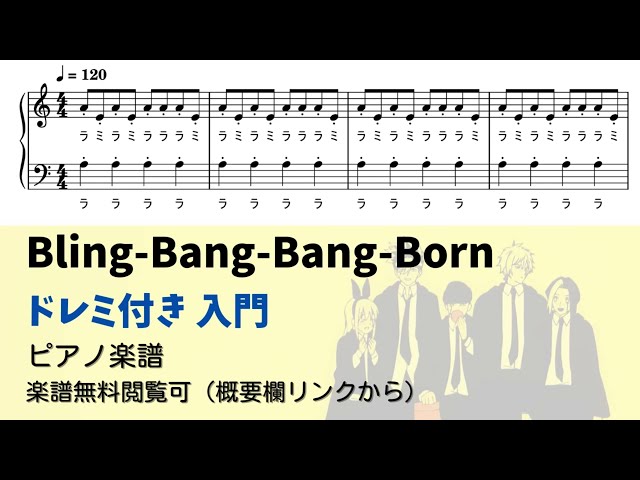
If you want to play anison and are a beginner at the piano, “Bling-Bang-Bang-Born” is highly recommended.
The song was composed by Creepy Nuts, a Japanese hip-hop duo consisting of DJ Matsunaga and R-Shitei, as the opening theme for the second season of the TV anime Mashle: Magic and Muscles, the “Divine Visionary Candidate Exam Arc.” Its catchy, driving rhythm is addictive and will stick in your head after just one listen.
Because the track is rap-style, it features many repeated melodies and rhythms.
Although it’s uptempo, once you can play one phrase, you’ll find it easier to handle the other repeated sections—another point in its favor.
After you can play it slowly without mistakes, try gradually approaching the original tempo.
You’ll be able to play it all the way through in no time!

CHA-LA HEAD-CHA-LAKiyooka Chiho

CHA-LA HEAD-CHA-LA from Dragon Ball by Akira Toriyama, the world-famous Japanese manga artist.
It’s probably also one of the most popular anime songs people want to play on piano.
The sixteenth-note runs in the intro seem difficult, but your hand position doesn’t change—you just need to play them fast.
Start by learning the note positions and fingering, and practice slowly at first.
The left-hand accompaniment is simple; if the number of notes feels like too much, playing just the first note as a quarter note should still work.
You probably have lots of favorite anime songs, and this left-hand accompaniment pattern shows up often, so once you learn it, you can apply it to other pieces.
If you lock in the syncopation in the vocal section, it will really sound like popular-style piano.
Level up your sight-reading power, and when the music hits the exciting parts, try to play with as much energy as if you were throwing a Spirit Bomb!
Odoru Pompoko RinOda Tetsurō

The manga and anime Chibi Maruko-chan, created by Momoko Sakura, is a beloved national anime representing Japan, alongside works like Doraemon and Sazae-san.
The song Odoru Pompokolin used in Chibi Maruko-chan is the series’ iconic first ending theme, and it energizes everyone who listens.
It’s a great anime song even for beginners who are just starting piano and still working hard to read sheet music.
Since it involves playing the same notes in rhythm and the bass line is simple, it’s easy to perform.
First, learn the rhythm of the original song’s vocals and try playing the notes along with it.
Little by little, memorize the positions on the keyboard and shape it into a performance.
Once you reach the chorus, you can just ride the groove and enjoy playing to the end.
When you get used to it, try playing along at the original tempo.
Sometimes, old storiesHisaishi Joe
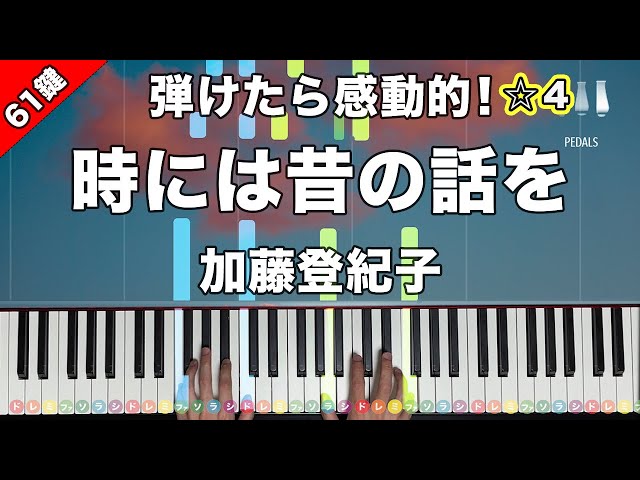

It’s a piece whose melancholy, chanson-like melody lingers in the heart, gracing the ending of the film Porco Rosso.
Originally created by Tokiko Kato in 1987, it was given a grand orchestral arrangement for the movie.
The lyrics warmly look back on days gone by, mirroring the protagonist Porco’s outlook on life and lending the story a deep afterglow.
This song also carries a heartwarming anecdote in which words from the lyrics inspired the studio’s name.
With its exquisitely beautiful melody line, even a simple accompaniment allows you to fully savor the song’s tender, bittersweet atmosphere.
It’s a piece I highly recommend to anyone who wants to immerse themselves in the story and perform with heartfelt emotion.
KICK BACKYonezu Kenshi

KICK BACK was co-produced by Kenshi Yonezu and Daiki Tsuneta of King Gnu.
It was newly written as the opening theme for the TV anime Chainsaw Man and swept various Oricon and Billboard charts.
In the original key there are many black keys, so if you can find sheet music a half step higher, it will reduce them and be preferable.
In the intro, the right hand can be played using just two adjacent semitone notes, so starting there is recommended!
