

[Anisong] Easy for Piano Beginners! Recommended Practice Pieces


Good news for all the anime-and-piano lovers who think, “Up-tempo anime songs with complex rhythms seem tough for piano beginners”! It’s true that many anime songs have intricate melodies and rhythms, but by choosing sheet music with simplified arrangements of the original, and by practicing the melody in your right hand while playing just the bass notes with your left, even those new to the piano can jump in with ease.
In this article, we’ll introduce plenty of anime songs that are perfect for beginners to practice.
Once you find a favorite, give it a try right away!
- [For Beginners] I Want to Play These on Piano! Recommended Anime Songs Compilation
- [For Beginners] Recommended Ghibli Masterpieces You’ll Want to Play on the Piano
- [Disney] Playable even if you’ve just learned Do-Re-Mi! A selection of iconic songs from beloved Disney animations
- [For Kids] Play Piano with One Finger! Recommended Songs Collection
- [Piano Pieces] Easy for Children to Play! A Roundup of Simple Classical Works
- [Piano × J‑Pop] A curated selection of the coolest new hits and anime songs that’ll look great when you play them
- [Piano × Vocaloid] A selection of recommended songs that are easy for beginners to play
- [Piano Beginners] J-POP That Looks Hard but Is Surprisingly Playable [2026]
- Pick up famous and popular anime songs! Along with piano solo
- [Beginner] Recommended Piano Pieces to Play at a Recital
- Even beginners can play them easily on the piano! A curated selection of popular and latest J-POP songs.
- [Disney] Introducing Moving Masterpieces with Sheet Music – Beginner, Intermediate, and Advanced
- [Latest & Greatest] A Special Feature on Anime Songs Recommended for Teens
[Anime Songs] Easy for Piano Beginners to Play! Recommended Practice Pieces (21–30)
Kaikai KitanEVE

The opening theme for the first cour of the TV anime Jujutsu Kaisen is Eve’s Kaikai Kitan.
It even ranked fifth on Billboard’s download chart.
In the A section, there are parts built around two adjacent notes, and in the chorus, parts centered on the same note an octave apart, which makes it easier to remember which keys to play.
To bring out the uptempo sound of the track, the left hand keeps playing at the same pace, and because there are many repeated notes, it’s beginner-friendly as well.

Tower of FlowersSayuri

The ending theme used in the anime Lycoris Recoil, which depicts the exploits of girls working to deter crime, is Sayuri’s “Hana no Tou.” The original is a cool rock tune with a driving band sound, but the piano arrangement has a different kind of charm.
In particular, the melody of the chorus isn’t as rhythmically intense as you might expect and can be played with quarter and eighth notes, making it approachable even for beginners.
Give it a try!
TouchIwasaki Yoshimi

The opening theme song for the anime adaptation of the classic baseball-themed manga Touch is also titled “Touch.” Sung by Yoshimi Iwasaki, it won the Gold Prize at the 27th Japan Record Awards.
Even today, it’s well known as a high school baseball cheer song often performed by brass bands.
The melody is distinctive for its many repeated notes, making it relatively approachable to play on the piano.
Although it’s an up-tempo piece, the chord changes are surprisingly gradual and the left-hand accompaniment can be played comfortably, so it’s recommended for beginners!
KICK BACKYonezu Kenshi

KICK BACK was co-produced by Kenshi Yonezu and Daiki Tsuneta of King Gnu.
It was newly written as the opening theme for the TV anime Chainsaw Man and swept various Oricon and Billboard charts.
In the original key there are many black keys, so if you can find sheet music a half step higher, it will reduce them and be preferable.
In the intro, the right hand can be played using just two adjacent semitone notes, so starting there is recommended!
Promise of SunflowersHata Motohiro

The nationally beloved anime Doraemon was adapted into 3D CGI and made waves with the film STAND BY ME Doraemon.
The theme song chosen was Motohiro Hata’s “Himawari no Yakusoku” (Promise of a Sunflower).
The melody in the A section uses many eighth notes and changes at a relatively steady pace, making it easy to catch the rhythm.
It’s recommended even for piano beginners who struggle with rhythm.
While the chorus melody gets a bit more intricate, it’s originally a slow ballad, so it remains approachable.
Spring Dayaimyon
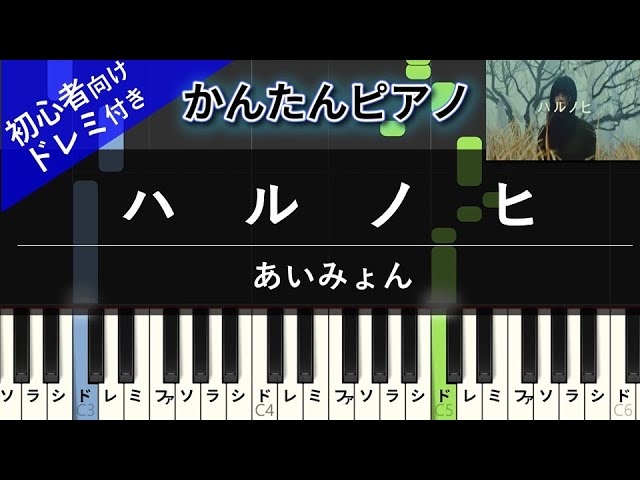
Aimyon’s “Harunohi” is a single released in 2019, written as the theme song for the animated film Crayon Shin-chan: Honeymoon Hurricane ~The Lost Hiroshi~.
The melody uses only notes from the major scale that matches the key of the song, making it catchy and easy to remember.
The rhythm is based on a simple 8-beat, so there aren’t many difficult rhythm patterns.
It’s approachable even for beginner pianists, so definitely give it a try!
Is there still anything that love can do?RADWIMPS

Ai ni Dekiru Koto wa Mada Aru Kai by RADWIMPS was created as the theme song for the anime film Weathering with You.
The film’s soundtrack, which includes this song, topped Oricon’s digital chart for five consecutive weeks.
It’s a beautiful piano ballad characteristic of Yojiro Noda, and it carries well even in a solo vocal-and-piano performance.
Most parts, except for a few sections, use the same chord progression, and it’s just a repetition of four chords, making it very easy to play.
The different sections only add a few chords and slightly change the order, so definitely give it a try!