

Top Inoue Yosui Songs Ranking [2026]

Since his re-debut under the name Yosui Inoue in 1972, he has produced numerous hit songs.
There are also many hits among the songs he provided to other singers, including Anzenchitai, which served as Inoue’s backing band.
Here is a compilation of his popular tracks.
- Inoue Yosui’s classic and popular songs
- Karaoke Popular Songs Ranking of Yosui Inoue [2026]
- [Karaoke] A roundup of easy-to-sing songs by Yosui Inoue
- Yosui Inoue CM Songs and Popular Songs Ranking [2026]
- Eikichi Yazawa Popular Songs Ranking [2026]
- [60s] Karaoke Popularity Rankings by Generation [2026]
- [For People in Their 50s] Ranking of Easy-to-Sing Karaoke Songs [2026]
- Inoue Sonoko Popular Songs Ranking [2026]
- Yoko Oginome Popular Songs Ranking [2026]
- Yuki Saito’s Most Popular Songs Ranking [2026]
- Top Songs Ranking of Anzenchitai [2026]
- Azumi Inoue Popular Song Rankings [2026]
- Karaoke Popular Song Ranking of Anzen Chitai [2026]
Yosui Inoue Popular Song Rankings [2026] (51–60)
summer festivalInoue Yosui56rank/position

It’s a song quintessentially Inoue Yosui—tinged with a gentle melancholy yet warm, evoking a unique sense of nostalgia.
This piece was included on the classic album “Yosui II: Sentimental,” released in December 1972, and it became a staple in his live performances at the time.
The acoustic sound—almost what you might call folk rock—beautifully harmonizes with the lyrics’ worldview, which sings of the passage of ten years and memories of summer.
The bustle of a festival evening and the scene of riding home with a younger sister on the bicycle come to life like a short film before your eyes.
If you listen while overlaying it with your own distant memories, you may be able to savor its world even more deeply.
goddessInoue Yosui57rank/position
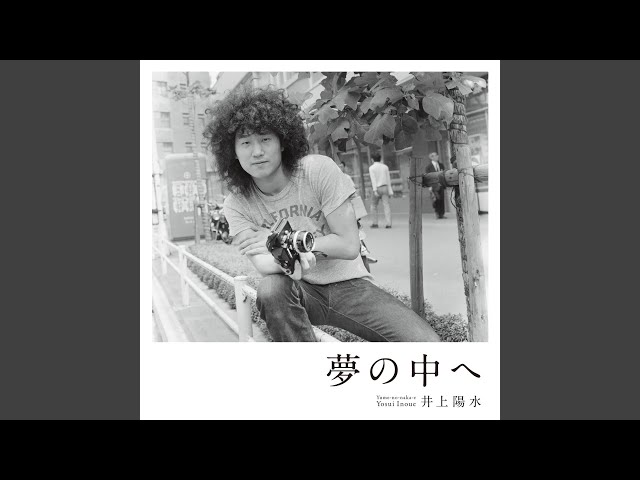
It’s a work that feels very much like Yosui Inoue—gentle and warm-eyed.
Even while handling a grand theme, it’s striking how it’s written in intimate language, as if speaking to someone close.
It may be a hymn to the precious things found in everyday life and in unassuming scenes on a journey—those irreplaceable presences.
This piece was written as the opening theme for NHK’s travel program “Buratamori,” and was later included on the cover album “UNITED COVER 2.” If you listen at the start of a trip, it will surely make you anticipate wonderful encounters.
Traveler,Inoue Yosui58rank/position

If you heard this song without any prior context and felt like you’d heard it somewhere before, you’re probably quite well-versed in the Showa era—or from the generation that lived through it.
“Tabibito yo” was the B-side to Yuzo Kayama’s 1966 single “Yozora o Aoi de,” and the version introduced here is included on Yosui Inoue’s 2001 cover album “UNITED COVER.” Choosing the B-side rather than the A-side—now that’s impeccable taste.
The original, composed and arranged by Kayama himself and sung in a folk style with The Launchers, is reimagined by Inoue in a J-pop style, fully transfiguring it into the world of Yosui Inoue.
The melody is simple, the pitch easy to grasp, and the vocal range relatively narrow, so it should be quite manageable to sing without much difficulty.

Cherry Blossom March PromenadeInoue Yosui59rank/position

This is a classic Showa-era song included on the landmark album Ice World, which became Japan’s first million-seller.
Released in December 1973 as the album’s tenth track, this piece stands out with a uniquely distinctive presence.
The lyrics were written by Kunio Hase, and the arrangement was by Masaru Hoshi—one notable feature is that the words were not penned by Yosui Inoue himself.
The title may evoke a gentle spring stroll, but as the song progresses, its unfolding sense of “madness” and “heat” is startling.
The spoken-word-like passages, reminiscent of poetry reading, are also a highlight that connects to later modes of expression.
When you want to feel the unease lurking within spring’s pleasant warmth, or to immerse yourself in the atmosphere of the era through the album as a whole, why not give it a careful listen?
mobile phoneInoue Yosui60rank/position

Even if you say “mobile telephone,” it might not immediately resonate with younger people.
It’s a general term for telephones you can use while on the move—car phones, cell phones, PHS, and the like—and this song titled “Idō Denwa (Mobile Telephone)” captures the distinctive atmosphere of the 1990s, when the idea of carrying a phone gradually became ingrained for many.
Released in 1994 as Yosui Inoue’s 39th single, it was also used as the tie-in theme for the TBS drama “Yume Miru Koro o Sugitemo.” It’s a J-pop track that uses the so-called “hachiroku” (8-beat, 6/8 feel) rhythm, arranged by the one and only Takeshi Kobayashi.
While the overall vocal range isn’t particularly high, the pitch fluctuations are somewhat pronounced.
Moving from the calmly sung A section, through the gradually building B section, into the expansive, soaring chorus—delivering those contrasts can be a bit challenging.
It might help to practice each section separately.