

Johann Burgmüller Popular Song Rankings [2026]

Johann Burgmüller, a German-born composer who spent most of his career in Paris from his twenties until his later years, left behind piano miniatures, operas, and ballet music.
In Japan, many piano players are familiar with him, partly because Yamaha has adopted his “25 Easy and Progressive Studies, Op.
100” as a piano method book.
This time, we present a ranking of Johann Burgmüller’s most popular pieces—enjoy immersing yourself in his musicality!
- Scott Joplin Popular Song Rankings [2026]
- Gabriel Fauré Popular Songs Ranking [2026]
- Jean-Philippe Rameau Popular Songs Ranking [2026]
- Johann Nepomuk Hummel Popular Song Rankings [2026]
- Niccolò Paganini Popular Song Rankings [2026]
- Pablo de Sarasate Popular Song Rankings [2026]
- Carl Maria von Weber Popular Song Rankings [2026]
- Cécile Chaminade Popular Song Rankings [2026]
- Bedřich Smetana Popular Songs Ranking [2026]
- Yamada Kōsaku Popular Song Rankings [2026]
- Jean Sibelius Popular Songs Ranking [2026]
- Bartók Béla Popular Song Ranking [2026]
- Mily Balakirev Popular Songs Ranking [2026]
Johann Burgmüller Popular Song Rankings [2026] (11–20)
Burgmüller 25 Etudes, Op. 100 No. 25 “La chevaleresque” (The Lady’s Ride)Johann Burgmüller15rank/position

A dazzling and valiant piece that concludes the 1851-published album 25 Etudes, Op.
100.
The original title of this work means “chivalry,” and true to its name, it lets you feel like the dignified yet elegant hero of a story.
The staccato passages, like a horse stepping lightly, and the scales driving toward the climax make your heart dance just by listening.
In performance, the key is whether you can express the shifting scenes through dynamics and varied touch.
It’s a piece that invites you to imagine a narrative and enjoy discovering your own unique interpretation.
severe thunderstormJohann Burgmüller16rank/position

This is a dramatic and cool piece included in Johann Burgmüller’s study collection 18 Characteristic Studies, Op.
109.
Like a single film, it brilliantly depicts the arrival of a violent storm, the rumbling thunder, and its quiet passing.
The thunder expressed through octave tremolos is powerful and highly effective in performance! It’s not only about building strength and excitement; the challenge lies in gradually softening the sound as if the storm is receding, which makes it very rewarding to practice.
It’s the perfect piece for elementary and middle school students who want to greatly enhance their expressive power with a story-like work.
If performed with rich emotion at a recital, it will draw every listener into its world.
Burgmüller No. 3 “La Pastorale” (Burgmüller “Pastorale”)Burgmüller17rank/position

This work features a performance of Burgmüller’s “Pastorale” using music software.
Because it’s machine-played, the keystrokes lack a human touch, but the rhythm is steady, so the piece is complete as a musical work.
As a well-known pastoral piece, it is highly recommended even for those who don’t usually listen to pastorales.
Burgmüller: 25 Etudes, “Pastorale”Burgmüller18rank/position
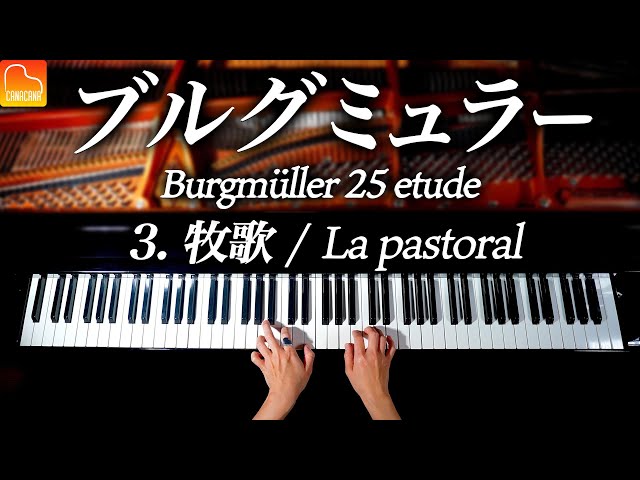
As a masterpiece among educational pieces depicting a serene pastoral scene, No.
3 from Burgmüller’s Op.
100 possesses a special charm.
Its gentle G major sonority and lilting 6/8 meter evoke a tranquil landscape with a shepherd.
The balance between the right hand’s graceful, singing melody and the left hand’s discreet chordal accompaniment is exquisite, naturally fostering legato cantabile technique and light handling of ornaments.
Published in Paris in December 1851 as part of the educational collection “25 Études faciles et progressives,” it continues to be included in grade examinations by Trinity College and Australia’s AMEB.
It is an ideal piece for learners wishing to cultivate musical expressiveness, as well as for anyone seeking solace in a beautiful melody.
12 Melodic and Brilliant Etudes, Op. 105: No. 11 “Harp of the North”Johann Burgmüller19rank/position

The German composer Johann Burgmüller left many indispensable pieces for piano learners.
No.
11, “The Harp of the North,” from his etude collection 12 Melodious and Brilliant Studies, Op.
105, which aims to balance technique and expression, is a striking piece with a melody that evokes the fantastical landscapes of the Nordic countries.
This piece demands delicate touch and rich expressiveness; rather than merely playing the notes, carefully reading the indicated dynamics and phrasing, expanding your imagery, and practicing attentively will enable you to deliver a moving performance.
12 Melodious and Brilliant Études, Op. 105: No. 12 “Heroic”Johann Burgmüller20rank/position

The 12th piece, “Heroic,” from German composer Johann Burgmüller’s Twelve Melodious and Brilliant Studies, Op.
105, is a work imbued with power and dignity befitting its title.
More than a mere vehicle for technical training, this culminating piece in a collection that emphasizes deepening a performer’s musical expressiveness offers the appeal of allowing one to fully convey its passionate character.
It is a piece that tests both technique and expression.
Johann Burgmüller Popular Song Rankings [2026] (21–30)
12 Melodic and Brilliant Etudes, Op. 105 No. 4 “La Campanella”Johann Burgmüller21rank/position

Johann Burgmüller, a German composer widely known for his piano studies for children.
His “12 Melodious and Brilliant Studies, Op.
105” is a collection aimed at intermediate to advanced learners, designed to improve technical skills and enhance musical expression.
No.
4 in this collection, “La Campanella,” demands delicate expressiveness and advanced technique, making it ideal for developing independence between the hands and refining the ability to play complex rhythms and melodies accurately.
With continued practice, you will acquire musical beauty and rich expressiveness.