

John Coltrane Popular Song Ranking [2026]

A giant of 20th-century jazz who made his mark on jazz history as a modern jazz saxophonist.
Though he spent many years in relative obscurity, he rose through the Miles Davis band and the Thelonious Monk band, and even performed with Duke Ellington.
Despite his early death, which left him with only about a decade at the forefront, he continues to be cherished today as a master of jazz.
- John Mayer Popular Song Rankings [2026]
- Miles Davis Popular Songs Ranking [2026]
- Hall of Jazz: Classic Blue Note Records. Recommended jazz albums.
- Sonny Rollins Popular Song Rankings [2026]
- Bill Evans Popular Songs Ranking [2026]
- Charlie Parker Popular Songs Ranking [2026]
- Bud Powell Popular Song Ranking [2026]
- Duke Ellington Popular Song Rankings [2026]
- Thelonious Monk Popular Song Rankings [2026]
- Wes Montgomery Popular Song Rankings [2026]
- Dave Brubeck Popular Song Rankings [2026]
- [Tearjerker] Songs that make your heart tremble with tears & moving tracks with lyrics that touch the soul
- Music festival in Western Japan held during Golden Week [2026]
John Coltrane Popular Song Rankings [2026] (1–10)
My One and Only LoveJohn Coltrane & Johnny Hartman8rank/position

A gem of a jazz ballad woven from a deep, warm singing voice and a saxophone that seems to gently accompany it.
It is known as a miraculous collaboration between John Coltrane and Johnny Hartman.
The song expresses wholehearted, devoted love dedicated to an irreplaceable person, and its romantic worldview is sure to draw everyone in.
This piece is included on the classic 1963 album “John Coltrane and Johnny Hartman,” and, remarkably, the session was recorded in just one day in March 1963.
Perfect for a quiet night alone or for enjoying a special atmosphere with someone you care about.
You can savor the profound allure that jazz has to offer.
Central Park WestJohn Coltrane9rank/position

A gem of a ballad that gracefully captures the gentle mood of spring.
Inspired by the streets of New York, John Coltrane created a serene masterpiece that was included on the 1964 album “Coltrane’s Sound,” and it continues to shine as a monument of modern jazz.
Its elegant world, woven from complex harmonic progressions and a melodious soprano saxophone, achieves a superb balance between urban sophistication and the breath of nature.
McCoy Tyner’s delicate piano touch is equally striking, with a fresh sensibility that evokes the coming of spring at every turn.
It’s a perfect track for a blissful moment—relaxing in a sunlit living room with a favorite book in hand.
Chim Chim ChereeJohn Coltrane10rank/position
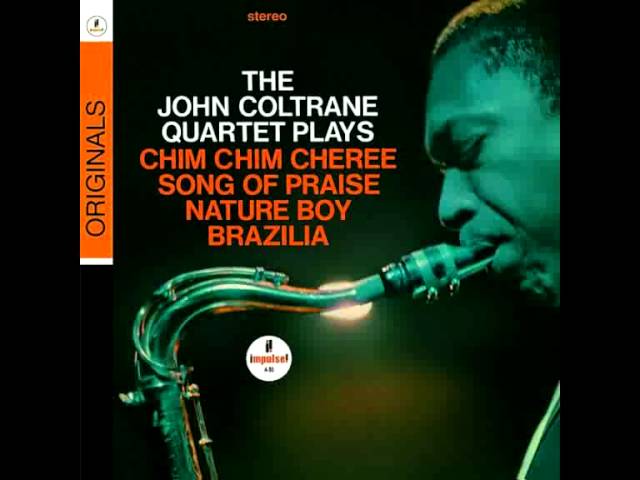
“Chim Chim Cher-ee” is one of the songs from the musical Mary Poppins.
In Japan, it was broadcast on NHK’s Minna no Uta and covered by artists such as Peggy Hayama, so many people may be familiar with it.
This version is included on the 1965 album The John Coltrane Quartet Plays—aptly named—recorded by jazz saxophonist John Coltrane with his own quartet.
Coltrane, who left an immeasurable legacy as a jazz musician and saxophonist, unleashes his signature, buoyantly floating solo style to full effect on this track as well.

John Coltrane Popular Song Rankings [2026] (11–20)
Time WasJohn Coltrane11rank/position

The scene where Dai Miyamoto performs jazz in front of his family for the first time—if you’ve ever moved from the countryside to the big city, even without aspiring to be a musician, it probably hit you right in the gut.
It’s an incredibly moving moment in the sense that Dai is setting off from his hometown to pursue a life as a jazz musician.
And the piece he plays there is John Coltrane’s classic “Time Was.” The choice makes it clear just how important Coltrane is to Dai, but there’s even more to read into it: the track appears on Coltrane’s first leader album, aptly titled “Coltrane,” and it was recorded as a one-horn number, which adds further depth to why this song was chosen.

What Child Is This? (Greensleeves)John Coltrane12rank/position

This song is a Christmas carol also known as “The Friendly Beasts,” sung to one of the oldest English folk melodies that was widely sung in the late 16th century.
John Coltrane is a legendary American modern jazz saxophonist.
Autumn SerenadeJohn Coltrane / Johnny Hartman13rank/position

Autumn Serenade, delivered by the duo of John Coltrane and Johnny Hartman, is an autumn jazz number brimming with romance.
Johnny Hartman’s sensual baritone riding the light, swinging jazz rhythm, paired with John Coltrane’s moody saxophone, creates an ensemble that is absolutely mesmerizing.
It’s a mature, atmospheric fall song—definitely one to add to your playlist.

GreensleevesJohn Coltrane14rank/position

This piece is a jazz standard arrangement of the English folk song Greensleeves.
Although the lyrics themselves don’t include the word “winter,” the theme revolves around a cold, winter-like heartbreak.
While the overall mood feels chilly, the tempo is relatively quick, making it an approachable listen even for those new to jazz.
