

A roundup of songs that start with “So.” Perfect for word-chain games or picking karaoke tracks!

How many song titles that start with “so” can you think of?
When it comes to words that begin with “so,” there are plenty—like “sora” (sky), “sotsugyō” (graduation), “songu” (song), and “sonzai” (existence)—and many of these words also appear in song titles.
In this article, we’ll showcase a bunch of songs with titles that start with “so.”
We’ve picked well-known tracks across generations as well as recent buzzworthy songs.
Use this as a reference for song-title shiritori or choosing tracks for “shiritori karaoke.”
- A big roundup of Vocaloid songs starting with 'So'! From mega-hits to hidden gems, all introduced at once
- What songs are there? A roundup of songs with titles that start with “Zo”
- Songs with titles that start with “Su.” A collection of tracks useful for shiritori.
- Songs that hype you up just by listening—recommended tracks from timeless classics to the latest releases
- Songs with titles starting with “To.” A selection from popular tracks across generations!
- Songs that start with “se”. Use them as references for shiritori or choosing tracks for karaoke!
- A compilation of Vocaloid songs with titles that start with 'Sa'
- [2026] A roundup of female enka singers in their 60s: Artists who support Japanese enka
- Songs with titles that start with “Sa”: a roundup you can use for shiritori or karaoke
- Winter Songs: Classic tracks you want to listen to in winter. Songs you long for during the winter.
- Songs that start with the letter “Shi.” Perfect for shiritori or karaoke!
- A compilation of Vocaloid songs with titles that start with 'Su'
- Songs with titles that start with a number. Useful for karaoke or playlist selection.
Songs that start with “So” (Japanese syllable ‘So’). Great for word-chain games or karaoke picks! (391–400)
Let the cherry blossoms bloomYoshida Yamada

Formed by classmates from their high school days, the duo Yoshida Yamada began their full-fledged music career after a training stint in New York before their debut.
Their 13th single, “Sakura Sake,” used as the ending theme for the TV anime Hinomaru Sumo, stirs the heart with their trademark beautiful harmonies and a clear, transparent ensemble.
The lyrics evoke images of striving toward one’s dreams, which seems to resonate with the spring atmosphere—a season when many people embark on new beginnings.
It’s a lyrical number that also makes a great BGM choice for spring events like cherry-blossom viewing.

To the ends of the skynatori sana

An emotional rock number from Sana Natori, a standout in the VTuber world.
Released digitally on September 20, 2024, this track resonates with a richly expressive band sound and Natori’s delicate vocals.
The lyrics, themed around dreams, hope, and anticipation for the future, are filled with messages that speak to the heart.
Highly recommended for those about to take on a new challenge or who want to move forward with their heads held high!
astronautGo Seihōn (Ū Chinfon)

Wu Qing-feng, the frontman of Taiwan’s refreshingly vibrant band Sodagreen, serves as both lyricist and composer.
He debuted with Sodagreen in 2004, rapidly becoming a popular artist.
During the band’s hiatus from 2017 to 2019, he made his solo debut with the single “Everybody Woohoo.” The following year, his first solo album, “Spaceman” (2019), earned him the Best Male Vocalist award at the 2020 Golden Melody Awards, Taiwan’s equivalent of the Grammys.
He has also written songs for countless famous artists, truly embodying the spirit of a “music craftsman.” With his uniquely transparent voice and superb songwriting sense, Wu Qing-feng’s music seems to convey the very wonder of music itself.

Early Spring Odeshouka
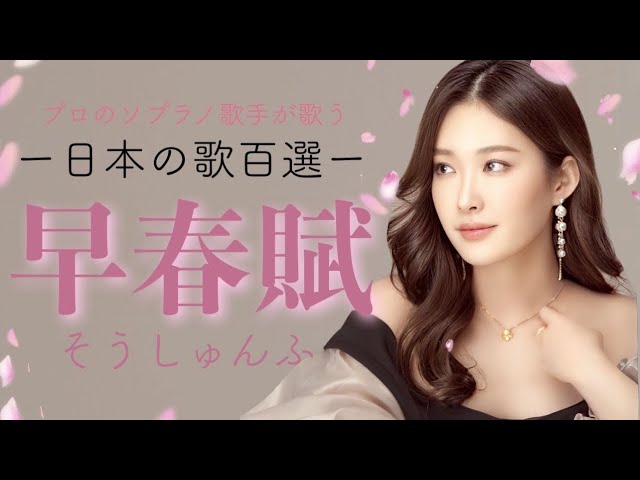
Early Spring Rhapsody is a celebrated song whose lyrics vividly depict landscapes that evoke the arrival of spring.
It portrays scenes from Omachi City in Nagano Prefecture through the Azumino area, letting us sense the lingering traces of winter and the warm promise of spring.
One can imagine the clear air and beautiful scenery spreading out before them.
Selected for the “100 Best Japanese Songs,” it continues to appear in school textbooks as a representative song of spring in Japan.
For many seniors, it is a piece that resonates with fond memories.
It’s best enjoyed at a relaxed pace while savoring the feeling of spring’s approach.
Soda WaterDakki

Since being introduced as the hottest rapper on “Ryūha-R,” Tsubaki—an Okinawa-reppin’ rapper—has skyrocketed in fame.
He’s known for his clearly enunciated, easy-to-catch rhymes.
His track “Soda Water” is included on the album “2 HORNS CITY #1 – MARS DINER -,” which features well-known trackmakers and rappers like Jinmenusagi and Sweet William.
It’s a smooth tune that evokes summer nights.

SorlemToki Asako

Asako Toki, a singer who made her debut as the lead vocalist of Cymbals and has since been active across a wide range of fields including commercial jingles and narration, delivers an impressive opener for her 11th major album, “Twilight,” with the track “Solrem.” Its floating, airy vocals and nostalgic sound leave a strong impression.
The slightly shadowy lyrics—linked to a title that, in Korean, signifies fluttering excitement or an uneasy stirring—create a mysterious atmosphere reminiscent of a summer night.
With arrangements that carry a pop sensibility amid a sense of wistfulness, it’s a track you’ll want to keep listening to.
Sora-buneJōshima Shigeru (TOKIO)

Shigeru Joshima, the leader of TOKIO and one of the most popular members of the Johnny’s groups.
He’s the only one in the group who speaks Kansai dialect, as he’s from Nara Prefecture! He joined Johnny’s while still in high school and later formed TOKIO.
He had been playing the guitar even before forming TOKIO, and his skills are top-notch.
On variety shows and the like, he comes across as gentle, a bit clumsy, and very approachable, but the moment he picks up a guitar, he suddenly looks sharp and super cool!
