
[March] A curated selection of classic marches and dazzling crowd-pleasers for concerts!


A march is a type of musical piece for marching.
In everyday settings, it’s often used as background music for parade-style processions at school sports festivals.
Originally, marches were performed for military parades and ceremonial occasions such as weddings and funerals.
When we think of marches, we often picture powerful percussion rhythms and bright, brassy melodic lines.
However, there are also pieces known as concert marches—written for performance in concert settings—that are characterized by an elegant, beautiful atmosphere.
In this article, we’ll introduce a variety of marches all at once, and we hope it will help you choose background music for processions or select repertoire for concerts.
- [March] Carefully selected popular songs recommended for entrance and exit at sports days and athletic festivals!
- Perfect for free selections and concert programs! Introducing famous and classic favorites in wind ensemble music.
- A classic brass band medley
- [Sports Day] Entrance songs that will hype the crowd! A comprehensive roundup from classics to the latest hits
- [History] A roundup of popular set pieces from the All-Japan Band Competition
- Songs with cool trumpet. Introducing famous pieces from wind ensemble and jazz.
- [Brass/Wind Band] Recommended for Beginners! A Collection of Classics and Popular Pieces Perfect for Practice
- [Wind Band] Guaranteed to hype up the school festival! Recommended pieces the brass band will want to play
- [Japanese Military Songs and Marches] A collection of famous Japanese pieces deeply etched in the hearts of the Showa and wartime generations
- Recommended pieces for a wind band contest
- Top Songs to Hype Up Sports Day and Athletic Festivals [2026]
- A collection of video game music I want to perform in a wind ensemble
- [March] A selection of famous march masterpieces played on the piano!
March: Carefully selected classics of marches and dazzling pieces popular in concerts! (31–40)
Album for the Young, Op. 68 No. 2: “Soldiers’ March”Robert Schumann

A bright, lively piece that conjures up soldiers marching in step right before your eyes! The second piece from “Album for the Young,” Soldier’s March, is built from a succession of chords and dotted rhythms.
You may find it challenging to play all the notes of each chord together evenly, but with slow, careful practice you’ll be able to catch every note solidly.
To internalize the buoyant rhythm, it’s also recommended to incorporate clapping or tapping out the rhythm into your practice!

March “Ramses II”Abe Yuichi

An exotically flavored work by wind band composer Yuichi Abe, themed around the great kings of ancient Egypt.
The brilliant fanfare that opens the piece and the heroic sonority of the horn section that follows are striking, vividly portraying the Pharaohs’ overwhelming majesty and their grand historical saga.
Selected as a required piece for the All-Japan Band Competition in 1995, it is also known for having challenged many players.
For those who have competed, many may have special memories tied to this work.
Though demanding, it is a piece that allows performers to fully showcase their abilities.
Perfect for bands aiming to captivate audiences with a sweeping, dramatic performance.
March “Patriotism”Saitō Ushimatsu

This march, with a powerful wind band melody ringing out, was composed by Ushimatsu Saito in December 1937 for the Navy Band.
Its dignified, weighty atmosphere and the solemn lyrical melody of the middle section are beautifully balanced, and its high level of craftsmanship led to its selection as an official piece jointly adopted by the Navy and Army.
An SP record was released at the time by Polydor, featuring a performance by the Imperial Japanese Navy Band under the baton of Seigo Naitō.
From the wartime period through the postwar years, it was widely performed at ceremonies and events throughout the Asia-Pacific region and became familiar to local audiences in places like Indonesia and Palau.
The trio section incorporates Tokichi Setoguchi’s nationally beloved song “Aikoku Koshinkyoku” (Patriotic March), the composer also known for “Gunkan March.” This is a must-hear for those who wish to savor the rich sonorities and solemn melodic beauty of wind band music, as well as for anyone interested in the history of Japanese military music.
Olympic MarchKoseki Yūji
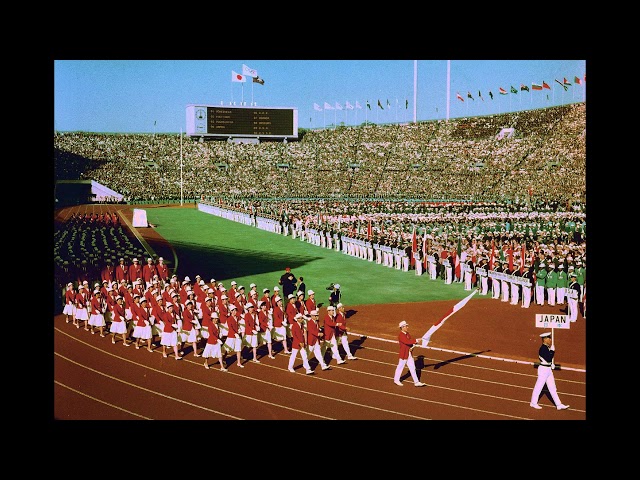
Composed for the 1964 Tokyo Olympics, this piece was also featured in NHK’s 2020 morning drama Yell.
Its crisp, lively melody gives it the refreshing character of a true march, which is part of its appeal.
It’s also a great choice for school sports days, with the brass band playing as they march.
Incidentally, the ending section incorporates an arranged version of the final phrase of Kimigayo, reminding us that this is a piece created for a nationwide celebration of sport.

Young powerShinichi Takada

This is a classic sports day staple that everyone in Japan knows, created during the postwar reconstruction period.
Composed by Shinichi Takata as a sports song to enliven the National Sports Festival venues, it is notable for its bright and powerful melody.
At the second National Sports Festival held in Kanazawa in October 1947, about 4,200 sixth-grade boys and girls performed a group routine to this piece, captivating the audience.
Since then, it has been widely loved as background music for school sports days and athletic festivals across the country.
With an up-tempo beat that makes you want to run, it was also used at the opening ceremony of the 2020 Koshien High School Baseball Exchange Games.
Highly recommended if you’re looking for a march for sports days or a lively piece for group performances.
[March] Carefully Selected Classics of Marches and Brilliant Pieces Popular at Concerts! (41–50)
Festive MarchDan Ikuma

This march was composed in 1959 to celebrate the marriage of the then Crown Prince.
Although it was not performed during the wedding parade known as the Parade of the Century, it has since been played at subsequent events and used as background music on television programs, making it a piece many people are likely to have heard.
It begins with a fanfare that is both powerful and refined, followed by smooth woodwind passages and brilliant brass phrases that are beautifully crafted and evoke a sense of elegance.
Seventy-six TrombonesMeredith Willson

The march that appears in American composer Meredith Willson’s signature musical, The Music Man, is “Seventy-Six Trombones.” It opens with a lively rhythm from snare drum and bass drum, followed by a bold theme played by the trombones.
There are arranged versions that incorporate melodies from various marches such as “The Stars and Stripes Forever” and “The Washington Post.” In Japan, the arrangement by Naohiro Iwai—who was a composer, arranger, and conductor—is particularly well known.
