

[Origami] Simple Origami Folding Ideas to Savor Spring with 5-Year-Olds

Origami is one of those activities that nurtures dexterity in the fingers and boosts concentration, positively supporting children’s healthy development.
By the time children are five, the range of things they can make with origami increases dramatically, so it’s great to incorporate an environment in childcare where they can freely create anytime.
Here, we’re sharing spring-themed origami ideas for five-year-olds.
We’ve included plenty of fun folding instructions featuring springtime flowers, insects, and seasonal foods.
Add little twists—like drawing on what you made or adding stickers—to expand the play, and make good use of these ideas for spring crafts.
- [Origami] Easy spring-themed origami ideas to enjoy with 4-year-olds
- For 5-Year-Olds: Let’s Make It! A Collection of Craft Ideas to Feel the Spring
- [Origami] Simple Origami Ideas to Feel the Spring with 3-Year-Olds
- [Kindergarten (older class)] What kind of season is March? Let’s make events and natural objects with origami!
- [Childcare] Simple origami ideas for kids, perfect for spring
- Origami Butterfly Ideas That Are Easy for 3-Year-Olds
- [For 5-year-olds] Let's make it in April! A collection of craft ideas using recycled and natural materials
- [For 4–5 year olds] A collection of recommended origami ideas for March—featuring seasonal events and natural motifs
- [For 4-year-olds] Let's fold! A collection of simple rabbit origami ideas
- [For preschoolers] A collection of origami ideas to enjoy February, including Setsubun and Valentine’s Day
- [For 5-year-olds] Picture Books to Read in Spring | Let’s Explore Different Worlds with Children
- [Childcare] A roundup of easy summer origami ideas to enjoy with 5-year-olds
- [Childcare] Make it in April! Recommended easy origami folds
[Origami] Simple spring-themed origami ideas to enjoy with 5-year-olds (61–70)
How to make a 3D dandelion
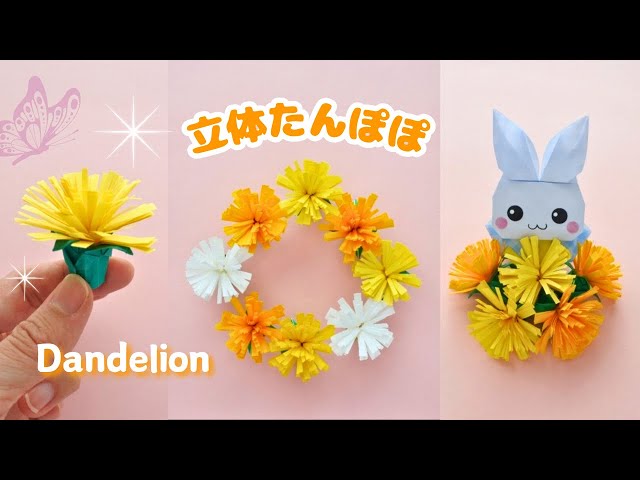
Here’s an idea for a softly rounded, three-dimensional dandelion finished by curling it up.
One of its charms is that it can be made with simple materials.
Fold a sheet of origami paper in half, make fine cuts, then roll it up tightly.
Fold another piece of origami into a diamond shape and open it outward to create the base for the petals.
Apply glue to attach them, and gently spread the petals to complete a three-dimensional flower.
Using different shades of yellow makes it even more vibrant.
The instructions are easy to follow, making it a project that people of all ages can enjoy together.

Cute when lined up! Dandelion origami

Let’s make an origami dandelion, like the cute ones that peek out along roadsides in spring.
Fold the origami paper in half, then fold both sides toward the center crease.
Fold it again along the center line, then open it slightly, puff it up, and gently squash it into a triangle, aligning the tips so they don’t shift.
For the flower, carefully form the petals with your fingertips, making sure the overall shape and size are even.
Be careful when making slits with scissors.
Once you make the stem and leaves with green origami paper, it’s complete.
It’s also great for decorating walls.

rabbit

This is an origami rabbit, a classic cute animal! First, crease the paper along the diagonal, then fold up the bottom edge by about 1.5 cm.
Turn it over and fold up the part you just folded once more, then fold both sides toward the center line.
To round the face, fold the bottom and side corners inward, and bend the tips so the ears match in shape.
Flip it to the front, fold the top corner of the face to the back, and draw the eyes, mouth, and cheeks to finish! Once you’ve mastered making this adorable rabbit, you’ll probably want to try all kinds of other animals too.

bamboo shoot

Let’s make bamboo shoots—one of the ingredients that come into season in spring—out of origami! First, crease the paper with a cross (horizontal and vertical).
Fold each side edge to the center line and open it back up.
Fold the bottom edge up to the nearest crease.
Turn the paper over, rotate it upside down, and fold the bottom edge up to the topmost crease.
Continue folding to mimic the overlapping layers of the bamboo shoot’s skin, and your origami bamboo shoot is complete.
If there are children who’ve only seen bamboo shoots in picture books or as part of their meals, making one with origami might help them better imagine its real shape.
asari (common orient clam)

Let’s make a familiar seashell! Here’s a fun clam (asari) craft idea.
You’ll need origami paper in your favorite colors, glue, and a pen.
When you think of asari, you picture that bumpy texture and a mix of colors like black and brown, right? The key point of this idea is expressing that bumpy design using accordion-fold creases.
It’s also great to let kids draw the patterns freely! It could be interesting to explore the features and appeal of asari together with the children before and after the craft activity.
dandelion

This is an origami dandelion that evokes the arrival of spring.
Take a sheet of origami paper cut in half, make fine accordion folds, and round off the corners.
Make two identical pieces, fold each in half and glue, then attach the two together.
Fan them out into a radial shape and adjust the form to complete the flower portion.
Finally, glue the origami leaves and stem to the flower to finish the dandelion.
Although the flower looks intricate, it’s actually very simple—just repeated accordion folding! Let children work within a comfortable folding range and create a lovely result.
horsetail

Let’s make horsetail shoots, which you can only find in spring, using origami! Cut a sheet of origami paper into thirds, then fold one of those strips into thirds again.
Fold back the top section along the top crease to create the head of the horsetail.
Next, fold the strip vertically into thirds to make it narrower, and then create a few stepped folds to suggest the “hakama” joints of the horsetail.
After that, leaving the head intact, fold the brown section so it gradually becomes thinner.
Round off the corners of the head to make it look more natural, draw the horsetail’s patterns, and you’re done! For the finer details, it may be easier if you look at a picture of a horsetail and fold while imagining things like, “Would this thinness be about right?”