


What Is Code? The Basics of Readable Code

This time, I’ll introduce one of the most essential elements in composition: chords (harmony).
By learning this basic form, you’ll be able to apply it in many different ways.
What is code?
To begin with, what a chord is can be described as “several different notes sounding at the same time.”
Broadly speaking
- major chord
- minor chord
- Augment code
- minor flat five chord
can be divided into
Let's take a look at them one by one.
major chord
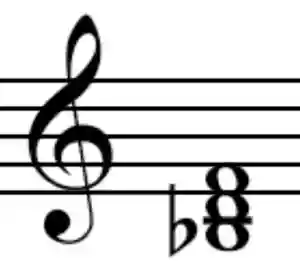
If we represent the chords in sheet music, it looks like this.
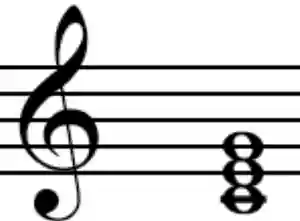
In this way, the code basically forms by stacking up in a dumpling-like clump.
By the way, the lowest note of a chord (here, the note C) is the fundamental note of the chord, so it’s called the root note, or simply the root.
Many of you may find the route sounds familiar.
The middle note (E) is called the 3rd, and the top note (G) is called the 5th.
There are various ways to make codes, but this time I’ll introduce a method that uses scales.
Please also make use of the scale article I previously wrote.
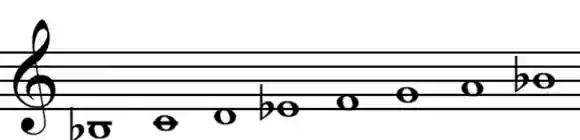
Now, let’s first try creating a C major chord using the C major scale.
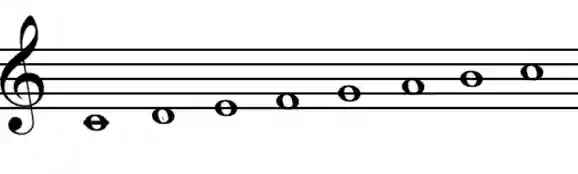
Pull out the 1st, 3rd, and 5th notes from the C major scale and stack them.
That's all there is to it.
This completes the C major chord.
This idea applies to all major chords.
If you want to build a D major chord, take the 1st, 3rd, and 5th degrees of the D major scale; if you want to build a B-flat major chord, take the 1st, 3rd, and 5th degrees of the B-flat major scale. Stack them, and you can make the chord easily.
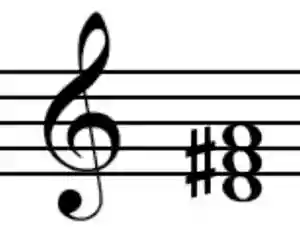
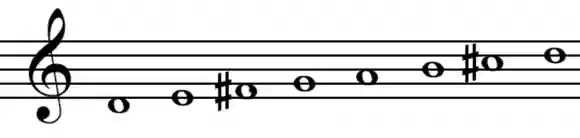
In sheet music, a major chord is
- C
- C△
- Cmaj
There are various notation methods, among others.
Major chords have a bright sound.
Please try using an instrument at least once to let the sound settle into your body.
minor chord
A minor chord is a major chord with its third lowered by a half step.
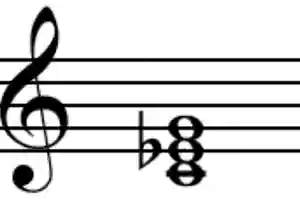
In other words, once you learn how to build major chords, you can easily create minor chords as well.
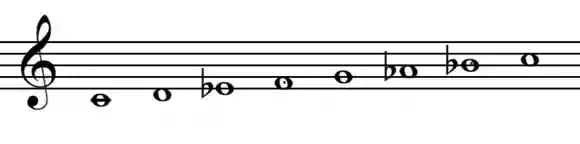
Another way to do it is to pull out the 1st, 3rd, and 5th notes of the minor scale and stack them.
It’s the same procedure as making a major chord.
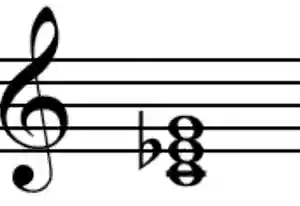
The notation for minor chords is
- Cm
- C-
and so on.
Minor chords have a dark sound.
Please be sure to try this on an instrument as well.
Augment code
An augmented chord is a major chord with its fifth raised by a half step.
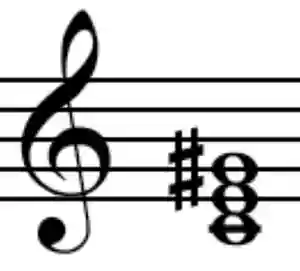
This chord has a much more unstable sound compared to major and minor chords.
It’s also rarely actually used in songs.
As one of the few examples of use
The Beatlesof "Oh! DarlingThe very first chord in “Oh! Darling” is an E augmented chord.
How is it? It has a strange ring to it, doesn’t it?
Translation
- Caug
- C(#5)
- C+
and so on.
minor flat five chord
This is a minor chord with its fifth lowered by a semitone.
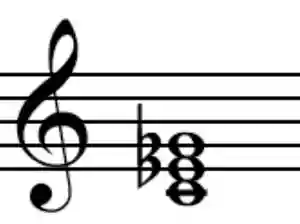
This is also rarely used, and there are hardly any examples of its usage.
It’s almost always used as a seventh chord when it’s used.
Like augmented chords, the sound has an unstable quality.
Translation
- Cm(♭5)
- C-(♭5)
and so on.
sus4 chord
One unusual chord is the sus4 chord.
When you build a major chord, it’s formed by stacking the 1st, 3rd, and 5th notes of the major scale, but here you stack the 4th note instead of the 3rd.
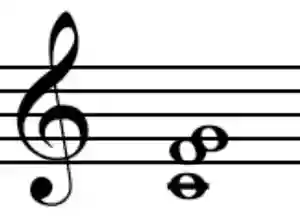
It’s rarely used on its own and is typically used in a progression like Csus4 → C.
Translation
- Csus4
Basically, just this.
Lastly
The basics of the code are these five.
If you can fully understand these,7th chordand/or; such as; or (used to list examples)tension codeI think things like that will also be easy to understand.
And be sure not to forget to check it by listening to it.