

Beginner Piano: Carefully Selected Easy and Famous Pieces You Can Play with One Octave

Have you ever thought, “I want to try playing the melody of a song I know on the piano!”?
Not just on the piano—being able to casually play a famous tune on any instrument is pretty cool, right?
In this article, we’ll introduce plenty of pieces whose melodies stay within a single octave, making them easy for piano beginners to play.
If a song has a narrow range and few large leaps, beginners can absolutely master it by practicing slowly and calmly.
Once you get used to it, you can add left-hand bass notes and challenge yourself to play with both hands!
We’ve collected famous songs you can practice by ear even if you can’t read sheet music perfectly, so pick your favorites and give them a try!
- [Disney] Playable even if you’ve just learned Do-Re-Mi! A selection of iconic songs from beloved Disney animations
- [For Kids] Play Piano with One Finger! Recommended Songs Collection
- [Anisong] Easy for Piano Beginners! Recommended Practice Pieces
- Even beginners can play them easily on the piano! A curated selection of popular and latest J-POP songs.
- [For Beginners] Recommended Ghibli Masterpieces You’ll Want to Play on the Piano
- [Piano Sheet Music] Free downloads available! A roundup of easy-to-play pieces
- [Beginner] Start Here: Classic Practice Pieces Recommended for Adult Piano Beginners
- [Piano Beginners] J-POP That Looks Hard but Is Surprisingly Playable [2026]
- Disney Classics on Piano: A Curated Selection of Easy Pieces, Perfect for Recitals
- [Children’s Song] Easy Even for Piano Beginners! Introducing Nursery Rhymes with Simple Chords
- [Easy to Play Even If You're Not Good with Both Hands!] Simple piano pieces for absolute beginners. Recommended piano songs.
- [Piano Pieces] Easy for Children to Play! A Roundup of Simple Classical Works
- [For Piano Beginners] Play Right Now with Free Sheet Music! A Roundup of Recommended Practice Pieces
Beginner Piano: Songs You Can Play with One Octave | A Curated Selection of Easy & Famous Pieces (11–20)
Lullaby, Op. 49 No. 4Johannes Brahms
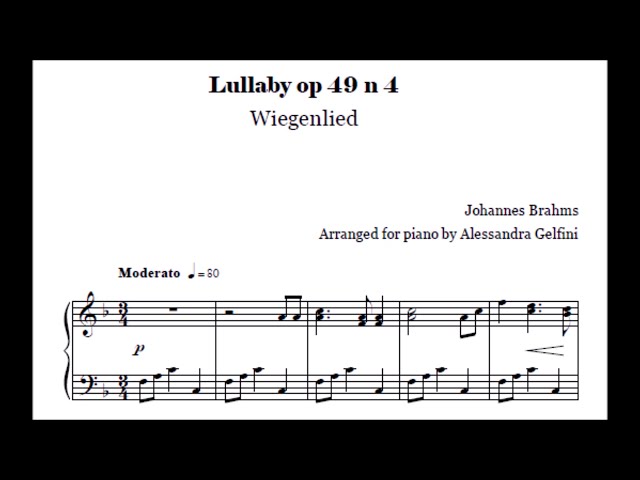
Among classical works, there are several pieces that bear the title “Lullaby.” Among them, alongside those by Schubert and Mozart, one of the most famous is Johannes Brahms’s “Lullaby, Op.
49 No.
4,” widely known as “Brahms’s Lullaby.” Its gentle, sparsely noted melody—typical of lullabies that lull children to sleep—is easy to play on the piano, making it perfect for beginners.
However, precisely because it is simple, the beauty of tone and flow becomes crucial.
Let’s aim for a soothing performance that helps listeners feel at ease and drift off to sleep.

hometownOkanoteiichi

“Furusato,” composed by Teiichi Okano, is arguably a children’s song that symbolizes Japan.
Its simple, beautiful melody—familiar to every Japanese person—fits within a single octave, and the rhythm is straightforward, making it approachable even for beginner pianists.
Even if you can’t read solfege, if the melody is ingrained in your body, you can learn key positions by actually producing the sounds as you go.
Once you’ve mastered the melody, try adding a bass line or simple accompaniment and challenge yourself to play with both hands!
Silent NightFranz Gruber

“Silent Night” is a Christmas carol composed in 1818.
Loved around the world as a classic Christmas song, it was inscribed in 2011 as an element of intangible cultural heritage in Austria, the composer’s birthplace.
Its simple yet moving and beautiful melody fits within a single octave, making it easy for piano beginners to try.
Aim to convey a quiet, calm atmosphere on the piano by playing gently and softly.
Once you’re comfortable, try adding the left-hand chords and challenge yourself to play with both hands.
The One and Only Flower in the WorldSMAP

SMAP’s classic “The Only Flower in the World” continues to captivate many with its heartwarming melody and lyrics.
The chorus melody fits within the range of one octave and can be played with minimal hand movement, making it approachable even for piano beginners.
Because the syncopated rhythms can look a bit complex on the score, it’s recommended at first to practice not so much by strictly following the sheet music, but by playing it on the piano as you remember the song’s melody—capturing it by feel.
Buzz buzz buzzBohemia min’yo

“Buzzy, Buzzy” (a Bohemian folk song) is a familiar practice and recital piece for piano beginners, especially children who have just started playing.
Regardless of prior musical experience, there are probably very few people who don’t know this melody.
Because the tune is simple and stays within a single octave, it’s easy even for beginners to play.
Even if you haven’t fully learned the note names yet, you can comfortably master it by following the sounds by ear during practice and playing it repeatedly while singing along.
If you perform it at a recital, playing it as a duet with accompaniment will make it sound even more impressive.
Children all over the worldicchī・naru

This song carries a wonderful message: that children’s smiles and tears have the power to change the world.
Its bright, rhythmic melody and lyrics that sing of a child’s pure heart are striking.
The warm vocals of Icchi & Naru make it even more approachable.
Released in July 2022 as a track on an album, it’s also being used in educational settings.
It’s a song that energizes not only children but adults as well.
If the whole family sings and dances together, it’s sure to spread smiles.
A dance video is also available on YouTube, so be sure to check it out!
Beginner Piano: Songs You Can Play with One Octave | A Curated Selection of Easy & Famous Pieces (21–30)
butterflyDoitsu min’yō
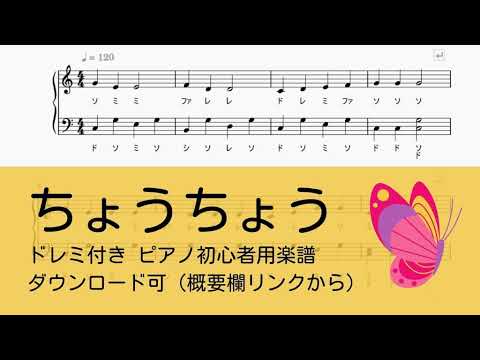
It’s one of the most beloved children’s songs.
The lyrics beautifully depict Japan’s four seasons, and you can easily picture butterflies dancing among the spring flowers.
The melody is simple and easy to remember, and the range is narrow, making it perfect for those touching the piano for the first time.
Since it stays within a single octave, you’ll be able to play it with ease if you practice slowly.
It’s also fun to add bass notes with your left hand and play with both hands.
Feel the arrival of spring and perform freely and relaxed.
This is a recommended piece for anyone who wants to experience Japanese culture or who has just begun learning music.