

[Taro Aso] Exhilarating, sharp-tongued, and cool quotes. Powerful, thought-provoking messages

There are times when politicians’ remarks carry a kind of exhilarating punch that makes you chuckle, aren’t there? In particular, Taro Aso’s famous quotes, with their blunt candor and distinctive humor, have stuck in many people’s memories.
Sometimes they’re so frank that they spark controversy; other times, a sharp, to-the-point line leaves you impressed.
In this article, we introduce some of Taro Aso’s most memorable quotes.
By understanding the true intent and background behind his words, you may gain a new perspective.
Be sure to check them out!
- [Taro Yamamoto] A passionate message that resonates with the heart and conveys humanity
- Shinjiro Koizumi’s quotes that make you do a double take! A slowly-sinking-in collection of uniquely original sayings
- Katsuya Okada’s famous quotes. A collection of words that reveal the true feelings of a politician.
- Akiko Oishi’s quotes are exhilarating—razor-sharp words that make you slap your knee.
- Fiery quotes by Shigeharu Aoyama: words that stay true to conviction
- [Sanae Takaichi] Quotes that reflect conviction and resolve. Powerful words with an eye on the future
- Yoshihiko Noda’s famous quotes: profound words that exude sincerity
- [Yuichiro Tamaki] A passionate message to politics and the people. Memorable, impactful words.
- Satsuki Katayama’s famous quotes: Looking back at the sharp words she delivered in the political arena
- Takashi Kawamura: Distinctive turns of phrase and memorable quotes. Addictive expressions spoken in Nagoya dialect.
- Kazuyoshi Shimba’s fiery quotes: words spoken from the citizens’ perspective
- [Yoshihide Suga] Lessons on Work and Life Mindset from His Notable Quotes: Words That Quietly Stir the Heart
- Exhilarating! A collection of memorable quotes by Haruo Kitamura. Sharp words from a legal professional.
[Taro Aso] Thrilling, sharp-tongued, and cool quotes. Powerful, thought-provoking messages (1–10)
If you look at a rainbow up close, it only looks like droplets of water. It looks like a rainbow because you’re seeing it from afar. In the end, it’s all about angle and distance. That’s why my work, too, can look completely different depending on the angle and distance from which you view it.Tarō Asō
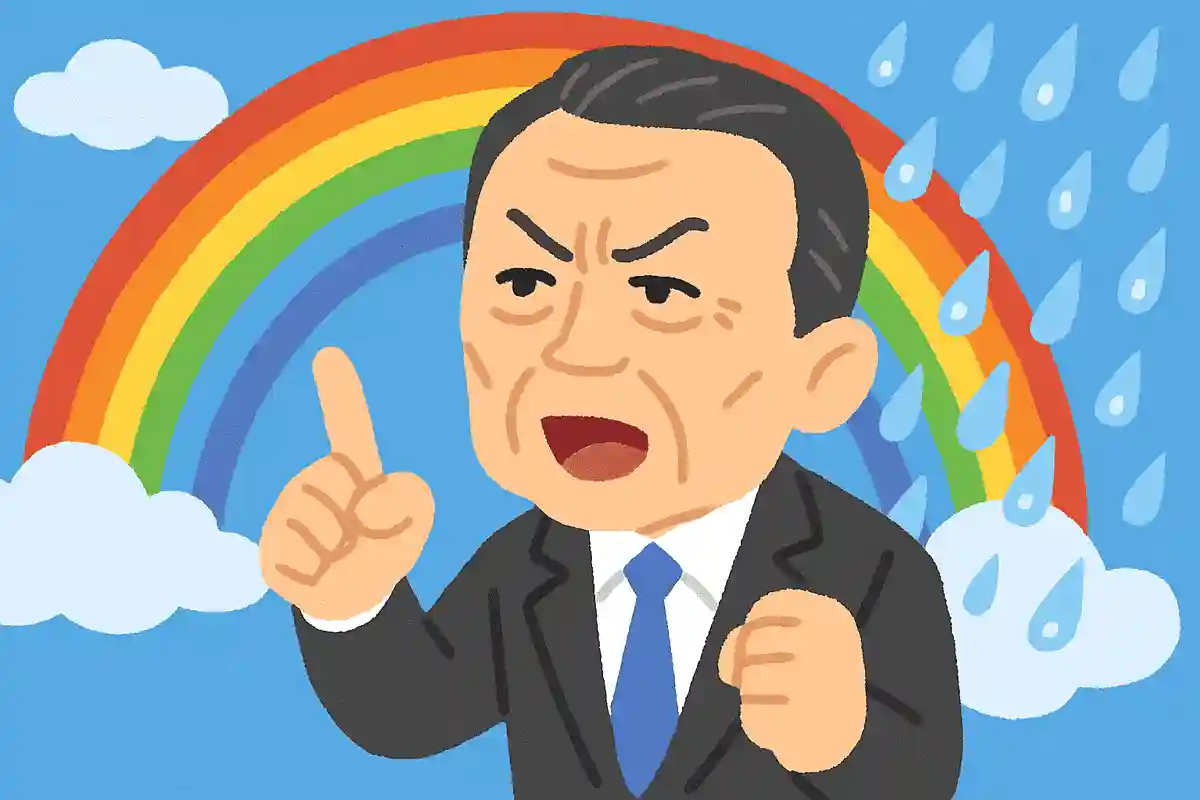
It’s a phrase that vividly expresses how the value of things can change dramatically depending on one’s perspective.
When older adults or people facing various challenges use ICT, and when we consider Japan as a safe, prosperous, long-lived nation, these can feel ordinary from the inside.
But by taking some distance and viewing them from the outside, their value can emerge as clearly as a rainbow.
Work is the same: seeing it from another department’s or role’s viewpoint can reveal its essence.
It teaches us that broadening our perspective opens up possibilities.
It’s a famous saying that clearly explains the importance of perspective.

Not being interested in politics isn’t such a bad thing. It means you’re living well enough that you can get by without paying attention to politics.Tarō Asō

Taro Aso’s words paradoxically illustrate the distance between politics and everyday life.
Being able to remain indifferent to politics is, in a sense, evidence that there is no anxiety in daily living and that a minimum level of security is being upheld.
If politics were not functioning well, people would inevitably be forced to take an interest.
This statement does not endorse apathy; rather, it is an ironic reminder of the value of a stable society.
It makes us realize that the ordinary days we take for granted are, in fact, the result of political outcomes.
These words also prompt us to become aware of the systems that underpin a peaceful life.
Whether you like it or not, the world will make you realize that your actions come with responsibility. That’s what turning twenty is about.Tarō Asō

Taro Aso’s words speak directly to the gravity of turning 20.
While 20 is an age to be celebrated, it is also the threshold at which society treats you as a full-fledged adult.
The reality that if you’re caught shoplifting you won’t be shielded as “Boy A” and your real name will be published means you’re expected to accept the consequences of your actions under your own name.
As your freedom expands, so too does your responsibility—this starkly confronts you with the reality of adulthood.
Beneath the uncompromising tone lies the hope that you will lead an independent life.
It is a stern maxim that calls for resolve and strength of will.
[Taro Aso] Exhilarating, sharp-tongued, and cool quotes. Powerful, thought-provoking messages (11–20)
Working is not a sin.Tarō Asō

These are words with a message that doesn’t make you feel guilty about working.
Work helps someone, keeps society running, and supports your own life.
There is no reason to feel it is a sin.
The reward you earn through effort is legitimate and something to be proud of.
Precisely because we live in an age of excessive self-restraint, these words have power.
A perspective that affirms work itself will lighten many hearts.
It is a memorable quote that straightforwardly affirms the value of labor, filled with passion for one’s work.
We can’t entrust the helm of the nation to someone who isn’t prepared to eat cold rice.Tarō Asō
It speaks directly to the gravity of power and position.
To “eat cold rice” is to accept a period of being unrecognized or to face headwinds.
Those who steer a nation must endure not only praise but also criticism and loneliness.
It confronts us with the harsh reality that one cannot serve with the resolve to step forward only when convenient and withdraw in difficult moments.
It shows that responsibility entails sacrifice and questions the quality of one’s resolve.
It also teaches that a stance that leaves no escape route is what earns trust.
This is a stern maxim that sets the conditions for those who take on heavy responsibility.
It is foolish to harm the national interest for the sake of friendship. I believe that friendship is sustained for the sake of the national interest.Tarō Asō
These words express an attitude that views relations between nations not through emotion but through principle.
Friendship is important, but if it harms the national interest, the priorities are reversed.
There are things that must be protected first, and only on that basis can healthy relationships be built.
Trust arises not from appeasement, but from maintaining an equal footing.
It may seem strict, yet it embodies a realistic judgment with a long-term view of the relationship.
It conveys a strong insistence on the importance of not losing a nation’s core.
It is a steadfast maxim that clarifies a state’s dignity and responsibility.
Grand causes come rolling in later, like loaded freight cars.Tarō Asō

It sharply captures the relationship between ideals and reality.
It holds that a grand cause isn’t perfectly assembled from the start, but takes shape afterward through accumulated actions.
Rather than stopping to seek legitimacy or praise from the outset, it says what matters is to decide and move forward first.
There’s a pragmatic view that meaning and support will naturally gather as you produce results.
These are words that push those who hesitate to act, reflecting a stance that values practice.
It shows that only those who have taken action have reasons they can speak to, a practical maxim that pierces the essence of decision-making.