

Play ballet music on the piano! A curated selection of exquisite masterpieces that color iconic scenes

Ballet, with its dancers in beautiful costumes and their dazzling, elegant movements, is truly captivating.
Beyond the dance itself, the music—essential to the unfolding of each story—is also incredibly appealing, filled with melodies that linger in the memory.
This time, we’ve selected only the most famous pieces from the world of ballet music—masterworks that even those not familiar with ballet have likely heard somewhere.
Alongside piano performance videos, we’ll share the background and allure of each piece.
While ballet music is typically performed by an orchestra, some of the works we’ll introduce here include arrangements for solo piano based on the original ballet scores.
Enjoy exploring the world of ballet while appreciating the differences from the originals!
- [For Elementary School Students] Brilliant, Showy Masterpieces That Sound Impressive at Piano Recitals
- [Intermediate Level] Cool Piano Pieces You Can Play [Great for Recitals Too]
- Masterpieces of Ballet Music: Introducing Classic Favorites
- Masterpieces of classical piano that are too beautiful for words. A gathering of delicate tones that cleanse the soul.
- [Masterpieces of the Waltz] A comprehensive introduction to classic works written for the piano!
- Today's Piano: Masterpieces and Popular Pieces Woven with Delicate Tones
- [Intermediate] Recommended Piano Duets | A Curated Selection of Cool and Dazzling Pieces
- Piano Masterpieces: Surprisingly Easy Despite Sounding Difficult!? A Curated Selection Perfect for Recitals
- [Classical Music] All pieces under 3 minutes! A collection of short and cool piano pieces
- [Low Difficulty] Recommended Tchaikovsky Piano Pieces [Intermediate]
- [Intermediate Level] A curated selection of piano masterpieces featuring strikingly brilliant melodies!
- Poignant and beautiful! A collection of recommended piano pieces
- Sounds awesome on the piano too! A curated selection of masterpieces where the violin takes center stage
Let's Play Ballet Music on the Piano! A Selection of Exquisite Masterpieces That Illuminate Iconic Scenes (11–20)
From the ballet music Ma mère l’Oye: 5. The Fairy GardenMaurice Ravel

Maurice Ravel, one of France’s foremost composers, excelled at expressing in music the world of fairy tales that stirs childhood memories and the imagination.
In particular, his piano four-hands suite Ma mère l’Oye, composed between 1908 and 1910 and inspired by works such as Charles Perrault’s Tales of Mother Goose, is a characteristically delicate and richly colored creation.
The fifth movement, The Fairy Garden, is marked by a beautiful melody befitting the suite’s finale.
The sensuous timbre of the violin evokes the story’s climax, drawing listeners into a fairy-tale realm.
Suggestive of a scene from Sleeping Beauty, this movement radiates a brilliant, fantastical glow worthy of a finale, making it an ideal recommendation even for those new to Ravel’s music.
The Rite of SpringIgor Stravinsky

This work, depicting a pagan ritual celebrating the arrival of spring, revolutionized 20th-century music.
Characterized by complex rhythms and bold use of dissonance, it unfolds with primal, powerful energy.
In the orchestra, the opening bassoon solo employs the instrument’s upper register, creating a distinctive sense of tension.
Although its premiere in May 1913 caused a major uproar among the audience, there also exists a two-piano version by the composer, Igor Stravinsky.
Because it is his own arrangement, the mechanisms of polytonality, harmonic structure, and other architectural elements of each movement become strikingly clear, and today it is widely performed as an important addition to the piano repertoire.
It is highly recommended for those interested in innovations that overturn the conventions of classical music.
Noble and Sentimental Waltzes: No. 1, Modéré (Moderato), G majorMaurice Ravel
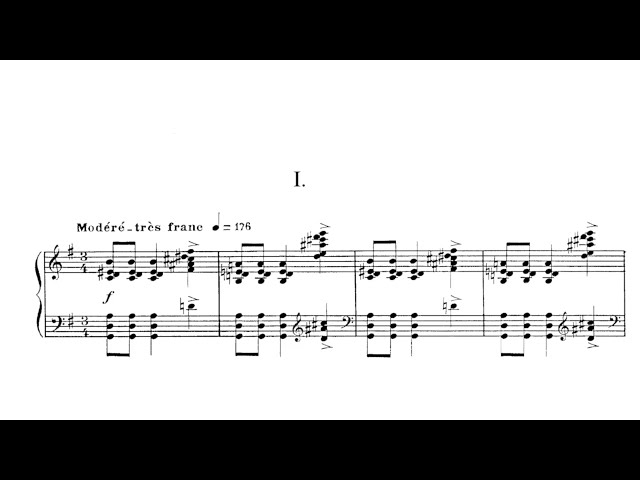
The suite Valses nobles et sentimentales fuses traditional waltz forms with Maurice Ravel’s characteristically modern sonorities.
Its opening piece is graceful yet tinged with melancholy, evoking a curious, elusive mood.
At its premiere in May 1911, the composer’s name was withheld, and the work astonished audiences with its originality.
One can almost picture a glittering ballroom where, amid the dancing, a secret, fleeting thought crosses the heart.
The work is also known in its ballet incarnation as Adélaïde, ou le langage des fleurs.
It’s perfect for those who want to experience the intriguing rhythms and harmonies that overturn conventional images of the waltz.
Aim for a rounded, gentle tone to convey the wistfulness that lies beneath the brilliance.
In conclusion
This time, we featured ballet music that is also popular in piano performance. Many of these pieces are frequently heard on television, in commercials, and at restaurants, so I imagine quite a few sounded familiar. Be sure to enjoy playing them on the piano while savoring the differences from the original orchestral versions.