

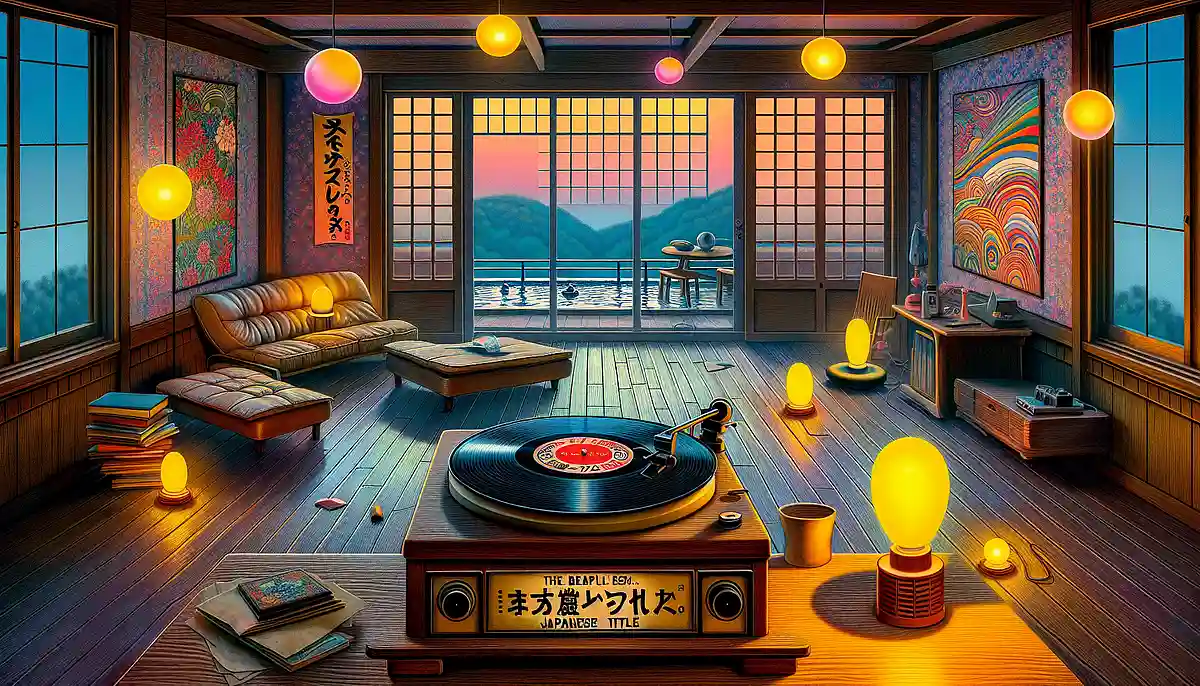
Behind-the-scenes stories about the Japanese titles of Beatles songs

Some Beatles songs have been given Japanese titles.
This time, we’ll introduce some of those that are said to possibly be mistranslations.
Even a single Japanese title can have various stories hidden behind it.
Why did you give it a Japanese title?
Many Japanese titles have been given to works by the Beatles.
There’s a reason for this: back in the 1960s, there were few Japanese people who understood English.
Well, I suppose you at least recognized “She Loves You.”
Even if not understanding the lyrics is unavoidable, you still need to get the title right—whether a record sells or not can depend on it.
Also, if the title is long, people won’t remember it in the first place.
“I Want To Hold Your Hand” — it must have been quite difficult for Japanese people at the time to memorize this, and in the first place, few probably understood what it meant.
ThereforeI want to hold you tight.It was given the title.
If we translate the original title faithfully, it would be “I Want to Hold Your Hand,” but I deliberately paraphrased it because that lacked impact.
Also, there were some parts that didn’t make sense even when translated faithfully.
And that's how it became common to use clear, easy-to-understand Japanese titles.
It’s the same with movies: take the classic film “Bonnie and Clyde.” If you translate the original title faithfully, it becomes “Bonnie and Clyde” in Japanese, but that doesn’t make things clear at all. :)
Since these are personal names, even if you know how to read them, it won’t convey anything to the general public.
So, the film distributor at the time gave it a title like this.
We Have No Tomorrow
This is a really catchy title, and it definitely conveys the film’s image to anyone who sees it.
These days, Japanese people’s English skills have improved quite a bit, so titles are often released as they are. But do you know what the movie title “Frozen” actually means?
If we translate it literally, it would be “Frozen,” but as expected, giving it just a Japanese title would be too bland and flavorless, right? :)
I’m not sure it would have been such a big hit with that title.
And the title that was given there wasFrozenIt is.
Even coming up with a title is a struggle.
Well, for that reason, it was common for Western songs to be given Japanese titles.
However, giving it a title is also quite a difficult task.
It’s not enough to simply understand English; coming up with a title that instantly conveys the content to the general public without undermining the original song’s image isn’t all that easy.
Moreover, you also need to understand things like the country's internal affairs, slang, and jokes.
It makes me appreciate how hard the person in charge had it back then.
So I put a lot of thought into it and gave them Japanese titles, but I ended up mistranslating some of them.
This time, I will introduce that.
Norwegian Wood — the mistranslation of the century!
Huh? Norwegian means 'of Norway' and wood means 'forest,' right?
I think most people are probably wondering, “Isn’t this correct as it is?”
And that, too, fits perfectly with the image of the song.
A vividly mist-shrouded, mysterious Norwegian forest scene comes to mind.
However, this is a complete mistranslation!
After all, Mr. Hiroyuki Takashima—the one who gave it this title (and the father of violinist Chisako Takashima)—has acknowledged it himself.
Wood also has the meaning of 'forest,' but here it is used in the sense of 'lumber' (wood material).
If it were a forest, I would have used 'Forest' instead.
More precisely, it’s “Norwegian-made lumber.”
The melody has a dreamy quality, and the sound of the sitar—an Indian instrument George Harrison played for the first time—is pleasant. The lyrics are also profound, so I suppose it was understandable that I ended up mistranslating them.
If anything, the Japanese title actually conveys the original song’s vibe much better than the original title.
I guess this is what they call a blessing in disguise.
Notably, this title was also used as “Norwegian Wood” for Haruki Murakami’s novel, which was later made into a film.
Mr. Takashima was reportedly delighted, saying it was a mistranslation but still the right answer.
However, the curious thing is why John Lennon gave it this title.
The lyrics had already been completed, but it still didn’t have a title.
And he later said that he himself couldn’t remember why he came up with this title.
Paul McCartney, who helped with this production, said that at the time Peter Asher of the duo group Peter & Gordon was decorating his room with Norwegian wood.
It’s only his conjecture, but at the time it had become something of a trend, and the idea is that John may have unconsciously adopted it.
If this is correct, since the lyrics say the protagonist was invited to a woman's room and talked all night, the closest translation would be “a room decorated with Norwegian wood,” but that has no poetic nuance, does it? (^_^;)
Roughly speaking, even the title “Norwegian Wood” itself is a bit unnatural.
There’s another theory: during the Beatles’ early days at the Cavern Club, a female fan who had traveled to Norway gave John a souvenir doll as a present.
And it was a bizarre thing too—it was a figurine of a man sitting on a toilet.
John, upon receiving it, asked, "What’s this? Norwegian Wood?"
However, this is a true story, but it happened three years before this work was produced, and it's doubtful whether John even remembered such a trivial exchange.
John himself has not said anything about this theory.
Ah, there was another theory.
There’s a theory that John’s original lyrics were “knowing she would,” but after being told that this could be misunderstood as implying John cheated, he quickly changed the line on the spot.
Sure, the rhythm fits perfectly, but I'm not so sure about it...
Alternatively, there’s also the theory that when Ringo Starr first heard the lyrics, he misheard “knowing she would” as “Norwegian wood,” and John thought it was funny and decided to use it.
At this point, I don’t even know what’s true anymore (^^;).
Paraphrase or mistranslation? — The Beatles Are Coming: Yeah! Yeah! Yeah! (A Hard Day’s Night)
The official line is that this wasn’t a “mistranslation” but rather a “liberal translation.”
But everyone, don't you feel that something is off?
Even if it’s a loose translation, the original title and the Japanese title are way too far apart, aren’t they?
Also, what does 'Yeah! Yeah! Yeah!' mean?
It makes no sense.
“Yeah! Yeah! Yeah!”—well, the Beatles used to sing that all the time, so I can still understand that.
Actually, the person who gave it this Japanese title was the late Mr. Haruo Mizuno, who was famous as a film critic.
Mr. Mizuno was an employee of the film’s distributor at the time and was also responsible for giving it a Japanese title.
This is one of them, too.
The reason suspicion arises as to why this isn't a mistranslation is that around the same time, a film titled 'The Beatles Come to Town,' which recorded their 1963 Manchester performance, came in.
Here is the poster.
If you translate this title, “The Beatles Comes to Town,” it fits perfectly as “The Beatles are coming to town!”
What's more, the posters from that time clearly say 'Ya! Ya! Ya!'
If it were just the first half, maybe, but since they even politely included the interjection “Ya! Ya! Ya!”, there’s no doubt about it.
There’s a suspicion that Mr. Mizuno may have mistakenly given it a Japanese title by confusing it with this.
At the time, Japan was still quite unfamiliar with circumstances overseas and had only very limited sources of information.
I think Mr. Mizuno, without a moment’s hesitation, simply used the Japanese title as-is.
They probably couldn’t even take the time to carefully verify their sources amid all the chaos.
It wasn’t a time when you could just casually make international phone calls.
This Japanese title was used across all kinds of media, including tickets, posters, advertisements, and magazines.
They must have realized the mistake after a while, but since they've already spent a large amount on expenses, it's too late to correct it now.
So my guess is that they decided to just pretend they didn’t see it and go ahead as is.
In this way, while some argue it was a mistranslation, there are also those who praise it for aptly capturing how Japanese fans felt at the time.
Therefore, the truth remains in the thicket (i.e., remains shrouded in mystery).
If Mr. Mizuno had seen the correct title, “A Hard Day’s Night,” I’m curious how he would have titled it in Japanese.
After all, the Japanese titles he gave to foreign films are all wonderful.
“For a Few Dollars More,” “The Great Escape,” “Bonnie and Clyde,” “The Longest Day,” “Rambo”...
And if you can believe it, in the case of Rambo, the original title was changed to the Japanese title, and Mr. Mizuno was presented with a letter of appreciation.
However, as expected, this 'The Beatles Are Coming' is no longer used these days, and it has become common to write it as 'A Hard Day’s Night.'
Japanese titles were actively given only up through the Beatles’ early period, and once they entered their later period and had become a major presence in Japan as well, such titles were applied less frequently.