

[Care Facility] Exercise activities everyone can enjoy: improve physical function, relieve stress, and help prevent dementia

Because exercise activities are a staple in care facilities, it can be hard to decide what content to include.
In this article, we introduce a variety of exercises that involve moving the body to familiar music for older adults, using props, and incorporating brain-training elements.
All activities can be enjoyed safely while seated, making them accessible to everyone and full of ideas that promote mental and physical refreshment and help maintain health.
Please make use of these ideas when planning exercise activities that older adults can enjoy comfortably and without strain!
- Summary of exercises for seniors: introducing preventative care movements by body part.
- Recommended simple exercises for recreational activities for the elderly
- For Seniors: Fun and Lively Exercise Recreation
- [Seated] Fun Health Exercises for Older Adults and Seniors
- [For Seniors] Simple Rhythm Exercises: Recommended Songs and Routines
- [For Seniors] A Collection of Fun Classic Caregiving Activities
- [For Seniors] Fun Exercises You Can Do While Seated
- [For Seniors] Rehabilitation exercises targeting each body part: Introducing easy routines you can incorporate without strainNEW!
- [Care Facilities] A Sports Day Activity Guaranteed to Get Everyone Excited! Classic Events and Seated-Participation ActivitiesNEW!
- For seniors: Enjoyable exercises done while seated, accessible for wheelchair users.
- [For Seniors] Stretching Exercises: Easy and Safe to Do
- [For Seniors] A Collection of Simple Exercise Programs Suitable for Beginners
- [Care Facility] Music Activities that Spread Smiles: Ideas for Large Groups to Enjoy, including Instrument Performances, Intro Quizzes, and RoundsNEW!
[Care Facility] Exercise activities everyone can enjoy: improve physical function, relieve stress, and help prevent dementia (1–10)
Kickboxing exerciseNEW!
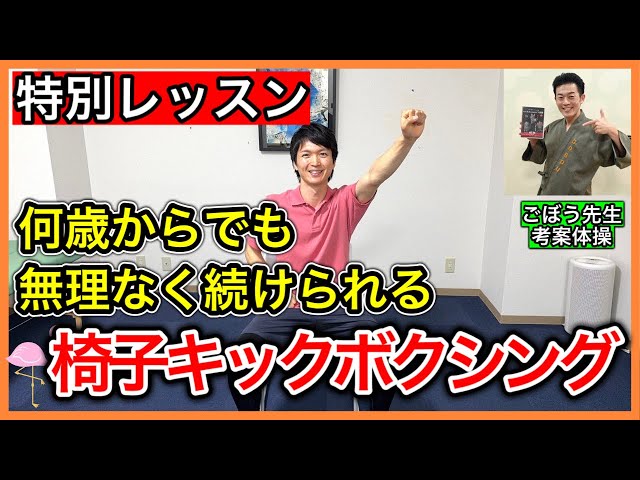
Here’s a seated “kickboxing” routine.
First, relax your shoulders by lifting them alternately left and right.
Next, raise both arms in front of your chest and do straights and body shots.
Extend your fists straight forward twice on each side.
Then continue with hooks and uppercuts, and this time perform all four moves in sequence.
After moving the upper body, it’s time for the lower body.
Move your legs with knee lifts and knee circles, then follow with low kicks and middle kicks.
Finally, try combining hand and leg movements.
You’ll get a solid full-body workout.

Rhythmic gymnastics with balls and castanetsNEW!

Let’s enjoy rhythmic exercises by stomping your feet to the beat and moving a ball up and down.
Because you move your body while engaging the senses—like hearing and sight—it’s also perfect for brain training.
If you’re doing it with a large group, you can vary the colors of the balls participants hold and have them exercise in turn to cues like “blue ball” or “pink ball.” Like a dance event at a sports day, it can create a sense of unity and make it more fun than simply doing exercises.
It might also be nice to have the older adults themselves keep the rhythm with castanets.
Preventive care Soran-bushi exerciseNEW!

Just listening to the Soran Bushi fills you with energy, doesn’t it? Many of you probably danced it in elementary school.
This “Soran Bushi Exercise” can be done while seated in a chair, so feel free to try it safely.
The choreography includes poses that mimic rowing a boat and movements inspired by waves.
Since it’s also intended for caregiving prevention, it incorporates opening and closing the legs partway through, as well as opening and closing both hands.
Recall your childhood and dance powerfully.
But please don’t overexert yourself!
[Elder Care Facility] Exercise Recreation That Everyone Can Enjoy: Improves Physical Function, Relieves Stress, and Helps Prevent Dementia (11–20)
Exercise with singing to Showa-era classics

This is an exercise done while seated, moving your body slowly yet deliberately to various classic Showa-era songs.
For “March of 365 Steps,” use big hand movements and marching steps; for “North Country Spring,” switch to finger exercises—change the movements with each song.
As the songs change, the size of the movements will also change, so it’s important to stay mindful of which part of the body to focus on.
While enjoying the rhythm of the music, the most important thing is to concentrate on moving each specific part of your body.

stick exercises

This exercise is done seated in a chair using a stick.
It includes movements that use grip strength by briefly letting go of the stick while moving it up and down, as well as throwing the stick straight sideways with both hands to train arm balance.
Keep your shoulders relaxed while you do it.
As you get used to it, try tossing the stick from your right hand to your left, and add more challenging movements.
This routine can improve upper-limb muscle strength and expand joint range of motion.
Stepping Brain-Training Exercise

This is a “marching brain-training exercise” that’s perfect for preventing falls.
Start with simple marching.
March in place while counting numbers aloud, and add a handclap on certain numbers.
It’s simple, but it engages both your body and your brain.
If you make the target numbers multiples of three, for example, it gets a bit more challenging.
It becomes more and more fun when done as a group, so it’s great for recreation.
Having someone stand at the front to demonstrate will help things go smoothly.
Donpan Exercises

Let’s try a health exercise called the Donpan Taiso set to a folk song.
Compared to pop and kayōkyoku, it has clearer melodic contours and a progression that even the elderly can easily remember, the tempo is slow so they can keep up with the speed, and many older people love folk songs.
For these reasons, it seems more familiar than dancing to trendy J-pop.