

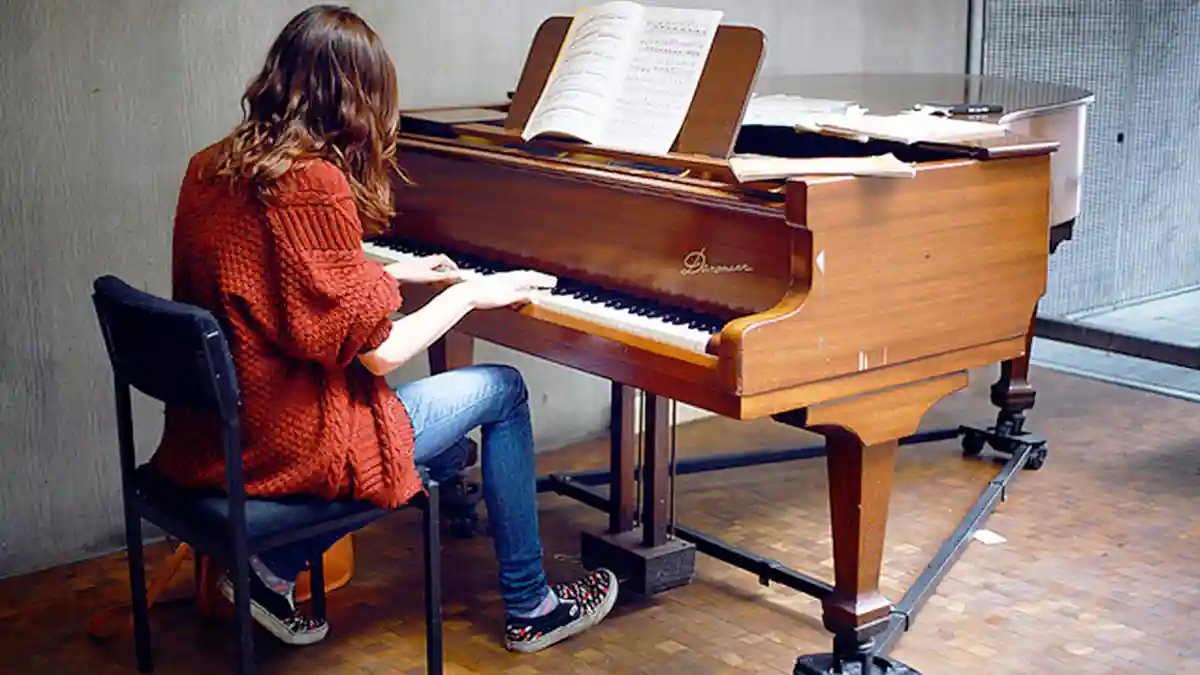
Master the Nursery Teacher Exam Songs! Tips for Playing “Katatsumuri” and “Obake Nante Nai sa”

This time, in 2016Nursery Teacher ExaminationI will talk about how to practice the assigned songs “Katatsumuri” and “Obake Nante Nai sa.”
We will focus on tips for playing the piano and introducing sheet music, so if you have the childcare worker certification exam coming up, please use this as a reference.
Songs for the nursery teacher certification exam
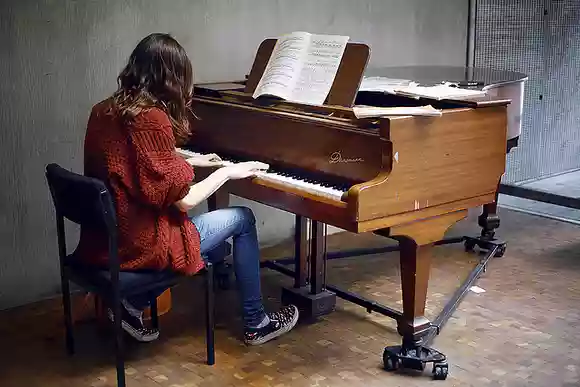
Perhaps as part of measures to address the declining birthrate, it seems that the childcare worker certification exam is now held twice a year, and one of the practical exams among them is "singing while playing an instrumentThere is something called “”.
Assuming it will be sung to young children, you will sing and play the two assigned songs with accompaniment on either piano, accordion, or guitar.
In “hiki-uta” (singing while playing), you have to sing while playing the melody.So, while it’s a bit more difficult than just playing chords and singing, you’re simply adding piano in the form of a piano solo using chords (right-hand melody + left-hand chords).
Even if you think it’s not related to the childcare worker exam, please do learn how to play piano solos using chord notation.
Since the nursery teacher exam involves singing while playing an instrument, the singing is important, so aim to play in a simple way.
2016 Nursery Teacher Examination assigned song: “Katatsumuri”
Left hand on the chords
First, practice with one hand.
Let's basically practice with the left hand focusing on the chords.
This time it’s in D major and only uses two chords, D and A, so even beginners should be able to play it right away.
Please remember how to play the chords in an easy way.
Reference:How to play piano accompaniment using simple chords
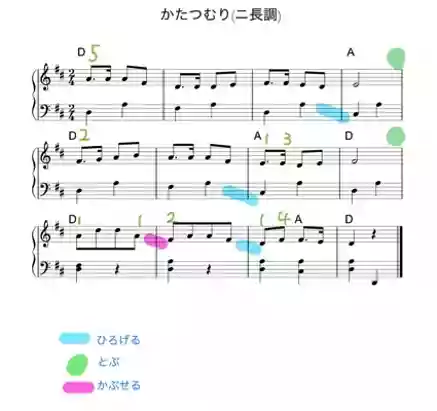
As you can see from looking at the sheet music, it’s basically playing D (re–fa–la) and A (la–do♯–mi) in various forms.
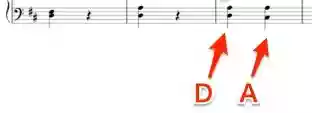
At the beginning, the D is played separately as “re–la,” but in the latter half it’s changed to a chord played simultaneously.
Once you’ve learned the code, try thinking for yourself and modifying it like this.
The key with the right hand is shifting finger positions.
Now, regarding the right hand, please pay attention to the initial placement of your fingers.
The key is the movement of the position.
It’s important to be mindful in advance of your finger technique, especially “spreading,” “jumping,” and “covering.”
You can also find detailed instructions on how to move positions in a previous article, so please refer to it.
Reference:Basic fingerings for piano beginners
If practicing with one hand at a time goes well, you can move on to practicing with both hands. However, beginners should practice with the left hand kept extended, as shown in the illustration below.
You can download the sheet music here.
Snail Practice Sheet Music.pdf
Lesson video (snail)
The 2016 Nursery Teacher Exam required song: “There’s No Such Thing as Ghosts”
Let's set the mood with chords on the left hand!
“There Are No Such Things as Ghosts” is a little more difficult than “The Snail.”
I recommend an arrangement that simplifies the left hand while still preserving the feel of the piece.
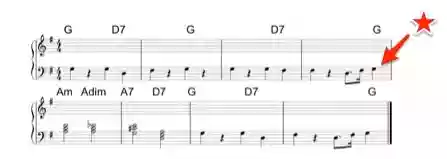
For the left-hand accompaniment, make the first four measures feel lively, and from measure 5 to measure 6, create a slightly "scary" atmosphere using chordal figures.
It’s important to really feel and convey the character of the Adim chord when playing the progression “Am→Adim→A7→D7.”
There’s a part (★) where the left hand moves a little, but it’s the same movement as the right hand, so please give it a try.
 Keep the rhythm with your right hand!
I recommend practicing the right-hand melody by using a song you know as a reference.
For beginners, the most difficult part of sight-reading is often the rhythm.
Especially with pop music and the like, it’s not uncommon to recognize the sounds but not understand the rhythm.
First, it's important to try playing a song you like and find out what kind of rhythm it has.
Gradually, you’ll be able to understand the rhythm from the sheet music as well.
Another point is "repeated homophones."
The triplet at the beginning uses the same note.
When repeating the same note, it’s best to play by using your wrist or by changing fingers (e.g., 3–2–1).
Please refer to the video below for details.
I can’t upload the sheet music for “Obake nante nai sa” here due to copyright issues, but the sheet music I used can be found here. There are two versions, and you can view samples, so please take a look if you’re interested.