

[Day Service] Setsubun decorations that bring smiles. Ideas for enjoying them with a variety of materials.

As Setsubun approaches, it’s fun to decorate the day-service space.
There are many hands-on projects that let you feel the season, such as 3D rolled sushi (ehomaki) made from origami, egg-shaped red oni, vibrant oni crafted with tsumami-zaiku, and hanging ball ornaments (temari) using chirimen fabric.
You can also recreate the traditional holly-and-sardine (hiiragi iwashi) custom with origami or make tabletop decorations with paper clay—there are endless ways to express yourself.
The conversations that naturally arise while crafting together create warm, heartwarming moments.
- [For Seniors] Liven Up Setsubun Crafts! Handmade Ideas Using a Variety of Materials
- [For Seniors] Fun and Easy Oni Crafts to Liven Up Setsubun: Simple, Enjoyable Ideas
- For Seniors: Wishing for Good Health — Handmade Setsubun Decoration Ideas
- [For Seniors] Ideas for decorating February walls with oni (demons). Unique personalities shine through with oni showing various expressions.
- Recreation Ideas for Seniors: Perfect for Setsubun and Bean-Throwing Activities
- For Seniors: Wall Decorations to Brighten Up February — Festive Ideas for Setsubun, Valentine’s Day, Plum Blossoms, and More
- [For Day Service Centers] February Craft Ideas: Decorations for Setsubun, Valentine’s Day, and the Feeling of Spring
- [For Seniors] February Wall Decorations: Setsubun-Themed! Fun Ideas with Oni Demons and Ehomaki Sushi Rolls
- [For seniors] A handmade calendar you’ll want to make in February
- [For Seniors] Recommended Wall Decorations and Crafts for January
- [For Seniors] Fun February Crafts: Ideas Inspired by Setsubun, Valentine’s Day, and Other Events
- [For Seniors] January Craft Ideas for Day Service Activities
- [For Seniors] Spring Wall Decorations: A Collection of Ideas to Brighten Up Your Room
[Day Service] Setsubun decorations that make you smile. Introducing ideas to enjoy with a variety of materials (41–50)
Origami Otafuku and Little Oni
Often written as “otafuku” using characters that also mean inviting good fortune, Otafuku appears as a symbol of luck.
Some say her face is modeled after an image of a beauty from the Heian period.
Long ago, it seems that being slightly plump with narrow eyes was considered a mark of beauty.
Quite different from today, isn’t it? How about folding an Otafuku with origami? It’s not very difficult, so even older adults can quickly learn how to make it.
You can draw Otafuku’s facial features with a pen or cut colored paper and paste it on.
If you have grandchildren, making them together sounds like fun.
[Day Service] Setsubun decorations that make you smile. Introducing ideas to enjoy with a variety of materials (51–60)
Plum blossoms made of paper
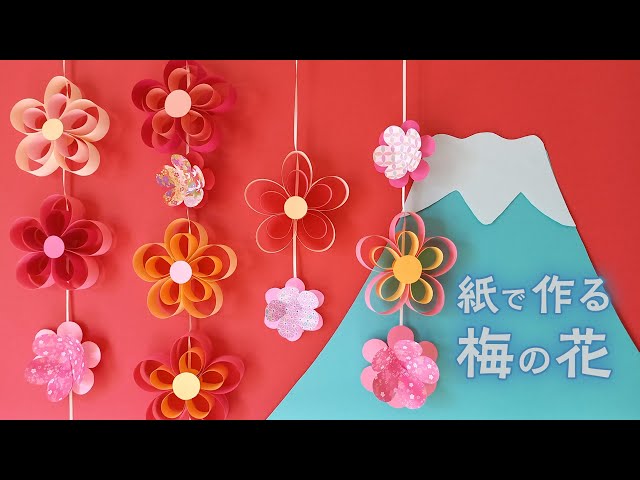
February, when Setsubun takes place, is the heart of winter and still a very cold season, but the plum blossoms that start to bloom around this time give us hope that warmer days are coming.
This craft features plum blossoms, which evoke the end of winter and the breath of spring.
Cut construction paper into strips, then join both ends to form a petal-like shape.
Apply glue to the joined part and combine about five of them to create a flower.
The key is to combine longer and shorter strips for a three-dimensional look, and to use two different colors of paper to add a festive touch.
Once the plum blossoms are finished, we recommend stringing them together and displaying them, incorporating other decorations as well.

Oni and Setsubun decorations made with paper bowls

Create three-dimensional Oni and Otafuku figures using paper bowls.
Paper bowls sold at 100-yen shops work perfectly.
Cut the bowls for the Oni and Otafuku, and use crumpled origami paper to form their faces and hair.
You can also make the Oni’s distinctive, permed-looking rounded hair by crumpling origami paper.
Yarn or thinly cut strips of origami paper can also be glued on as hair.
Because this craft involves crumpling and squeezing paper, it uses the hands a lot.
It’s said that “the hands are a second brain,” with many nerves connecting the fingertips to the brain.
Using the hands and fingers helps activate the brain and can aid in dementia prevention.
Enjoy this brain-training craft activity and create wonderful pieces!

square incense box

A kōbako is a box for holding incense and is used as an implement in the tea ceremony and kōdō (the Way of Incense).
Thanks to its ornate appearance and auspicious associations, it would also be perfect for holding Setsubun beans.
This content introduces how to make such a kōbako out of origami.
The design creates volume in the compartment that holds items and features protruding corners on all four sides to give a three-dimensional look.
Because the finished piece clearly shows both sides of the paper, using paper with patterns on both sides—or laminating two sheets of origami before folding—will result in a more striking, decorative finish.
bean box

Every year, large crowds gather for the Setsubun Day event held at Naritasan Shinshoji Temple.
Many older people might say, “I’ve been there.” You often see on the evening news how everyone eagerly scrambles to catch the beans tossed by actors from the NHK Taiga drama and sumo wrestlers.
Let’s try making a ‘mamebako’ (bean box) out of origami, which is always used when throwing beans.
Fold a square box shape and attach a handle to finish.
Don’t forget a cute touch like an oni (ogre) face, too.
baby ogre

If you create the demons that appear during Setsubun in a cute design, they’ll be easier to incorporate into decorations.
Let’s make a small origami mascot with the theme of a baby oni.
Start with a large triangle as the base, then fold it while adding stepped layers to form the head and body.
A key point is the structure where these layered folds protrude on the back; by adjusting the angle, you can make the mascot look like it’s sitting.
Draw the face, attach separately made pants, and it’s complete.
Try varying the colors you use and the expressions you draw to create a variety of baby oni.
Wall decoration of ogre pants

At Setsubun, the ritual of throwing beans to drive away demons (oni) is indispensable.
Although oni have a strong image of being evil or frightening, I think they are an important motif for Setsubun.
This decoration is inspired by the tiger-striped pants that oni always wear.
Just using tiger-patterned pants conveys the idea of an oni and evokes a sense of the oni’s powerful, shouting presence.
The process is very simple: cut yellow construction paper into the shape of pants, then add black paper to create the stripes, and you’re done.
Another key point is how freely you can customize it—what shape you make the pants, and how you add the stripes are entirely up to you.