



twice beforediatonic chordI’ve studied about it, but this time we’ll finally put it into practice.
TranslationWhat are the functions of diatonic chords: “primary triads” and “substitute chords”?
Let's add chord symbols using diatonic chords.
- [Composition] A roundup of famous songs that use classic chord progressions [by ear]
- [For Beginners] Play on the Piano! A Collection of Songs Using the Canon Progression
- [2026] Practice Songs for Metal Beginners: Learn the Basics of Metal Guitar!
- Songs that are easy to play without a capo for guitar beginners
- A must-see for beginner composers! A roundup of classic chord progressions
- A must-see for anyone who wants to try piano-and-vocal performances through code! From nostalgic oldies to the latest hits, all introduced at once.
- [Piano] Piano Accompaniment Patterns | A selection of arrangements useful for adding accompaniment and for piano-vocal performance
- [Children’s Song] Easy Even for Piano Beginners! Introducing Nursery Rhymes with Simple Chords
- [Guitar] Easy Chord Progressions! A Compilation of Recommended Japanese Songs for Singing and Playing
- Playable with easy chords! A collection of practice songs for acoustic guitar beginners
- [Easy Chords] A collection of popular Japanese songs that are easy to play on guitar
- Resonates beautifully at karaoke! Harmony practice songs that anyone can match right awayNEW!
- Songs with satisfying key changes: classic J-POP and Japanese tracks where the mood and impression shift naturally
How to assign codes
This time, let’s actually try it with a song I made.
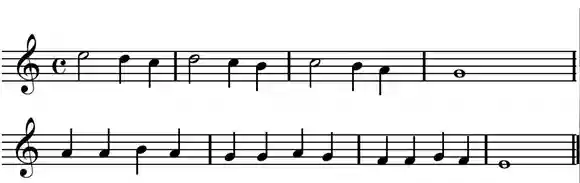
Without attaching the code, it looks like this.
Now, the question is how we should proceed when attaching the code.
The musical score is made up only of do-re-mi-fa-so-la-ti-do.Key (tonality)C major or A minor can be considered.
In the case of C major
Let's try finishing this piece as a song in C major.
Use CMajor diatonic chordIt is.
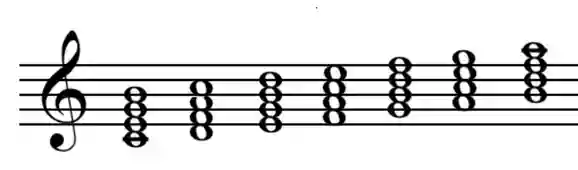
The very first measure is made up of the notes “mi–re–do.”
In this case, I think it's safest to use a C major chord.
in C majorcode toneSince the melody already contains two of the notes (C and E), it won’t sound dissonant.
For example, if you make the first chord a D minor chord, the only chord tone will be the note D, which gives quite an off impression.
like thisMatching melody notes with chord tones is the key point when adding chords.It is.
We will apply this procedure in the same way to the subsequent sections.
And here is what I came up with.
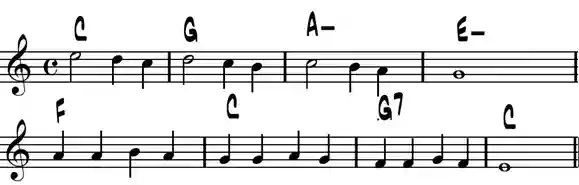
Please have a listen.
There’s no single correct way to code; this is just one example.Please try doing so.
In the case of A minor
Use AMinor diatonic chordIt is.
The order is different, but they are the same as the C major diatonic chords.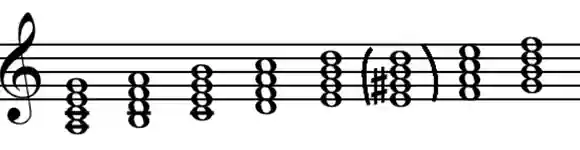 This time, we’ll use an A minor chord instead of a C major chord for the first chord.
Even if you substitute an A minor chord, it still contains the notes C and E, so it doesn’t sound dissonant.
We proceeded with this in the same way, and here is what we produced.
The chord progression is Am→E7→Am→G→F→C→Dm→Am.
How does that sound?
Even with the same melody, just changing the chords gives it a different vibe.can make it
Lastly
The possibilities for assigning codes are endless.
If you like, please use my song this time as practice.
And once code has been attached, I think one option is to have someone else take a look at it.
To my fellow musicians around me, if there’s anything I can help with, I’d be happy to cooperate.
next timeFrom here, I will introduce techniques for coding.