

[Falla’s Piano Works] A gem of masterpieces by a composer from the passionate land of Spain

Manuel de Falla, the Spanish composer who was captivated by the Andalusian dance known as flamenco and left works that incorporate its passionate musical elements.
Born in Cádiz, Spain, in 1876, he began studying piano and composition in the 1890s.
As he deepened his friendships with renowned composers such as Paul Dukas and Claude Debussy, he developed as an artist and produced numerous masterpieces, including operas and ballets.
In this article, we introduce some of Falla’s passionate piano works imbued with the fragrance of Spain.
- Rodrigo’s Piano Pieces: Masterworks by a Blind Composer Evoking the Fragrance of Spain
- [Granados’s Piano Pieces] A romantic masterpiece imbued with the fragrance of Spain.
- [Chaminade’s Piano Works] Masterpieces of Delicacy and Boldness by a Woman Composer
- Piano Works by Bizet: Exquisite Masterpieces by the Composer Who Created Carmen
- [Albeniz’s Piano Pieces] A selection of masterpieces left by the passionate Spanish composer
- Piano Pieces by Ibert: Gem-like Masterworks by a 20th-Century French Composer
- [Piano Works of Sibelius] Exquisite Music Crafted by a Nordic Finnish Composer
- [Lyadov’s Piano Pieces] A pianistic masterpiece crafted by a brilliant but lazy composer
- [Fauré] Lower Difficulty! Recommended Piano Pieces by a Master of French Music
- Janáček’s Piano Works: Sparkling Masterpieces Reflecting National Pride
- Ginomasteira’s Piano Works: A Curated Selection of Masterpieces by a Leading Latin American Composer
- [Szymanowski’s Piano Works] Masterpieces Left by a Composer Who Lived Through Turbulent Times
- [Rameau’s Piano Pieces] A curated selection of harpsichord works by a Baroque master
[Falla’s Piano Pieces] A Treasury of Masterpieces by a Composer from Passionate Spain (1–10)
Symphonic Impressions: Nights in the Gardens of SpainManuel de Falla

Manuel de Falla, a Spanish composer active in the early 20th century, had a profound influence on the development of Spanish national music throughout his life.
During his stay in Paris, he deepened his interactions with Impressionist composers and produced a succession of works that vividly reflect the climate and spirit of Spain.
Nights in the Gardens of Spain, a set of symphonic impressions, is one of his masterpieces.
Set in Spanish gardens at night, it unfolds music that is both mysterious and richly evocative.
Expressing folk-inspired melodies and rhythms in a refined style and creating a distinctive sound world, this work is ideal for anyone wishing to savor the allure of Spanish music.
Love, the Magician, No. 3: Dance of TerrorManuel de Falla

The works of Spanish composer Manuel de Falla vividly reflect the passion of Andalusia.
His especially famous ballet music, The Love Wizard (El amor brujo), is a masterpiece in which flamenco rhythms and elements of classical music are brilliantly fused.
Centered on the story of the heroine Candela, who is tormented by the ghost of her late husband, its folkloric steps and dramatic performance deftly portray a wide range of human emotions.
From this piano arrangement of the celebrated ballet, one can sense a romantic worldview imbued with the fragrance of old Spain, offering a full appreciation of the charms of both folk and classical music.
It is a highly recommended piece for those interested in Spanish culture and history.
Vals CapriccioManuel de Falla

Spanish composer Manuel de Falla was captivated by the passionate flamenco music of Andalusia and left many works that skillfully incorporate its elements.
Vals-Capricho is one of his important early pieces, created as his talent began to blossom.
While following the European waltz tradition, its lively music—woven with rhythms and melodies imbued with Spanish national color—fills listeners with a buoyant excitement that makes one want to get up and dance.
It is a friendly yet highly artistic masterpiece that I recommend even to those just beginning to explore classical music.
[Falla’s Piano Works] Exquisite Masterpieces by a Composer from Passionate Spain (11–20)
Four Spanish Pieces, No. 4: AndalusaManuel de Falla
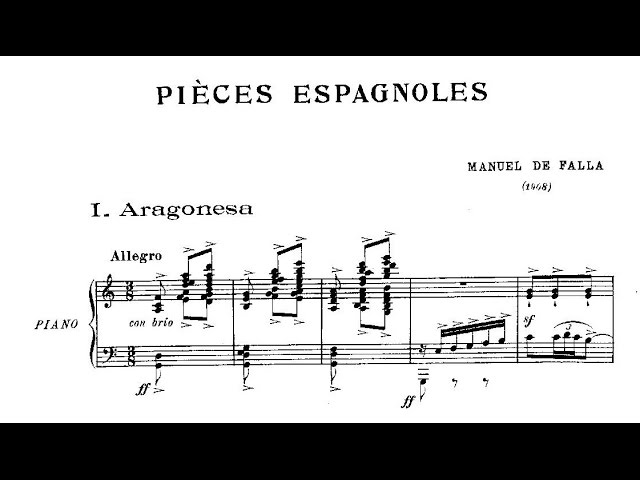
Manuel de Falla, a master of classical music who was active in the early 20th century, is known for his distinctive style that fuses nationalism and Impressionism, and at times reflects the influence of Stravinsky’s neoclassicism.
The fourth piece, “Andaluza,” from his Four Spanish Pieces, is a work that expresses Andalusia in southern Spain through music.
Characterized by Gypsy flamenco rhythms, colorful guitar-like figurations, and a melancholic melody, it conveys the rich culture and emotive spirit of Andalusia.
Please enjoy this passionate piano work imbued with the fragrance of Spain!
Seven Spanish Folksongs, No. 7 “Polo”Manuel de Falla

Manuel de Falla’s song cycle Seven Spanish Folksongs distills the passion of Spain into song and music.
The seventh piece, Polo, is a masterpiece that vividly reflects the influence of flamenco, swirling with intense romantic feelings and anger at betrayal.
Its lyrics convey the protagonist’s burning passion and poignant sorrow.
This expressive work fuses the Spanish color of modal harmonies with Falla’s distinctive refinement.
It’s a piece I recommend not only to classical music enthusiasts but to anyone captivated by passionate music.
Song of the Volga BoatmenManuel de Falla

Manuel de Falla, a leading composer of 20th-century Spain, reinterpreted the Russian folk song “Song of the Volga Boatmen” as a character piece for piano.
While preserving the original’s power, this arrangement conveys Russia’s landscape and culture to Spanish audiences through a more refined musical expression.
From the music—symbolizing the harsh lives and solidarity of the workers who hauled boats along the Volga River—one feels a universal message of people maintaining hope even under severe conditions.
Blending Spanish passion with Russian lyricism, this work is recommended not only for piano enthusiasts but also for anyone interested in folk music.
Serenata of AndalusiaManuel de Falla

Manuel de Falla, a composer who epitomizes 20th-century Spain, began studying piano in his childhood and later studied composition in Madrid and Paris.
During his time in Paris, he deepened his connections with Debussy and Ravel, establishing a unique musical style that fused Spanish folk music with the influence of French Impressionism.
Serenata Andaluza, an early landmark work composed in his early twenties, is notable for melodies and rhythms rich with the spirit of his native Andalusia.
Featuring a gracefully flowing, serenade-like melody interspersed with passionate flamenco rhythms, this piece is a celebrated work that fully showcases the piano’s rich sonorities and dynamic expressive range.