

![[Falla’s Piano Works] A gem of masterpieces by a composer from the passionate land of Spain](https://i.ytimg.com/vi_webp/hPSemiKrY7E/maxresdefault.webp)
[Falla’s Piano Works] A gem of masterpieces by a composer from the passionate land of Spain

Manuel de Falla, the Spanish composer who was captivated by the Andalusian dance known as flamenco and left works that incorporate its passionate musical elements.
Born in Cádiz, Spain, in 1876, he began studying piano and composition in the 1890s.
As he deepened his friendships with renowned composers such as Paul Dukas and Claude Debussy, he developed as an artist and produced numerous masterpieces, including operas and ballets.
In this article, we introduce some of Falla’s passionate piano works imbued with the fragrance of Spain.
[Falla’s Piano Pieces] A Treasury of Masterpieces by a Composer from Passionate Spain (1–10)
Spanish Dance No. 1 from the opera La vida breveManuel de Falla

Manuel de Falla, who left behind passionate piano works imbued with the spirit of Spain.
“Spanish Dance No.
1” is one of the most popular pieces from his opera La vida breve.
Strongly influenced by Spanish folk music, this work is characterized by its rhythmic, fiery dance style, with a dramatic progression that portrays love and sorrow and expressions rich in emotional contrast.
It’s a piece that lets you savor rhythms and melodies that vividly reflect the essence of Spanish music.
If you love passionate music, be sure to try performing it yourself!
The Fantasia Bética (Andalusian Fantasia)Manuel de Falla

The Spanish composer Manuel de Falla established a unique style that captured the essence of Spanish folk music while absorbing influences from Impressionism and Neoclassicism.
Among his works that strongly reflect the land and culture of Andalusia, Fantasia Baetica stands as one of his masterpieces.
It is a virtuosic piano piece that reinterprets the rhythms and melodies of flamenco within a modern musical context.
Demanding a passionate and dynamic performance, the work is beloved by many pianists as a piece that evokes the soul of Andalusia.
Requiring not only advanced technique but also profound emotional expression, it is an ideal choice for advanced players interested in Spanish music and culture.
NocturneManuel de Falla

Manuel de Falla, an Impressionist composer from Cádiz, Spain.
Through music deeply influenced by Spanish folk songs and dance, he built a unique world of neoclassicism and impressionism.
After his studies in Paris, he produced many masterpieces, and his works—capturing the essence of Spanish music—are still loved around the world today.
His early piano piece Nocturne, imbued with the passion of his youth, is a gem in which his unique sensibility shines through romantic expression.
Within its classical style, you can sense glimpses of his budding talent.
Four Spanish Pieces: No. 1, “Aragonesa”Manuel de Falla
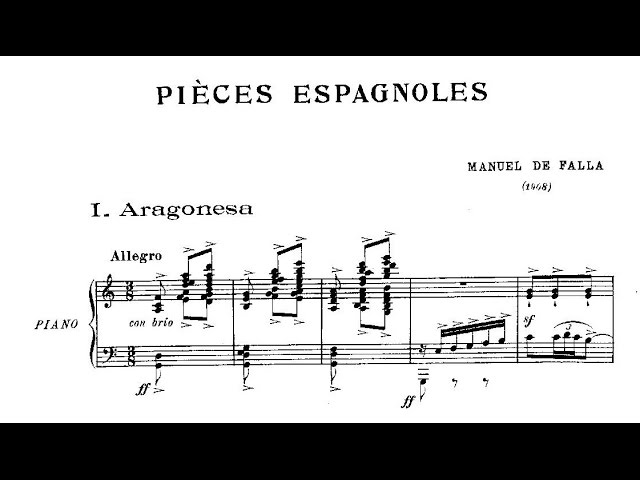
Manuel de Falla, a Spanish composer active in the early 20th century, refined the folk music of various regions of Spain into classical music while studying in Paris and deepening his ties with composers such as Dukas and Ravel.
Four Spanish Pieces is an early masterpiece in which Falla depicts the landscapes and scenes of his homeland.
The first piece, Aragonesa, is a captivating miniature that weaves together glittering arpeggios and passionate rhythms, inspired by the traditional dance of the Aragon region.
This is a work where you can savor Falla’s unique world, a fusion of Spain’s distinctive musical character with Impressionism.
Highly recommended for those who want to experience the allure of far-off lands and feel a longing to travel to Spain through music!
From the ballet music The Three-Cornered Hat: Three Dances, No. 2 “Dance of the Miller”Manuel de Falla

The Spanish composer Manuel de Falla is known for his unique style that captures the essence of Spanish music while incorporating elements of Impressionism and Neoclassicism.
One of his major works, the ballet The Three-Cornered Hat, is notable for its vivid color and passionate rhythms.
In particular, The Miller’s Dance is a powerful scene that employs the flamenco rhythm of the farruca, clearly revealing Falla’s deep commitment to Spanish music.
It’s a highly recommended piece for those interested in Spanish or folk music, or anyone seeking passionate, fiery music.
Three Dances from the Ballet The Three-Cornered Hat, No. 1: Dance of the NeighborsManuel de Falla

Manuel de Falla, a composer from Cádiz, Spain.
His music had a profound impact on the development of Spanish national music, establishing a unique style that fused nationalism and impressionism.
His representative ballet score The Three-Cornered Hat is a lively, rhythmic work that incorporates the rhythms of the traditional dance seguidilla.
In particular, “The Neighbors’ Dance” is beloved as a bright and passionate piece that captivates listeners.
Falla’s colorful, rhythmically vibrant music is recommended not only for classical music fans but for anyone seeking passionate music.
Symphonic Impressions: Nights in the Gardens of SpainManuel de Falla

Manuel de Falla, a Spanish composer active in the early 20th century, had a profound influence on the development of Spanish national music throughout his life.
During his stay in Paris, he deepened his interactions with Impressionist composers and produced a succession of works that vividly reflect the climate and spirit of Spain.
Nights in the Gardens of Spain, a set of symphonic impressions, is one of his masterpieces.
Set in Spanish gardens at night, it unfolds music that is both mysterious and richly evocative.
Expressing folk-inspired melodies and rhythms in a refined style and creating a distinctive sound world, this work is ideal for anyone wishing to savor the allure of Spanish music.