

[Kayō Star] Hiromi Go’s Best Hits & Classic Songs Collection

Pop music star Hiromi Go.
Ever since his 1972 debut with “Otoko no Ko Onna no Ko,” he’s remained at the forefront, still appearing on TV even in the Reiwa era.
In his early years, along with Goro Noguchi and Hideki Saijo, he gained popularity as one of the “New Gosanke” (the new big three).
Signature crowd-pleasers like “GOLDFINGER ’99” and “Ni-oku Yon-senman no Hitomi” are killer tunes that many people have heard at least once, regardless of generation.
While Go is strongly associated with a lively, bursting energy, his carefully delivered ballads are wonderful as well.
We’ve put together a rich feature on Go’s classic songs that captivate with their dazzling charm—please take your time and enjoy.
- Hiromi Go Popular Songs Ranking [2026]
- [Kayō Star] Recommended easy-to-sing songs by Hiromi Go
- Hiromi Go Karaoke Popular Songs Ranking [2026]
- [Kayō Star] Hiromi Go’s Best Hits & Classic Songs Collection
- Hiromi Go Love Songs: Popular Song Ranking [2026]
- Classic and hit songs by nostalgic Japanese idols from the 1970s
- [For People in Their 40s] Karaoke Songs That Are Easy to Sing: 2026 Ranking
- [For People in Their 50s] Ranking of Easy-to-Sing Karaoke Songs [2026]
- Thrilling to Cool Showa-Era Tunes! Classic Songs from Female Singers and Artists of the Showa Period
- Chiharu Matsuyama’s masterpieces and popular songs
- [Enka Hattori-kun] A Collection of Easy-to-Sing Songs by Hiroko Hattori [2026]
- Evokes the charm of the good old days. Showa-era inspirational songs that are still loved today.
- A vitamin voice that brings comfort and energy! Ranking of Hiroshi Miyama’s most popular songs
[Kayo Star] Hiromi Go’s Best Hits & Classic Songs Compilation (11–20)
Premeditated Offender, 100th GO!Gō Hiromi

A song that reveals a new side of Hiromi Go.
It’s a dance tune that samples his past signature hits and updates them with a modern twist.
The lyrics, which highlight Go’s charm, are memorable for their playful, passionate take on love.
Phrases that incorporate parts of the title stand out, emphasizing the continuation of the romance.
Released in August 2021, the track has been praised as a work that symbolizes Go’s musical evolution.
With its energetic vibe, it’s perfect for getting the crowd going at parties and similar occasions.
My ladyGō Hiromi

It was an insert song for the TV drama ‘Ieji’ released in September 1979.
While it peaked at No.
8 on the Oricon chart, it held the No.
1 spot on The Best Ten for five consecutive weeks, becoming his first big hit in a while.
The song is quintessential Hiromi Go: an up-tempo number that conveys “I love you,” crafted not in an idol-like manner but with a mature turn of phrase.
Both the lyrics and the music suit Hiromi Go extremely well.
I can’t help wanting to see you.Gō Hiromi

Released in April 1995, it’s an adult ballad that’s still sung in karaoke today, but perhaps his private life was already showing cracks in what had seemed a happy marriage.
After divorcing Yurie Nitani in April 1998, she published a book, “Daddy,” in which she confessed that Hiromi Go’s infidelity was the cause.
Although he was criticized, it didn’t become a case of sustained media scrutiny like we often see today.
Angel’s PoemGō Hiromi

Hiromi Go’s beautifully bittersweet love song.
Its clear, translucent vocals and lively melody express the pure feelings of youthful love.
Released in December 1972 as his third single, it was also used as the theme song for the TV drama “Oyaji Sanmyaku.” The song reached No.
17 on the Oricon chart and sold about 103,000 copies.
The lyrics, which sing of a love as transparent and beautiful as an angel’s tears—yet out of reach—resonate deeply.
It’s a perfect track for those who want to savor the sweet tang of a first love or reminisce about a pure romance.
The Bride SambaGō Hiromi

Released in May 1981, it has somewhat unusual lyrics, but it’s a fun song and was Hiromi Go’s third biggest hit.
It’s said that Go initially refused to sing it because he couldn’t really understand the lyrics, but he ended up performing it and turning it into a hit.
Depending on how you take it, it can sound like a song cheering on women, but if you interpret it cynically, it could also come across as sexist.
Personally, though, it’s the most memorable song for me.
Sexy You (Monroe Walk)Gō Hiromi

Released in January 1980.
It’s a cover of Yoshitaka Minami’s “Monroe Walk,” but with a different vibe that builds a world uniquely Hiromi Go’s.
The lyrics of the first verse are mostly unchanged, while the second verse is entirely different.
In both versions, the story is a fairly common one about trying to pick up an attractive woman at the beach, but when the song is good, that light, casual image somehow disappears.
[Kayō Star] Hiromi Go’s Best Hits & Classic Songs (21–30)
Same road, same placeGō Hiromi
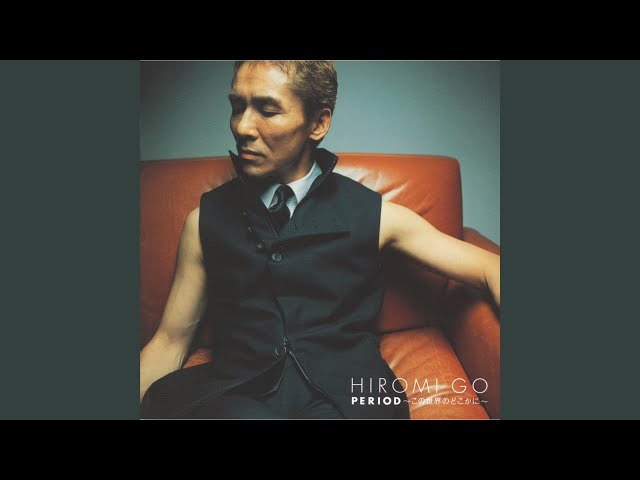

In Takasu Clinic’s commercials from the early 2000s, Hiromi Go appeared.
This particular ad aired in 2001, and many fans were surely captivated by his cool mannerisms.
The BGM features his 2001 release “Onaji Michi, Onaji Basho,” making it a commercial where you can feel Hiromi Go’s charm both visually and aurally.
