

![Hiromi Go Popular Songs Ranking [2026]](https://i.ytimg.com/vi_webp/HAkUeMEOXzQ/maxresdefault.webp)
Hiromi Go Popular Songs Ranking [2026]

Hiromi Go made his debut in 1972 with the smash hit “Otoko no Ko Onna no Ko.” Alongside Hideki Saijo and Goro Noguchi, he was dubbed one of the “New Big Three,” quickly becoming a top idol.
Since then, he has released numerous hit songs.
Even now, he continues to reign in the entertainment world as an idol.
Here is a collection of some of his popular songs.
Hiromi Go Popular Songs Ranking [2026] (1–10)
I can’t say it.Gō Hiromi1rank/position

A ballad you can sing with a moist, mature allure.
Released in 1994, it became a big hit.
The range itself isn’t very high; if you can firmly nail the G4 in the chorus as an accent, you’ll be in good shape.
Since it’s a relaxed song, it’s easy to rack up points with pitch accuracy, long tones, and vibrato, so you need to take solid breaths and project your voice.
The structure builds clearly from verse (A) → pre-chorus (B) → chorus.
Deliver the A section in a spoken, narrative style, gradually raise the tension in the B section toward the chorus, and then let your emotions burst in the chorus!

240 Million Eyes -Exotic Japan-Gō Hiromi2rank/position

Though remarkably original for its time, this signature song by Hiromi Go was crafted squarely within the framework of Showa-era hits.
It features a dazzling, visually evocative melody and a grand-scale theme that amplifies the heat of the entire Japanese archipelago and the stirrings of romance.
Released in February 1984 as his 50th single, it was chosen as the campaign song for the final tourism campaign by Japanese National Railways.
With plenty of easy call-and-response moments, it’s a karaoke staple.
Even those lacking confidence in their singing have nothing to fear—once you find a key that suits you, it’s not hard to master.
It’s a song everyone can sing together across generations and really get the crowd going!
Melancholy CasablancaGō Hiromi3rank/position

A song by Hiromi Go released in July 1982.
It was featured in a Suntory “Akadama Punch” commercial and became a major talking point.
It reached No.
2 on the Oricon Weekly Chart and ranked 14th on the 1982 year-end chart.
It also finished 8th on The Best Ten’s year-end ranking, showcasing its immense popularity at the time.
The song centers on lost love and the melancholy of reminiscing, with lyrics reminiscent of the film Casablanca.
Hiromi Go’s heartrending vocals resonate deeply with listeners.
It’s a perfect track for those who want to immerse themselves in memories of romance.
240 Million EyesGō Hiromi4rank/position

This is a parody of Hiromi Go’s “24 Million Eyes” that thoroughly describes, down to the fine details, the kinds of issues you find in low-rent apartments.
The sample rent used for the cheap apartment is “24,000 yen,” echoing the original song’s title, which clearly conveys both how inexpensive it is and what kind of environment comes with that price.
It doesn’t just say the room is small; it also depicts psychological anxieties in detail—like the presence of talismanic paper charms—adding to the unease.
The fact that it’s presumed to be set in Tokyo further underscores the anxiety about the rent level.
It’s a parody that makes you feel that only those who can tolerate these conditions get to choose a low rent.

The Bride SambaGō Hiromi5rank/position

Let’s dance to some nostalgic tunes and relive those days! Today’s pick is “Oyome Samba.” Many of you probably feel your spirits lift when you hear Hiromi Go’s sweet, unmistakable voice.
This time, let’s shake it out to “Oyome Samba” and blow off some steam.
Moving your body boosts blood flow to the brain and releases neurotransmitters, which can help relieve stress.
It’ll lift your mood and leave you feeling refreshed! Give it a try and work it into your routine.
Nice to meet you, melancholy.Gō Hiromi6rank/position
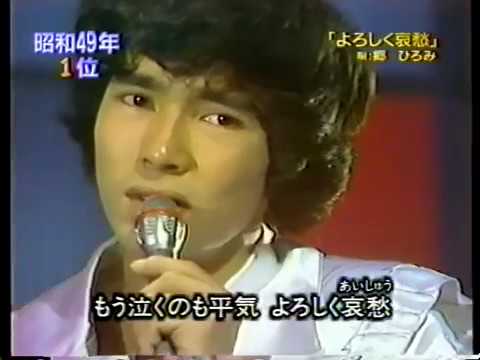
Gently singing of the complexities of love, “Yoroshiku Aishū” stands out among Hiromi Go’s many songs.
Released in September 1974, it became familiar as the theme song for the drama “Chotto Shiawase.” It expresses the heartache of love through a tender melody and Go’s sweet vocals.
Its theme—that time spent apart deepens love—resonates with distant memories and speaks to the heart.
The lyrical portrayal of a man and woman missing each other’s feelings evokes empathy in many and ensures the song’s lasting affection.
Even today, it remains a timeless classic that touches the heart when sung at karaoke.
GOLDFINGER 99Gō Hiromi7rank/position

Released in 1999, “GOLDFINGER ’99” became a social phenomenon.
There’s hardly anyone—adult or child—who doesn’t know that chorus.
In fact, this song is also a cover.
The original is “Livin’ la Vida Loca,” sung by Puerto Rican singer Ricky Martin.
While the melody is the same, the lyrics and choreography are Hiromi Go’s originals.
That said, both the original and “GOLDFINGER ’99” share the same theme: a man whose life is thrown into chaos by a woman.
The original’s lyrics are a bit darker, though.
If you’re curious, be sure to check it out.
