

Hiromi Go Popular Songs Ranking [2026]

Hiromi Go made his debut in 1972 with the smash hit “Otoko no Ko Onna no Ko.” Alongside Hideki Saijo and Goro Noguchi, he was dubbed one of the “New Big Three,” quickly becoming a top idol.
Since then, he has released numerous hit songs.
Even now, he continues to reign in the entertainment world as an idol.
Here is a collection of some of his popular songs.
- Hiromi Go Karaoke Popular Songs Ranking [2026]
- [Kayō Star] Hiromi Go’s Best Hits & Classic Songs Collection
- Hiromi Go Love Songs: Popular Song Ranking [2026]
- [Kayō Star] Recommended easy-to-sing songs by Hiromi Go
- Hiroshi Itsuki Popular Songs Ranking [2026]
- Songs Women Want Men to Sing: Popular Karaoke Picks Chosen by Girls
- [For People in Their 50s] Ranking of Easy-to-Sing Karaoke Songs [2026]
- Debut song of a 1970s idol
- Debut single becomes a smash hit and social phenomenon! Ranking of Akiko Kobayashi’s popular songs
- Recommended Japanese karaoke songs for men in their 60s
- Goro Noguchi’s Most Popular Songs Ranking [2026]
- Yoshi Ikuzo Popular Song Rankings [2026]
- Hiromi Uehara Popular Songs Ranking [2026]
Hiromi Go Popular Songs Ranking [2026] (41–50)
You are special.Gō Hiromi41rank/position

Released in June 1974.
It’s a song with a title that would make any girl swoon if the boy she likes thought, “You’re special.” The lyrics are actually quite provocative—inviting a boy to her room, alone, and so on—but when Hiromi Go sang it, for some reason it didn’t come across as particularly racy.
Around the same time, Momoe Yamaguchi was being marketed with a ‘blue’/sexual-maturity image, so there was some overlap, but it didn’t really suit Hiromi Go.
A small experienceGō Hiromi42rank/position
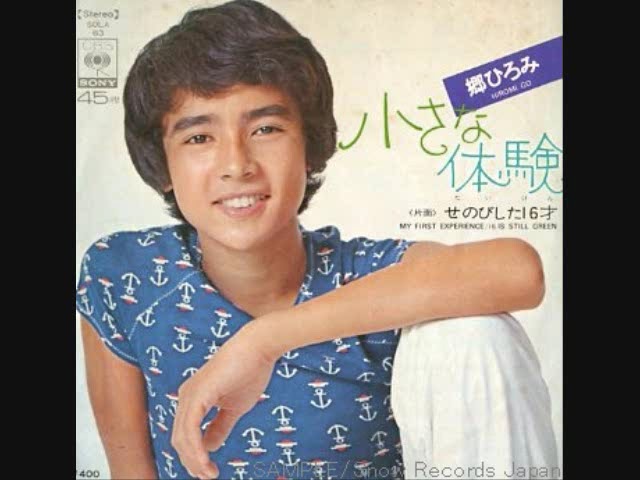
It’s a song that peaked at No.
4 on the charts, surpassing the No.
8 peak of their debut single released in November 1972.
The lyrics are full of lines like “Why are you so cute?” and “You’re mine, so don’t look at anyone else,” the kind of words that tickled women’s hearts at the time.
What feels a bit odd is that there’s a canary in the café where they’re meeting.
Even in the Showa era, were there really canaries in cafés? That’s what it makes me recall.
At least in city cafés I never saw any, so I’ve taken it to mean it must be something that happened in some countryside café.
Before the floodGō Hiromi43rank/position
Released in July 1977, Hiromi Go—whose features evoke a Greek sculpture—appears once again in an outlandish outfit.
The song itself resembles Yomei Samba, which would later become a much bigger hit, but for some reason this track carried a somewhat mismatched image that seemed to precede it, and it didn’t become as successful as people around him expected.
As an aside, it’s said that he tried to woo the era’s absolute idol, Momoe Yamaguchi, by slipping his phone number and such into a book he gave her as a present, but she apparently paid him no mind.
RomanceGō Hiromi44rank/position

It’s a single by Hiromi Go, released in April 1983.
The song was originally performed by Spanish singer Julio Iglesias, with Japanese lyrics written by Keisuke Yamakawa.
It peaked at number 20 on the Oricon chart.
I was who I was because you were there.Gō Hiromi45rank/position

Released in August 1976, this work is known as one of Hiromi Go’s signature songs.
With distinctive composition and arrangement by Kyohei Tsutsumi and Go’s powerful vocals, it’s an impressive pop rock number.
The lyrics, centered on gratitude and forgiveness in a romantic relationship, are relatable and remind us of the importance of caring for one another.
From its release, it achieved success on the Oricon singles chart, and it won the Popularity Award at the 1976 Japan Record Awards.
The sight of Go moved to tears with emotion was unforgettable.
The song has also been covered by other artists, including Goro Noguchi and Iyo Matsumoto.
It’s a track you’ll want to listen to when you want to feel the bond with someone special.
I won’t forget the goodbye kiss.Gō Hiromi46rank/position

Released in May 2000, this song came about 15 years after Seiko Matsuda and Goro Go broke up.
Reportedly, it was Go’s side that proposed the idea, and Matsuda’s side agreed, making the collaboration a reality.
That said, given such a suggestive title and lyrics, did they both just treat it purely as business?
Angel’s PoemGō Hiromi47rank/position

Hiromi Go’s beautifully bittersweet love song.
Its clear, translucent vocals and lively melody express the pure feelings of youthful love.
Released in December 1972 as his third single, it was also used as the theme song for the TV drama “Oyaji Sanmyaku.” The song reached No.
17 on the Oricon chart and sold about 103,000 copies.
The lyrics, which sing of a love as transparent and beautiful as an angel’s tears—yet out of reach—resonate deeply.
It’s a perfect track for those who want to savor the sweet tang of a first love or reminisce about a pure romance.
We might be able to meet.Gō Hiromi48rank/position
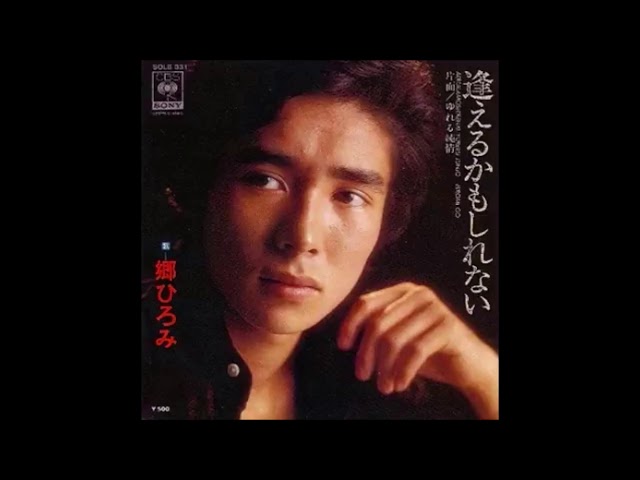
Released in October 1975.
The somewhat enka-like feel may be because the lyrics were written by Yoko Yamaguchi, who is famous for writing songs for Hiroshi Itsuki and others.
However, since his voice is quite high, it might have been difficult to fully convey an enka-style atmosphere.
As a result, it feels like the song doesn’t really express Hiromi Go’s bright persona or his other cool image very well.
Even so, thanks to name recognition, it debuted at No.
4 on the Oricon chart.
As much as possible,Gō Hiromi49rank/position

This song is filled with Hiromi Go’s bright, uplifting message.
Its hope-filled lyrics and warm melody truly resonate.
Released in June 2024, it was also performed as part of a nationwide tour.
The gentle vocals that stay close to the listener and the positive attitude of never forgetting to smile even in difficult times leave a strong impression.
It’s recommended for those feeling worn out by daily life or ready to take a new step forward.
Encouraged by Go’s voice, this is a track that will give you the energy to face tomorrow.
Rock-paper-scissors, go!!Gō Hiromi50rank/position

This is Hiromi Go’s 107th single, released in August 2022 to commemorate the 50th anniversary of his debut.
It’s an energetic and incredibly fun track.
The catchy, guitar-driven rock melody gives it an irresistible party-tune vibe.
The lyrics repeatedly feature the “rock-paper-scissors” phrase, delivering a positive and empowering message.
It sparked buzz with hashtag challenges on TikTok, too.
The music video is a highlight, showcasing Go playing two roles and even diving into the audience.
It’s a song that lifts your spirits and gives you the courage to move forward.
All the more reason to give it a listen when you’re struggling in life.