
A Japanese female singer with excellent singing ability; an outstanding vocalist.


Even when we say someone is “a good singer,” that can mean many different things.
They might have astonishingly steady pitch, a superhuman vocal range, exquisite sense of rhythm, or a truly overwhelming voice.
This time, I’ve picked out female singers who are widely regarded as “great” from various angles like these, as well as female singers who, from my years of experience as a vocal producer and voice coach, make me think, “She’s outstanding!”
Of course, a singer’s appeal doesn’t necessarily lie only in technical skill.
But every now and then, isn’t it nice to listen with a focus on “skill”?
I hope this will be helpful for those who aspire to become singers as well.
- [Overwhelming Vocal Ability] A Compilation of Popular Female Singers
- Diva of Enka: A roundup of female singers leading the enka world
- Cool If You Can Sing! Popular Karaoke Songs Recommended for Women
- [Feels Great to Listen To!] Popular Songs by Female Artists with Captivating High Notes
- [Powerful] A roundup of Japanese pop singers with incredible vocal power
- 【2026】Difficult Enka Songs to Sing — Women Singers Edition
- Recommended female vocalists for anime songs
- A masterpiece with exhilarating high notes. An enchanting high-tone voice.
- Reiwa era mustn't be missed: an enka singer with excellent vocals.
- [For Teen Girls] Popular Karaoke Songs That Are Easy to Sing
- [Crystal Voice] An artist with a clear, translucent singing voice.
- [For Women] A roundup of enka songs that can score high in karaoke
- Songs you’d want women to sing at karaoke! Karaoke picks recommended for Gen Z
Great singers. Japanese female vocalists with high singing ability (81–90)
Tomorrow as wellMiyazaki Asako (SHISHAMO)

This is a song by the Japanese three-piece rock band SHISHAMO, included on their album SHISHAMO 4 released in February 2017.
It was also used in an NTT Docomo commercial.
The charm of the vocalist, Asako Miyazaki, is without a doubt her bright, clear, and energetic straight-ahead singing, which you can hear to the fullest in this track.
At first listen it may not give off a “virtuoso” or “technical” impression, but her pitch and vocal production are extremely stable.
She skillfully switches between a light, gentle falsetto for the high parts and powerful, piercing chest high notes, fully expressing the song’s world.
Bright, cute, and skilled! I think it’s also an ideal study piece for people in bands.

My lover is Santa ClausMatsutōya Yumi

Yumi Matsutoya, known as Yuming, is a singer sometimes called the “Queen of Love Songs.” “Koibito ga Santa Claus” (My Lover Is Santa Claus) is one of her signature songs and was included on the 1980 album SURF & SNOW.
It was used as an insert song in the film Take Me Out to the Snowland.
I’m crazy about youUtada Hikaru
Hikaru Utada was born into a musical family and raised in New York.
With her 1998 debut single “Automatic/time will tell,” she sparked an R&B boom in the Japanese music scene.
Her arrival helped popularize a vocal style that set Japanese lyrics to a 16-beat groove.
The following year, her first album “First Love” set a domestic record with about 7.65 million copies sold and won the Japan Gold Disc Award, demonstrating her immense influence.
While R&B forms the core of her sound, she incorporates elements like electronica, resulting in a diverse musicality.
Yet across all her songs, there’s an underlying rhythm that invites a pleasant sway of the body.
Experience that feeling where words and beat become one.
Flower of loveaimyon

Rather than being a singer who boasts superhuman range or volume, Aimyon’s charm lies in her unadorned voice and songs.
Even so, her solid projection that doesn’t recede in the lower register, her way of feeling the rhythm across different song sections, and her nuanced use of timing in her singing all strongly convey her innate talent.
Because she has a simple, down-to-earth image, you might be tempted to listen casually, but try focusing on how she spaces phrases and how she handles rests.
Cotton HandkerchiefŌta Hiromi

A Japanese singer and singer-songwriter born in 1955.
Known for a musicality that transcends the boundaries between folk and kayōkyoku, she is said to have paved the way for today’s female J-pop vocalists.
Her signature song, released in 1975, was a massive hit, selling 867,000 copies.
Distinctive features include her style of singing while playing the piano and kayōkyoku that incorporates elements of folk music, setting her apart from the typical idols of the time.
Many of her songs have a calm, composed atmosphere, reflecting her individuality and talent as a singer-songwriter.
After marrying at 30 and becoming a mother of two, she continued her music career at her own pace while balancing childrearing.
Recommended for those who enjoy nostalgic Shōwa-era kayōkyoku and music with a serene mood.
LetterYuki Saori

Saori Yuki has continued to shine in the Japanese music scene for many years.
She debuted in 1965 and had a major breakthrough with “Yoa ke no Scat” in 1969.
In 1970, she topped the Oricon charts for six consecutive weeks with “Tegami” and won the Vocal Performance Award at the 12th Japan Record Awards.
Known for her beautiful voice and scat singing, she has been active not only as a singer but also as an actress and TV host.
On her show “Saori Yuki’s Lovely Music Hall,” she featured a wide range of artists and performed timeless classics.
With her astonishing pitch stability and exquisite sense of rhythm, Saori Yuki’s singing is highly recommended for anyone seeking to elevate their vocal abilities.
Great singers. Japanese female vocalists with high singing ability (91–100)
Don’t look back.Za Pīnattsu
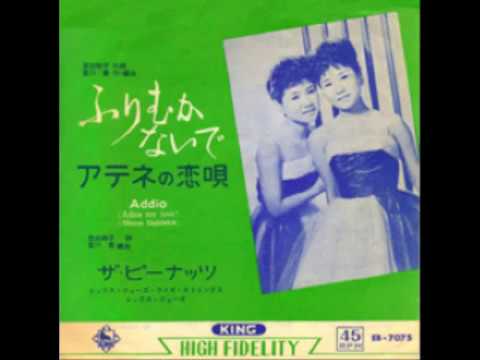
The Peanuts were a sister duo consisting of Emi Ito and Yumi Ito, acclaimed not only in Japan but also overseas.
“Furimukanaide” is a single released in 1962 and has been covered by various singers, including Candies and Yasuko Matsuyuki.