

[Stylistic Techniques] A Collection of Ideas Useful for Graduation Projects


Are you struggling to come up with an idea for your graduation project? A graduation project, the culmination of your school life, is something special.
That’s exactly why it’s so hard to decide what to make.
In this article, we’ll introduce plenty of graduation project ideas, starting with stained glass.
We’ve gathered a wide range—from projects you can tackle with classmates to ones you can take on individually.
Use this as a reference, add your own creative touches, and make a memorable piece!
- A collection of moving graduation illustrations that will bring tears to your eyes. Memorable ideas.
- Feelings That Reach the Heart! Handmade Gift Ideas to Give at Graduation
- A graduation surprise that delivers heartfelt emotion: a collection of memorable ideas
- [Heartfelt] A Collection of Japanese Graduation Songs to Sing and Play on Guitar [2026]
- [Graduation Song] A tear-jerking track sung by an idol! A moving piece depicting friendship and gratitude [2026]
- Let's make a handmade graduation certificate! A collection of memorable design and crafting ideas
- Heartwarming surprise ideas that will excite everyone at school
- A graduation song that's trending and popular on TikTok. A perfect track for memory videos.
- A gift to give your teacher at graduation that conveys your gratitude
- [For High School Students] A Collection of Touching Friendship Songs
- [For Middle Schoolers] Recommended Classic Songs to Sing at Graduation Ceremonies
- From classic choral pieces to popular J-pop! Moving songs you’ll want to sing at graduation ceremonies
- How to Write a Graduation Essay That Conveys Your Feelings: A Collection of Moving, Ready-to-Use Example Ideas
[Rhetorical Techniques] A Collection of Ideas Useful for Graduation Projects (21–30)
Sputtering
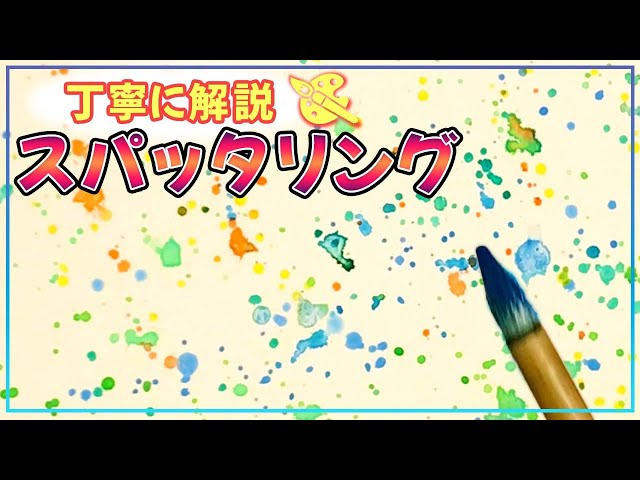
We’ll introduce techniques that can be used for watercolor painting and more.
Splatters (spattering) refers to a method where you load paint or ink onto a brush, then rub it over a fine mesh or similar surface to scatter it in fine particles.
In the video, it covers the basics of spattering using two brushes, as well as techniques that use a toothbrush and wire mesh.
With a bit of creativity, you can incorporate it into any kind of artwork, so be sure to give it a try.
dripping

A modern technique that kids and adults can try together! One type of dripping technique, called “blowing,” involves placing thinned paint on paper and blowing through a straw or with your mouth to enjoy the unique patterns and trails that form by chance.
Part of its appeal is that no two patterns can ever be exactly the same, and you can express individuality through your choice of colors and the strength of your breath.
In the video, we introduce the basic steps and fundamentals of dripping.
Be sure to use it as a reference!
[Rhetorical Techniques] A Collection of Ideas Useful for Graduation Projects (31–40)
finger painting

You hardly need any tools! Finger painting is an art technique where you apply ink or paint directly to your hands and fingers and paint without using brushes or stencils.
One of its charms is the freedom to express yourself while enjoying the cool feel of the paint and the way colors blend together.
The video compiles techniques that even beginners can try and shows the steps for creating a piece.
Each work turns out beautifully, so why not try it with your classmates as a way to commemorate your graduation?
Modeling

Among CG designers, there are 3D modelers who create forms that make characters appear three-dimensional.
Their work spans many fields, including creating characters and backgrounds for games and anime, prototyping figures, and modeling industrial products.
Some of you may aim for this path after graduation.
If you have access to a modeling environment, why not try creating a graduation project? On a computer, you combine points, lines, and surfaces to build three-dimensional shapes.
You might end up with something interesting or a wonderful piece of work.

Fun for kids too! Fluid Art

Let’s try making an interesting piece using acrylic paints.
Put several colors of paint and liquid laundry starch (or glue) into separate paper cups and mix each well.
Then pour all the paints and starch together into one paper cup, and pour that onto drawing paper (Kent paper).
You can create a work with flowing patterns where the paints don’t fully blend.
Watching the paint flow is fascinating, making this perfect for young children’s art projects.
Because the flowing patterns are unique, you can create a one-of-a-kind, original piece.
Combining fluid art with other techniques also seems like a great way to broaden the scope of your work.
A painting technique using only a brush

If your graduation project is a painting, using a variety of painting techniques will help you finish it in a way you really like.
For example, you can dab the paper with a paint-loaded brush like making dots, or wet the drawing paper first and then apply paint.
With a few tweaks and creative touches to your technique, you can achieve a wide range of expressions through painting alone.
Some people might even find themselves impressed, thinking, “I didn’t know you could paint like this,” as they work.
This is a method that can be applied to everything from postcard- or photo-sized pieces to large-scale works on big sheets of paper.
lithograph

Lithography, a technique that uses the repellent action of water and oil, is a type of printmaking in which an image drawn on a flat stone or metal plate is transferred onto paper.
Although it is one form of printmaking, it is said to excel at expressing beautiful lines and touches, and is known for enabling richer color expression.
In the video, the process is organized into four steps so you can try lithography yourself! How about printing your carefully crafted design with lithography? It seems like it could lead to a valuable experience.