

You can see philosophy and a way of life through words. Short famous quotes by historical figures.

When asked to name someone who achieved great feats and etched their name into history, who comes to mind?
Many of us learned in school about people who created ideas and things that are now taken for granted, or those who laid the foundations of culture.
This time, we’ve compiled a list of short quotes left by especially famous historical figures—names that almost everyone has heard at least once.
Each quote reveals the person’s philosophy and way of life, so be sure to check them out!
- Witty quotes by great figures and celebrities where wordplay shines even in brevity
- Beautiful words by great and famous people that illuminate life
- Uplifting words by great figures and famous people that, despite their brevity, convey a sense of philosophy.
- A collection of quotes from people of the past: messages from famous military commanders and great figures of the world.
- Gives you the power to overcome entrance exams! Short quotes by great and famous people.
- Words from great and famous people that make you forget negativity in an instant!
- Famous quotes everyone knows, including words from great figures and characters
- Just remembering them fills you with courage! Striking quotes that touch the heart from great figures and famous people
- You might even find your motto—short phrases that leave a lasting impression.
- That one line is sure to jolt you! Short but cool words
- Knowing this will surely ease your heart… Comforting words from great and famous people.
- Short maxims by great figures that you’ll want to etch into your heart and remember
- Cherish each and every day! Let your life shine with profoundly moving, supreme quotes.
You can see philosophy and way of life through words. Short famous quotes (21–30) by historical figures
To love is to layer your own happiness over another’s.Gottfried Leibniz

Gottfried Leibniz—often called an intellectual giant—wore many hats: philosopher, mathematician, thinker, politician, and diplomat.
He left us numerous maxims and famous sayings, and this one is a striking reflection on love.
I believe it is extremely difficult to align one’s own happiness with another’s.
Each person’s notion of happiness differs, and even two people in love are unlikely to have theirs overlap perfectly.
Yet perhaps it is precisely for that reason that our capacity to love is proven there.

Only by living desperately does one’s life shine.Oda Nobunaga

Lord Oda Nobunaga, a warlord counted among the Three Unifiers of the Sengoku period for his innovative political methods.
From his famous saying, “It is only by living desperately that one’s life shines,” we can truly sense the very essence of Oda Nobunaga’s life.
Not only should we act energetically with dreams and goals, but it is by throwing ourselves wholeheartedly into the act of living itself that our lives gain profound meaning.
This message teaches us that such a way of living becomes the proof that we truly lived and allows us to create a life uniquely our own, unlike anyone else’s.

You can see philosophy and ways of life through words. Short quotes (31–40) by historical figures
Beneath mud and earth lies solid rock; above clouds and mist shines the sun. At the height of discontent, there is still fortune, nor is hope absent.Kanzo Uchimura

I would like to introduce a famous saying by Kanzo Uchimura: “Beneath the mud lies bedrock; above the clouds and mist shines the sun.
Even at the height of complaint, happiness and hope are not absent.” Kanzo Uchimura was a Christian thinker active in the Meiji era.
Disasters can bring many hardships.
At such times, Uchimura left words he hoped we would remember.
It is said to mean that even when times are painful and difficult now, a stable and bright future surely awaits beyond.
He likens difficult situations to mud, and the bedrock represents the strength within us that lies beneath these serious problems.
Furthermore, he tells us that even when we feel or voice complaints, happiness and hope still exist.
Life brings all kinds of experiences, doesn’t it? Even so, we are reminded of the importance of maintaining a positive outlook.

Nature is an impartial and merciless enemy. Society is an unjust enemy with human sentiment.Soseki Natsume
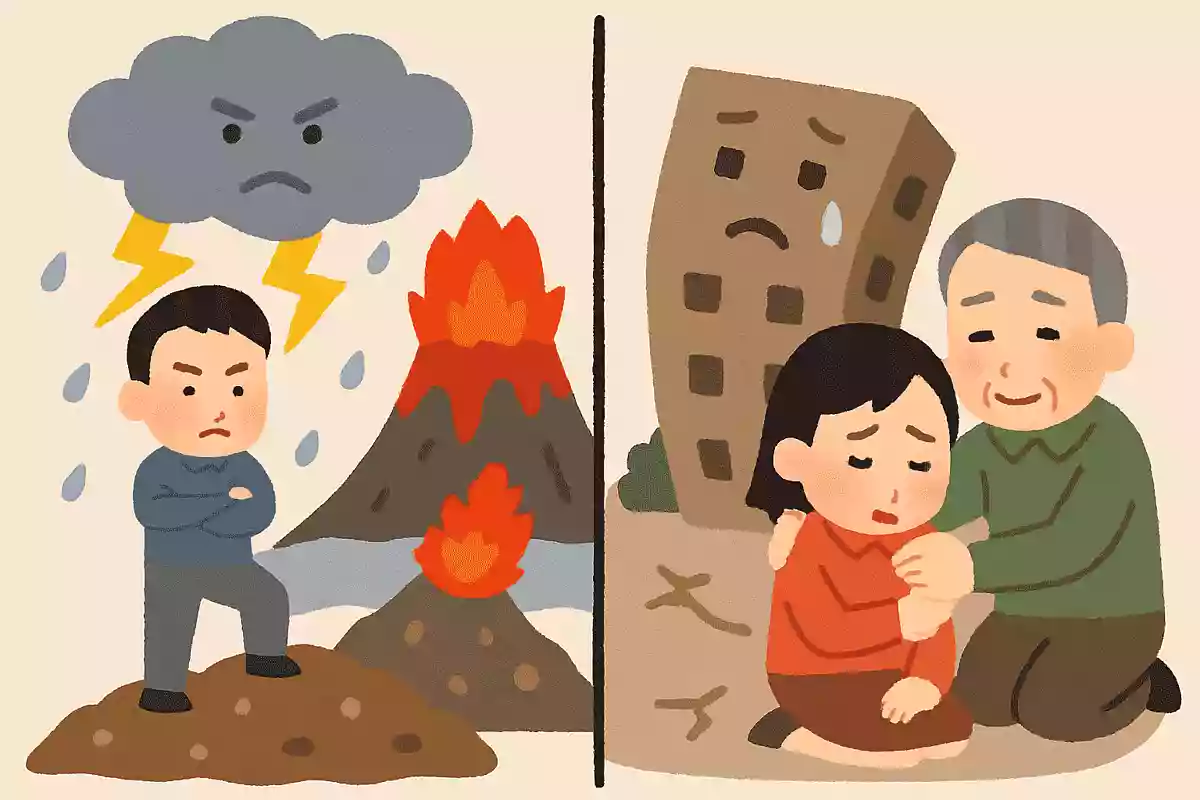
Let me introduce a famous quote by Natsume Sōseki: “Nature is a fair yet ruthless enemy.
Society is an unjust yet compassionate enemy.” Natsume Sōseki was a Japanese novelist and scholar of English literature.
His major works include I Am a Cat, Botchan, Sanshirō, And Then, Kokoro, and Light and Darkness.
This line—“Nature is a fair yet ruthless enemy.
Society is an unjust yet compassionate enemy.”—appears in his work Reminiscences.
It’s a quote that encourages us not to underestimate nature and to prepare for natural disasters.
Natural disasters strike when we least expect them.Torahiko Terada

Here is a famous and important saying by Torahiko Terada: “Natural disasters strike when they have been forgotten.” Terada was a Japanese physicist, essayist, and haiku poet.
As a researcher, he was interested in disasters such as fires and earthquakes, and it is said that after the 1923 Great Kanto Earthquake, he became even more deeply engaged with the subject.
This quote reminds us that the peaceful passing of everyday life without incident is not something to be taken for granted.
It is a phrase worth engraving in our hearts.
In one’s whole life, never harbor greedy desires.Miyamoto Musashi

People are often ruled by desire, aren’t they? There are surely those who live their whole lives steeped in it.
In the midst of that, Miyamoto Musashi declared that he would have no desire.
Perhaps he understood well that harboring desire would ruin him.
He was a very stoic person.
And this quote also seems to express a resolve: if you think “a little is fine” and let desire in, it will pull you along and ruin the path you were striving to master—so don’t have it at all.
When you feel you’re about to be ruled by desire, remember these words.

The heart never strays from the Way.Miyamoto Musashi

Many of the disciplines regarded as traditionally Japanese—such as kendo, judo, and aikido—include the character for “dō” (the Way) in their names.
And although they are not sports, ikebana (kado), the tea ceremony (sado), and kōdō (the way of incense) also use this character.
This may be a somewhat self-serving interpretation, but I suspect Japanese people applied the character “dō” to practices that require long years of training.
Of course, Miyamoto Musashi’s “dō” refers to the Way of swordsmanship.
To think of nothing but that, whatever one is doing—this strikes me as a grand word that encapsulates Musashi himself.