

[Conductor] A Japanese conductor. Recommended Japanese conductors.

Do you know any Japanese conductors? Centered in Europe, classical music has been loved by people from many countries and widely popularized by numerous performers and the conductors who lead them.
There are many renowned conductors like Karajan, and a conductor’s interpretation can change the atmosphere of the same piece so much that it often determines which concert audiences choose to attend—making conductors truly essential.
While foreign conductors’ names may roll off the tongue, how many Japanese conductors can you name? Foreign conductors are outstanding, but Japanese conductors are no less impressive.
In this article, we’ll introduce Japanese conductors active in Japan and abroad—from principal conductors and music directors, to familiar faces in orchestral concerts of video game and anime music, to popular wind band conductors, and those who have founded Japan-based ensembles to showcase the appeal of Japan’s classical music scene.
- Masterpiece Performances: Introducing Japan’s World-Renowned Pianists and Their Iconic Performances
- Ranking of popular classical pieces
- Popular classical piano pieces. A collection of masterful performances by Japanese pianists.
- [2026] Japan’s Leading Famous Drummers — From Veterans to Rising Stars
- Classical music by Japanese composers. Recommended classical music.
- 【2026】A Collection of Beloved Japanese Classics Worldwide【JAPAN MUSIC】
- From Fast Picking to Acoustic: Famous Japanese Guitarists
- YOSHIKI's famous and popular songs
- Only famous artists! Anime songs that energize the Reiwa era
- [Japanese-style Piano Pieces] A selection of recommended works with a pleasantly Japanese flavor
- [Japan] A collection of J-pop with a traditional Japanese (wa) vibe and Japanese-style taste
- Cute masterpieces of J‑Pop: recommended popular songs
- [J-POP] For those who want to listen to everything! A compilation of medleys by popular artists
[Conductor] Japanese conductors. Recommended Japanese conductors (21–30)
Symphony No. 1 in C minor, Op. 68 / Senzoku Gakuen College of Music OrchestraAkiyama Kazuyoshi

Kazuyoshi Akiyama, one of Japan’s leading conductors, is highly regarded in the world of classical music.
After graduating from Tokyo University of the Arts, he studied at the Berlin University of the Arts, and has since been active both in Japan and abroad.
Born in Tokyo in 1964, Akiyama has made remarkable achievements in contemporary composition and conducting, receiving numerous awards for both.
With a musicality that combines technical sophistication and emotional depth, he captivates audiences.
He also serves as Artistic Advisor to the Osaka Shion Wind Orchestra, making him a familiar figure to those with a background in wind ensembles.
He is a conductor recommended not only for those interested in classical music but also for anyone interested in Japanese musical culture.
Proof of a Hero / Tokyo Philharmonic OrchestraKurita Hirofumi

This is Hirofumi Kurita, a Japanese conductor who has earned high acclaim primarily for conducting concerts of video game and anime music.
He studied at Tokyo College of Music and made his debut after winning first prize at the Tokyo International Music Competition in 1988.
With a wide-ranging repertoire from classical to contemporary works, he also achieved the top distinction at the Sibelius International Conductors’ Competition in 1995.
In addition to orchestral conducting, he is active in the fields of game and anime music.
He has showcased his skills in orchestral concerts for titles such as Girls und Panzer and the Monster Hunter series, receiving high praise.
He’s a recommended conductor not only for classical music fans but also for those who want to enjoy game music.
Overture to the opera “Ruslan and Lyudmila” / City of Birmingham Symphony OrchestraYamada Kazuki

Kazuki Yamada, born in 1979 in Kanagawa Prefecture, is a conductor active both in Japan and abroad.
After graduating from the Tokyo University of the Arts, he conducted numerous orchestras with a wide-ranging repertoire and a distinctive musical voice, winning many competitions.
His victory at the 2009 Besançon International Competition for Young Conductors was a remarkable achievement, making him the seventh Japanese winner.
He has served as Music Director of the Tokyo Philharmonic Chorus and Principal Guest Conductor of the Orchestre de la Suisse Romande, and in 2017 he received the New Artist Award from Japan’s Ministry of Education, Culture, Sports, Science and Technology.
He is currently the Chief Conductor of the City of Birmingham Symphony Orchestra.
Highly recommended not only for classical music fans but also for anyone interested in emerging talent.
Pomp and Circumstance March No. 1 in D major / Tokyu Silvester Concert 2012Fujioka Yukio

Yukio Fujioka, who began playing the piano at age four and the cello at ten, graduated from the Conducting Department of the Royal Northern College of Music in the UK.
In 1992, when he conducted Concerto for Orchestra at the Lutosławski Festival in Manchester before the composer himself, he was lauded as “a conductor with immeasurable promise.” He is a conductor known for leading performances that are powerful and crisp, and he possesses a deeply passionate spirit.
From 1995, he conducted the Manchester Camerata and the Japan Philharmonic Orchestra, and since 2000 he has been active as the Principal Conductor of the Kansai Philharmonic Orchestra.
He is one of the Japanese conductors from whom great achievements are expected in the future.
Symphonic Poem “Finlandia”Matsuo Yoko

Yoko Matsuo is a Japanese female conductor.
Known for uniting orchestras with her rich melodies and distinctive musicality, Matsuo’s music is highly acclaimed by many music enthusiasts.
She showed a deep interest in music from childhood and blossomed as a talented musician at a young age.
She made her name with the symphonic poem Finlandia and has since collaborated with renowned orchestras in Japan and abroad, conducting at numerous music festivals.
Her activities extend beyond composing, arranging, and conducting to producing music projects and mentoring young musicians.
Matsuo’s music blends tradition and innovation, opening up new possibilities for classical music.
The Blue Danubeasahina chitari

Chitaru Asahina studied clarinet under Heinrich Geuser at the Berlin University of the Arts, and further studied conducting while serving as an assistant to the music director of the Berlin State Opera.
Takashi Asahina, who served as the principal conductor of the Osaka Philharmonic Orchestra for 54 years, is Chitaru’s father.
As a Japanese conductor, Chitaru has appeared as a guest with major orchestras in Japan, including the Kyoto Symphony Orchestra, the Tokyo Metropolitan Symphony Orchestra, and the New Japan Philharmonic, and has also appeared on the TV program “Untitled Concert.”
Swan of TuonelaWatanabe Akio
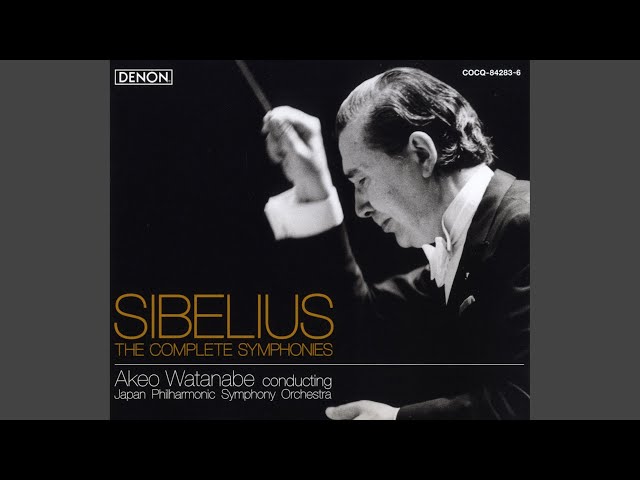
An indispensable figure in the development of classical music in Japan is the conductor Akio Watanabe.
Born in Tokyo Prefecture to a Finnish vocalist, Siri Watanabe, he began piano at age five and violin at age ten, later studying at the Tokyo Music School (now Tokyo University of the Arts) and performing as a violinist and violist.
After performing with orchestras in Japan, he became the resident conductor of the Tokyo Metropolitan Philharmonic Orchestra (now the Tokyo Philharmonic Orchestra) in 1945 and went on to become one of Japan’s leading conductors.
He also devoted himself to nurturing younger generations, mentoring figures active in Japan such as Hiroshi Hoshina, Hiroyuki Iwaki, Naotsugu Yamamoto, Ken-Ichiro Kobayashi, and Yukio Fujioka, and contributed to the founding of the New Japan Philharmonic, among other efforts to advance classical music in Japan.
Symphony in Three Movements, a work commissioned by the Japan Philharmonic Orchestra from the eminent Japanese composer Akira Miyoshi, received its premiere in 1960 under Watanabe’s baton.