

![[Conductor] A Japanese conductor. Recommended Japanese conductors.](https://i.ytimg.com/vi/d5-sCPQrlT0/sddefault.jpg)

Do you know any Japanese conductors? Centered in Europe, classical music has been loved by people from many countries and widely popularized by numerous performers and the conductors who lead them.
There are many renowned conductors like Karajan, and a conductor’s interpretation can change the atmosphere of the same piece so much that it often determines which concert audiences choose to attend—making conductors truly essential.
While foreign conductors’ names may roll off the tongue, how many Japanese conductors can you name? Foreign conductors are outstanding, but Japanese conductors are no less impressive.
In this article, we’ll introduce Japanese conductors active in Japan and abroad—from principal conductors and music directors, to familiar faces in orchestral concerts of video game and anime music, to popular wind band conductors, and those who have founded Japan-based ensembles to showcase the appeal of Japan’s classical music scene.
- Masterpiece Performances: Introducing Japan’s World-Renowned Pianists and Their Iconic Performances
- Ranking of popular classical pieces
- Popular classical piano pieces. A collection of masterful performances by Japanese pianists.
- [2026] Japan’s Leading Famous Drummers — From Veterans to Rising Stars
- Classical music by Japanese composers. Recommended classical music.
- 【2026】A Collection of Beloved Japanese Classics Worldwide【JAPAN MUSIC】
- From Fast Picking to Acoustic: Famous Japanese Guitarists
- YOSHIKI's famous and popular songs
- Only famous artists! Anime songs that energize the Reiwa era
- [Japanese-style Piano Pieces] A selection of recommended works with a pleasantly Japanese flavor
- [Japan] A collection of J-pop with a traditional Japanese (wa) vibe and Japanese-style taste
- Cute masterpieces of J‑Pop: recommended popular songs
- [J-POP] For those who want to listen to everything! A compilation of medleys by popular artists
[Conductor] Japanese conductors. Recommended Japanese conductors (1–10)
Indicator of Advanced Technology / Siena Wind OrchestraSado Yutaka
This is Yutaka Sado, a conductor admired throughout the Japanese wind band world.
Born in Kyoto, Sado has close ties to wind music, having played the flute in his school wind band, and he has made broad, approachable contributions to Japan’s music scene, including serving as host and conductor on The Untitled Concert.
He studied under Seiji Ozawa and Leonard Bernstein, won the Besançon International Conducting Competition in 1989, has conducted the Siena Wind Orchestra—Japan’s leading professional wind ensemble—served as a guest conductor with the Berlin Philharmonic, is Artistic Director of the Hyogo Performing Arts Center Orchestra, and, since April 2023, Music Director of the New Japan Philharmonic.
He is one of the conductors indispensable to Japan.
Boléro / Russian Bolshoi Symphony OrchestraNishimoto Tomomi

After graduating from the Composition Department of Osaka College of Music, Tomomi Nishimoto studied conducting at the Rimsky-Korsakov St.
Petersburg State Conservatory in Russia.
She is one of the few female conductors in the classical music world and is particularly popular among women.
In 2004, she was appointed Artistic Director and Principal Conductor of the Tchaikovsky Foundation’s Russian Symphony Orchestra.
Since then, she has conducted around the world, and in October 2014, she became the first Japanese recipient of the “Honorary Award” from the Vatican’s Fondazione Pro Musica e Arte Sacra.
Under Artistic Director Tomomi Nishimoto, the IlluminArt Philharmonic Orchestra was formed by principal players with award-winning backgrounds from orchestras in Japan and abroad, contributing to Japan’s classical music scene.
Suite ‘The Planets,’ Op. 32 / Sendai Philharmonic OrchestraŌta Gen

Conductor Gen Ota is drawing attention in the classical world as a young talent.
He graduated at the top of his class from Tokyo University of the Arts and currently serves as the principal conductor of the Kyushu Symphony Orchestra.
He specializes in large-scale symphonies, including Mahler and British music.
He had his first full-fledged conducting experience in his freshman year of university, which launched his career.
Among his notable recordings is a live album with the New Japan Philharmonic, Schubert: Symphony No.
8 (9) “The Great,” released in February 2021, whose taut, energetic performance created a major buzz.
In 2015, he won second prize and the Audience Prize at the Tokyo International Music Competition at the record-young age of 21.
His meticulously crafted music—often described as “refined and lucid”—may be perfect for those who want to savor the structural beauty of the works or feel the passion of a young maestro.
Fantasia on Osaka Popular Songs / Osaka Philharmonic OrchestraAsahina Takashi

Takashi Asahina is the founding father of the Osaka Philharmonic Orchestra and an indispensable figure when discussing classical music in the Kansai region.
Born in Tokyo in 1908, he made his professional debut in 1940 with the New Symphony Orchestra.
He served for an extraordinary 55 years as the music director of the Osaka Philharmonic Orchestra, repeatedly recording complete cycles of Beethoven’s and Bruckner’s symphonies.
Highly acclaimed both in Japan and abroad, he received numerous honors, including the Order of Culture.
Asahina’s passionate conducting brings out the full allure of classical music.
His profound interpretations—centered on the German repertoire—and his powerful musicality captivate classical music fans and never let go.
Overture from the Incidental Music “Egmont,” Op. 84Yamashita Kazufumi

Kazufumi Yamashita is a world-renowned conductor who once served as an assistant to the legendary Herbert von Karajan.
He made his debut in 1988 conducting the NHK Symphony Orchestra and has since wielded the baton across a wide spectrum, from orchestral concerts to opera.
In addition to his brilliant achievement of winning the 1986 Nicolai Malko International Conducting Competition, one story that has become the stuff of legend among music fans is that in the same year he stepped in for the suddenly ill Karajan and conducted the Berlin Philharmonic wearing jeans.
The passionate, grand-scale music he draws from the ensemble moves listeners to their core.
He is the perfect conductor for those who want to experience world-class performances or immerse themselves in the dramatic world of opera.
Prelude to Act I from ‘Die Meistersinger von Nürnberg’ / Tokyo Symphony OrchestraŌtomo Naoto
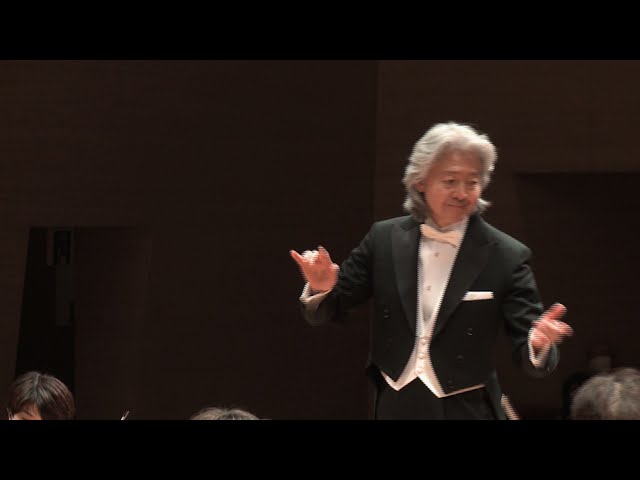
Naoto Otomo, a conductor who made his early debut with the NHK Symphony Orchestra and has continued to lead Japan’s music scene.
Beyond the core classical repertoire, he has captivated many fans with cross-genre projects, such as conducting the 1984 Uchū Senkan Yamato Grand Symphony, which transformed the music of the popular anime into a grand symphonic work.
His distinguished accolades, including the Hideo Saito Memorial Fund Award, attest to his artistry.
Equally striking is his passion for nurturing the next generation and promoting culture—rooting classical music in Okinawa as a music director and launching an educational music festival.
He is a conductor to watch for anyone who wants to experience how an orchestra’s sound changes under different batons, or who wants to enjoy a variety of musical genres performed by an orchestra.
Symphony No. 5 (Tchaikovsky) / New Japan Philharmonic OrchestraKobayashi Kenichirō

Ken-Ichiro Kobayashi, affectionately known as “Kobaken of Fire,” lives up to his nickname: the passionate music that bursts forth from the podium seems to breathe life into the orchestra.
His international career began when he won first prize at the Budapest International Conductors’ Competition in 1974.
Among his many milestones, it is widely known that in 2002 he became the first Asian conductor to lead Smetana’s Má vlast at the opening of the Prague Spring International Music Festival, receiving thunderous acclaim.
The sight of him expressing the music with his whole body, hair flying, conveys the dynamic allure of classical music.
He is a maestro I urge anyone to experience at least once—especially those who wish to be moved by the orchestra’s energy.