

[Dance Basics] Simple Choreography for Middle School Students


You probably have a lot of chances to dance at events like sports festivals and culture festivals.
For people who already do dance as a hobby or take lessons, being good at it might be a given, but beginners often don’t even know the names of the moves.
Here, we introduce easy-to-understand basic steps and choreography for dance beginners.
Once you learn the basic movements, you’ll find that trending dances on social media are easy to do!
Try combining different moves and use them as inspiration for your own original dance!
- Easy-to-dance songs [Perfect for dance beginners]
- [Easy to Remember] A Collection of Cool Dances Recommended for Girls
- [Even Dance Beginners Are Welcome!] Dance Songs You Can Perfectly Copy
- Dances that elementary school kids can do! Recommended tracks to liven up a school sports day
- [Must-See for Beginners] Amazing Pop Dance Choreography
- [Easy-to-dance dance tracks] Gentle K-pop dance numbers
- [For Creative Dance] A Collection of Easy-to-Dance Japanese and Western Tracks
- [Dance Tracks] Perfect for School Sports Days! A Curated Selection of Fun, Popular Songs to Dance To [2026]
- In season now? Popular Japanese dance music among junior high school students
- Cool Dance Moves! A Roundup of Popular Girl Idol Groups
- A must-see for street dance beginners: A roundup of basic steps for each genre.
- Get into it! Dance to it! Enjoy it! Best J-POP Dance Tracks
- Helpful for creative dance! Steps and choreography. Tips for dancing cool.
[Dance Basics] Simple Choreography for Middle School Students (21–30)
club step

The club step is a basic dance step where you move side to side with your knees turned inward.
First, place your feet a little narrower than shoulder-width apart.
Then, to move to the right, shift your weight onto the heel of your right foot and the toes of your left foot.
To move to the left, shift your weight onto the heel of your left foot and the toes of your right foot.
Once you’ve mastered this basic motion, you can add all kinds of variations.
Its comical look makes it a good match for upbeat, pop-style music.
However, it’s also a movement that can easily strain your knees, so be sure to warm up thoroughly before practicing!

down chest

The down-chest is a move where you keep rhythm while pulling your chest backward.
The key is to imagine someone pressing into your solar plexus and to make a big, full-body motion to cave your chest in.
Once you get used to it, try extending your arms forward or lowering your hips at the moment you cave your chest—your choreography will instantly level up and look cooler! That said, a routine using only the down-chest can feel a bit lacking, so it’s best to incorporate it between other moves.
It works not only with dance music but also with rock tracks, so give it a try.

[Dance Basics] Easy Dance Choreography for Junior High School Students (31–40)
Charleston

It’s a bit tricky, but a great step to try for hip-hop-style tracks is the Charleston.
Start by practicing the move called “pata-pata,” where you first turn your heels outward and then quickly turn them inward as you step.
Once you’ve got that down, combine it by walking while crossing your feet forward and backward at the same time as the pata-pata motion.
Finally, add a lift of your foot timed with the moment your heels turn outward in the pata-pata, and you’re done.
It can be tough until you get used to it, so take it slow and practice each part while referring to videos on YouTube and the like!
Twell & Lock

This is a combination of “Twirl” and “Lock,” which are fundamental shapes in Locking.
First, the Twirl is a movement where you rotate your wrist twice in sync with the up (bounce) motion.
The key points are to relax your wrist and coordinate your elbows and shoulders with the up.
The Twirl fits into the flow of the dance, while the Lock creates the hit or accent—so you move with the Twirl and make your punctuation with the Lock.
Adopt a slightly hunched posture, put your weight on the supporting leg, extend both arms lightly forward, and open the elbows to brace your body.
Since sharpness is crucial in Locking, it’s important to engage and tighten at the accents.
It’s recommended to incorporate this to tracks with emphasized rhythmic beats.
With fast-tempo songs, the movements can become too flowy, so it’s best to start with slower tracks and gradually get used to it.

Paper Goo-Goo Paper Goo
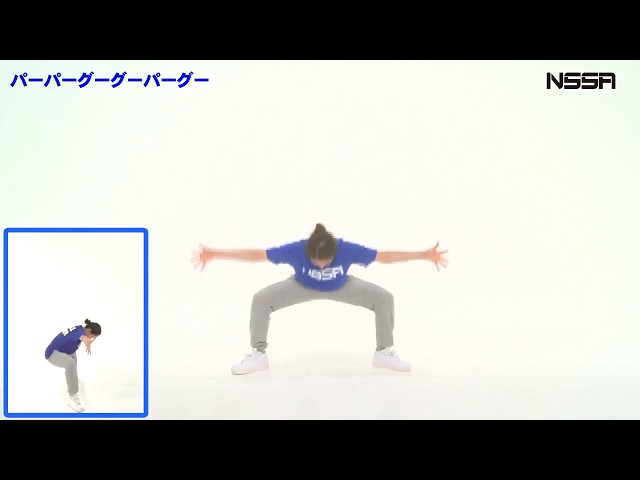
For those looking for simple yet dynamic choreography, I recommend a move called pa-pa, goo-goo, pa-goo.
On the first “pa,” extend your right hand and right foot forward; on the next “pa,” extend your left hand and left foot forward.
With the two “goo” beats, close both your hands and feet to the center.
For the final “pa-goo,” extend both hands and feet at once, then bring them back in.
Since we don’t usually move the hand and foot on the same side simultaneously, it might be tricky at first.
But once you get used to it, your body will start moving automatically.
Because it uses space broadly, it also works well for the chorus of a song where you want to add impact.
Inverted jump

The step characterized by large up-and-down movement is the “reverse jump.” Swing your arms widely backward and move your legs back to match.
As you land, open your legs and drop your body low.
Because it ends in a low position, it works well as a transition into movements that start low.
It’s a simple move that makes your body look big, so it’s a handy technique you can use as part of choreography for almost any genre of music.
Brooklyn

Brooklyn is characterized by movements that open the legs and arms outward from the center to the left and right.
The choreography is simple yet powerful, making it a perfect match for hip-hop or dance music with heavy beats.
The key is to stay mindful of your body’s center so your position doesn’t shift as you dance.
Start with your legs turned inward and open them outward to both sides.
Go up on your toes here, aiming for dynamic motion.
For the upper body, push your chest forward and repeatedly swing your arms left and right.
Keep the overall concept of opening from the inside out in mind.
This choreography is recommended for those trying an energetic number in creative dance.

In conclusion
The dance steps and choreography—they look doable when you watch clear tutorial videos, don’t they? Each one carefully teaches you with slow and mirrored versions, so every piece seems very easy to dance. I highly recommend these for anyone who wants to start dancing as a hobby, so be sure to make use of them.