

Kids go wild! Popular hand games and fun sing-alongs

Kids love fingerplay! When the teacher cheerfully sings and moves their hands, the children’s eyes light up as if to say, “What’s starting?” They gaze intently or try to imitate, showing such adorable reactions.
Fingerplay is essential in early childhood settings—for introducing activities or drawing children’s attention.
So this time, we’re introducing popular fingerplays and action songs for kids.
From classic routines often used in nurseries and kindergartens to trendy new ones, we’ve got plenty that will captivate children.
Find options that match their interests and age, and give them a try!
- [Hand Play] Popular with kids! A collection of trendy hand-play songs and nostalgic traditional children’s songs
- [Childcare] Fun Rhythm Play! Recommended Games and Hand-Clapping/Hand-Play for Kids
- Get excited! A list of popular and fun hand games that captivate children
- Popular hand games and hand game songs for toddlers and children! Full of ideas for childcare/early childhood education.
- [Parenting] Parent-child bonding! Hand-play songs and traditional nursery rhymes collection
- [For 1-year-olds] Fun Together! Recommended Songs and Hand Play Collection
- Traditional Games: Fun Old-Time Play. Popular Activities Useful in Childcare
- Useful for childcare! Today’s recommended recreational activities, including fingerplay and games!
- Hand games toddlers and infants can do. Popular hand play songs in childcare
- [For 0-year-olds] Recommended songs for babies: A special feature on bonding play and traditional nursery rhymes
- [Children's Songs] Cute songs recommended for childcare. List of popular nursery rhymes.
- [Music Play] Children’s Recreational Music: Rec Songs You Can Sing and Play
- Recommended for daycare activities! A Halloween song you can sing and play with
Kids Will Love It! Popular Hand Play and Fun Singing Games (1–10)
tangledSuzuki Tsubasa・Fukuda Sho

This song delivered by Tsubasa Suzuki and Sho Fukuda is perfect for children’s favorite hand-play games.
The lyrics, which depict tangled-up ninjas and rabbits, are full of humor and are sure to bring smiles.
It’s included on the album “Shokun-Tsukun no Karamatta Tehe!” released in July 2016, and has become popular in nursery schools and kindergartens.
The rhythmic choreography and the cute little “Tehe!” at the end are sure to capture children’s hearts.
It’s a recommended track for times when everyone wants to enjoy hand-play together, such as during morning meetings or at the end of the day.
Horn, horn, hoooorn!Suzuki Tsubasa・Fukuda Sho

A singing game that excites children’s “I wonder what it is?” mood: “Tsuno Tsuno Tsū-no.” The choreography—swaying the ‘horns’ you make with your index fingers to a relaxed rhythm—is super cute, isn’t it? The unique lyrics that make kids think, “What will come next?” are fun and spark their curiosity, and they also seem to help them develop the ability to listen attentively.
A rapid parade of many animals appears, so children who love animals will be thrilled.
Be sure to belt out the final “None!” with lots of energy and have fun!

Mitsuya CiderOhtaki Eiichi

The hand game inspired by the refreshing fizz of Mitsuya Cider is a big hit with kids! The choreography, which uses fingers to count numbers as you go, also helps with number learning.
With its breezy rhythm and fun movements, it’s perfect for keeping spirits high even in hot weather.
It’s ideal for starting an activity or when you want to draw everyone’s attention.
When teachers and children enjoy it together, it creates summer memories too.
You can freely adapt it by changing the tempo to suit different ages or having pairs face each other to play.
You can just picture the children’s eyes sparkling with excitement!
Kids will love it! Popular hand games and fun sing-alongs (11–20)
Dango, dango, they stuck together.

Let us introduce the hand-play song “Dango Dango Stuck Together,” which is very popular with children.
This song has a humorous theme in which dumplings end up sticking to various parts of the body, capturing kids’ interest.
As you sing, you move your hands and feet, making it a fun way to learn rhythm and body movement.
It’s especially popular during the autumn moon-viewing season, so it also conveys a sense of the season.
The choreography is simple, so even very young children can enjoy it.
We also recommend singing and playing together with parents or guardians.
It’s sure to be a delightful time full of smiles!
A bamboo shoot has sprouted.warabeuta asobi
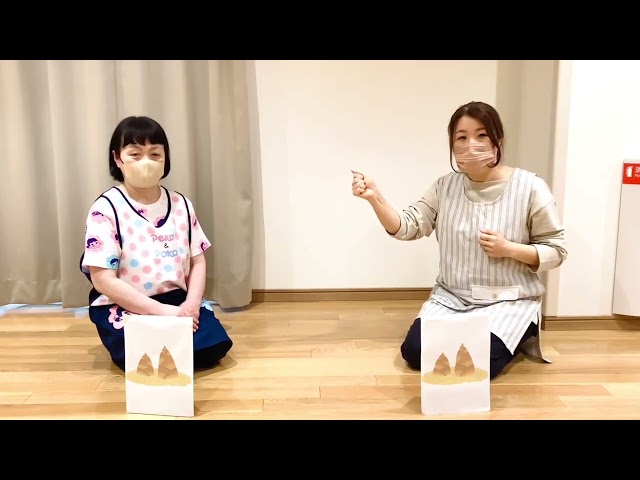
A children’s hand-play song that vividly expresses the growth of bamboo shoots, which are in season from spring to early summer.
Through hand motions, kids enjoy the story of a sprout emerging from the soil, a flower blooming with a pop, and finally being snipped with scissors.
Because the rock-paper-scissors hand shapes—fist, scissors, and open hand—are naturally built into the actions, it’s also perfect for helping children learn the rules of the game.
Though it’s a traditional folk song passed down through generations, its introduction on children’s programs like those on NHK has helped it become a familiar group activity in preschools and kindergartens.
It typically ends with everyone chanting “Essa, essa!” together and deciding the winner with rock-paper-scissors.
On a fresh May day under the blue sky, get moving energetically with your family and friends!
Shopping at the bakerySakushi: Sakura Tomoko / Sakkyoku: Ozawa Tatsuyuki

While playing both the customer and the baker, you can enjoy a fun hand-play activity set in a bakery—perhaps a relatively new song in the hand-play repertoire.
As you rhythmically act it out, you express different types of bread through gestures.
It might also be fun to come up with new kinds of bread yourselves and add corresponding gestures.

Crocodile familySakushi: Kamitsubo Maya / Sakkyoku: Mine Akira

A beloved, heartwarming piece is “The Crocodile Family.” It’s a hand-play song about the daily life of a crocodile family.
With lots of comical expressions, it’s something you can enjoy together in a lively way.
Plus, the choreography uses the whole upper body, so it doubles as light exercise.
When you portray the adult crocodile, use your whole arm as the jaw.
For the baby crocodile, use just your fingers.
It also includes swimming motions, which might spark kids’ interest in the pool.
