

[Trivia] A quiz to learn about the ecology and habits of medaka (Japanese rice fish)

Medaka, which are often kept at schools and in homes, are popular across a wide range of ages, from children to senior citizens.
Because aquariums and food for medaka are easy to prepare, they are kept in a variety of places, both indoors and outdoors.
Some people may want to deepen their knowledge about medaka, which are also beloved as ornamental fish.
In this article, we will introduce a quiz themed around the ecology and characteristics of medaka.
If you keep medaka or are interested in living creatures, be sure to give it a try.
- Surprisingly unknown? Trivia Quiz [Multiple Choice: 3 Options]
- Let's take on a four-choice quiz that everyone can enjoy together!
- [Knowledge Expander!] A Three-Choice Quiz about Fish for Elementary School Students
- [For Elementary School Students] 3-Choice Quiz to Deepen Knowledge of Living Things
- [For Seniors] Liven Things Up! Fun Fish Trivia Quiz
- Insect trivia quiz: A collection of fun facts and questions about bugs for children.
- [For Kids] Fun Facts & Trivia Quiz about Koinobori (Carp Streamers)
- Quiz on various kinds of fish
- [3-Choice Quiz] A quiz about foods that will make you hungry
- [For Elementary School Students] Animal Quiz to Learn Knowledge and Fun Facts
- [Trivia] Do you know the answers? A roundup of animal quizzes
- [Animal Quiz] Learn about animals through quizzes!
- Trivia: The Aquarium’s Crowd Favorite! A Quiz About Jellyfish
[Trivia] A Quiz to Learn About Medaka Ecology and Habits (1–10)
Which body function of the medaka (Japanese rice fish) is particularly well developed?

- vision
- hearing
- renal function
See the answer
renal function
Among the bodily functions of medaka, the renal function is particularly well developed. Because the kidneys of medaka can efficiently expel excess water and waste products from the body, they are highly resilient to changes in water quality and possess strong survival capabilities. Thanks to this advanced kidney function, medaka can survive in a variety of environments.

How can you tell male and female medaka apart?

- body color
- Shape of the dorsal fin and anal fin
- eye size
See the answer
Shape of the dorsal fin and anal fin
The most reliable way to tell male and female medaka apart is by looking at the shapes of the dorsal and anal fins. Male medaka have long, slender dorsal and anal fins, and during the mating season the anal fin often extends even longer. In contrast, female medaka have relatively round, short dorsal and anal fins. Keeping this difference in mind will help you identify the sex of medaka.
What is the average lifespan of wild medaka?

- 1 to 2 years
- 3–4 years
- 5–6 years
See the answer
1 to 2 years
The average lifespan of wild medaka is considered to be 1 to 2 years. This is because, in nature, they are easily preyed upon and are greatly affected by environmental conditions. In artificial environments, they may live a little longer with proper care, but remember that medaka are fundamentally very short-lived creatures.
[Trivia] Quiz on Medaka (Japanese rice fish) Ecology and Habits (11–20)
What is the scientific name of the medaka?
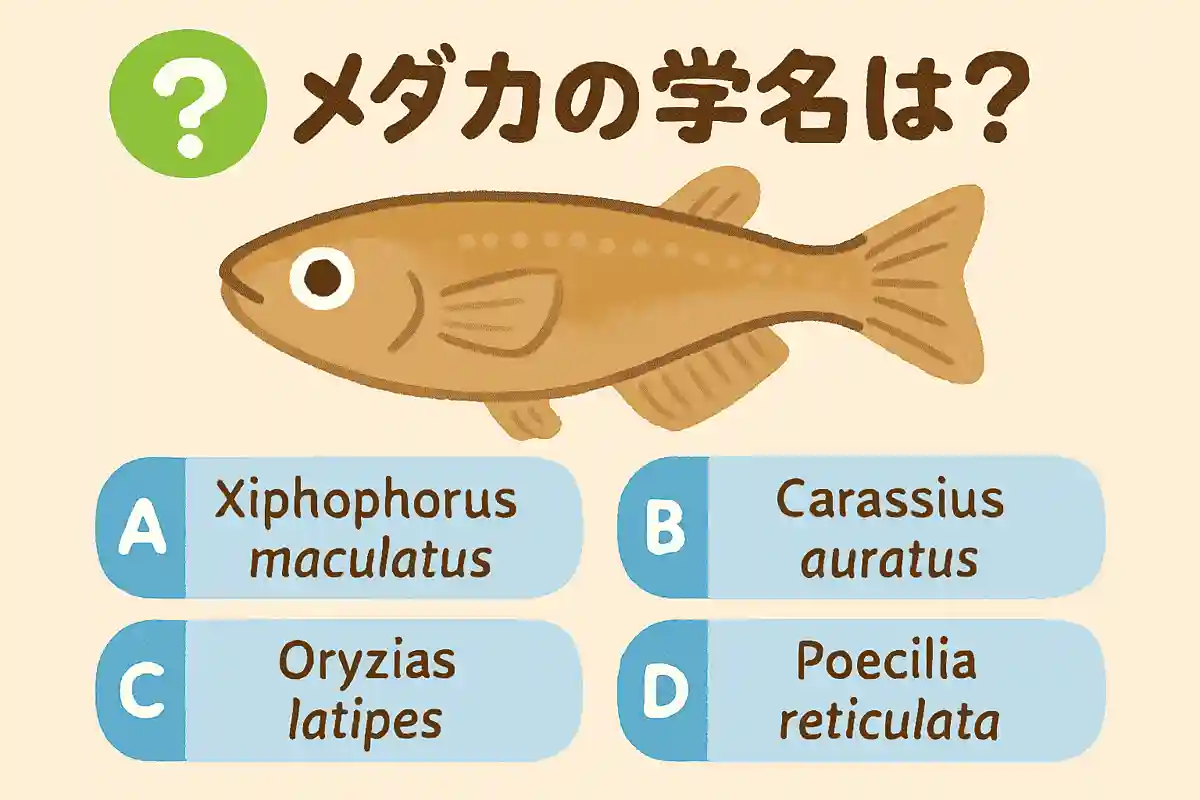
- Oryzias latipes
- Carassius auratus
- Danio rerio
See the answer
Oryzias latipes
The scientific name of the medaka is Oryzias latipes. Medaka are widely distributed in freshwater habitats across Asia, including Japan, and due to research on their ecology and genetics, they have become a very popular model organism in the field of biology.
Where did the medaka come from?

- Indian subcontinent
- North American continent
- Australian continent
See the answer
Indian subcontinent
The medaka’s place of origin is the Indian subcontinent. Over millions of years of evolution, medaka have come to inhabit a wide area across East Asia, including present-day Japan. It is thought that they spread from the Indian subcontinent through Southeast Asia and eventually reached Japan. The reason medaka have become a familiar and popular presence around Japan’s waters lies in this long history of migration and adaptation.
What is the name of the medaka (Japanese rice fish) with an orange body color?

- Himedaka (Japanese rice fish, orange variety)
- black medaka (black Japanese rice fish)
- White Cloud Mountain minnow
See the answer
Himedaka (Japanese rice fish, orange variety)
Himedaka are a type of medaka (Japanese rice fish) with a beautiful orange body color. Thanks to their bright hue, they are popular ornamental fish kept by many enthusiasts. Especially among selectively bred varieties, some have deeper coloration and greater luster, offering additional appeal and a wide range of types to enjoy.
Where are medaka born?

- Driftwood and stones
- Aquatic plants
- water surface
See the answer
Driftwood and stones
Medaka eggs are often laid by the parent fish on underwater objects such as driftwood and stones. These locations provide protection for the eggs and serve as hiding places for the fry after they hatch, helping them avoid predators. Driftwood and stones rest stably on the bottom and offer an environment suitable for medaka to lay their eggs.