

[Beginner-friendly] Easy Mozart piano pieces. Recommended Mozart works.


Wolfgang Amadeus Mozart, a composer familiar from textbooks.
A genius of the classical world known as a child prodigy, he excelled in every kind of music—opera, concertos, symphonies, chamber music, and sonatas.
It’s said he wrote more than 600 works.
This time, we’ve selected some of Mozart’s piano pieces that are on the easier side.
We also point out which aspects make them easy, and, even within that, which parts can be challenging—so be sure to check it out.
- [For Elementary School Students] Brilliant, Showy Masterpieces That Sound Impressive at Piano Recitals
- Beginner to Intermediate: Chopin pieces with relatively low difficulty. Recommended works by Chopin.
- [For Piano Recitals] Simple yet Cool Classical Pieces
- Lower difficulty: Not as hard as it sounds!? Debussy’s piano pieces
- Beginner to Intermediate: Recommended Bach Pieces You’ll Want to Play on Piano
- Beethoven: A selection of gem-like masterpieces that are easy to play on the piano
- [Intermediate Level] Cool Piano Pieces You Can Play [Great for Recitals Too]
- [For Adults] Recommended for Piano Recitals! A Curated Selection of Impressively Sounding Masterpieces
- Piano Masterpieces: Surprisingly Easy Despite Sounding Difficult!? A Curated Selection Perfect for Recitals
- [Piano Pieces] Easy for Children to Play! A Roundup of Simple Classical Works
- [Classical Music] All pieces under 3 minutes! A collection of short and cool piano pieces
- [Piano Recital] Recommended for Boys! A Curated Selection of Cool, Impressive, and Popular Pieces
- [For 5-year-olds] A curated selection of recommended pieces for a piano recital!
[Easier Level] Simple Mozart piano pieces. Recommended Mozart pieces (21–30)
Overture from The Magic FluteWolfgang Amadeus Mozart

Mozart’s famous opera The Magic Flute.
This time, I’d like to introduce the Overture from The Magic Flute.
While it’s commonly performed as a violin solo, it is also played as a piano piece.
Since the original contains passages that are clearly unplayable as-is on the piano, it can be considered a difficult work in that sense; however, many scores simplify those sections.
In terms of difficulty, it’s around an intermediate level, and if your left-hand technique is nimble, you should be able to play it smoothly.
The duet sections also turn out to be easier than expected when you try them, so be sure to check it out.

Lacrimosa — from “Requiem”Wolfgang Amadeus Mozart

Mozart’s famous piece “Requiem in D minor, K.626: Lacrimosa,” with its strikingly weighty melody, is widely recognized and often used in the media, so even beginners are likely familiar with it.
Among beginner-level works, this one is suitable for those with relatively little experience.
Some editions include left-hand octaves, but more commonly they do not, so hand size shouldn’t be a concern.
The tempo is also slow, making it an excellent piece for those just starting out to practice.
Variations on ‘Twinkle, Twinkle, Little Star’Wolfgang Amadeus Mozart

When we were kids, someone in class was probably playing the famous masterpiece, “Twelve Variations on ‘Ah, vous dirai-je, Maman’” (Twinkle, Twinkle, Little Star Variations).
It’s known as an easy Mozart piece, but that really only applies to the opening sections.
From the 12th variation onward, it boasts a difficulty suited to advanced players, or at least the upper tier of intermediate pianists.
In the latter half, true to Mozart’s style, the left hand carries and transforms the melody, so hand size also becomes important.
For beginners, it can be a good idea to keep practicing it over a long period as a benchmark to gauge your progress.
Allegro in G minor, K. 312Wolfgang Amadeus Mozart

Mozart’s piece Allegro in G minor, K.
312, known as an unfinished masterpiece.
Although the reason it was composed remains unknown, it is still performed by many piano enthusiasts today.
In terms of difficulty, it’s suited for intermediate players: while it includes repetitive, straightforward phrases that are approachable even for beginners, it also features frequent hand crossings and some fast passages in tricky spots.
If you can just about manage Fantasia in D minor, K.
397, it’s definitely worth tackling—be sure to check it out.
Minuet in F major, K. 2, from the Nannerl NotebookWolfgang Amadeus Mozart
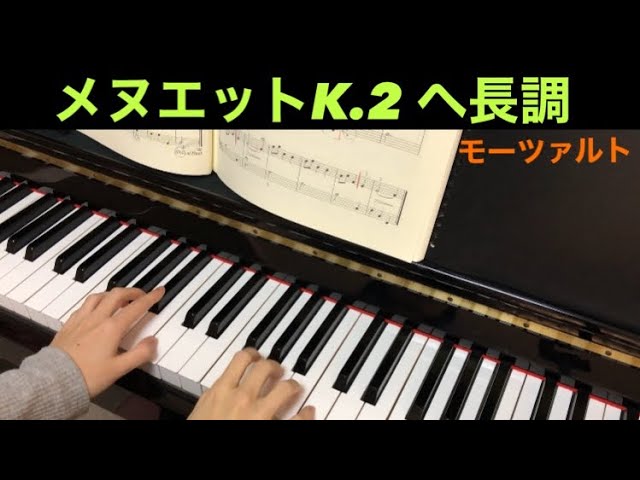
The piece Minuet in F major, K.
2 is said to have been composed by Mozart when he was six years old.
To write something like this at six—what a frighteningly gifted child, right? Jokes aside, this work is popular as a beginner-friendly Mozart piece.
Its characteristic, very Mozart-like structure features a steady rhythm in the right hand while the mood shifts with the left-hand melody.
It’s also great practice for the left hand, so if you’re just starting out, be sure to check it out.
Overture from The Marriage of FigaroWolfgang Amadeus Mozart

Mozart’s opera The Marriage of Figaro—anyone with even a slight interest in opera will know this piece.
This time, I’d like to introduce the Overture from The Marriage of Figaro.
Although it’s from an opera, it also stands well on its own as a solo piano piece and is frequently performed at piano recitals.
The difficulty is suited to intermediate players, and it’s notably faster than it looks on the score.
If you want to develop your fast passagework, it makes an excellent study piece.
Piano Concerto No. 23 in A major, K. 488 – II. MovementWolfgang Amadeus Mozart

Among Classical-era piano works, Mozart’s Piano Concertos are especially beloved.
Here, I’d like to introduce the second movement from his Piano Concerto No.
23 in A major, K.
488.
This piece, classified as an Adagio, is notable for its melody that blends clarity with a sense of pathos.
Since the music was sketched from the piano part, its structure showcases the instrument’s strengths to striking effect.
Although not a short work, it isn’t constructed in a way that demands great stamina, so even beginners should be able to perform it without much difficulty.