

[Mr. Children] A roundup of piano sheet music for their smash-hit classics!

Since their major debut in 1992, Mr.Children—affectionately known as “Misuchiru”—has remained at the pinnacle of the Japanese pop scene as one of the nation’s most iconic bands.
With lyrics that carry powerful messages resonating deep in the heart, the earnest vocals of Kazutoshi Sakurai, and that grand, quintessential Mr.Children sound, their songs have consistently won support across generations.
This time, from among Misuchiru’s many hits, we’re introducing songs that are perfect for piano performance, along with recommended sheet music.
A must-read for longtime Misuchiru fans and anyone with a special connection to their music!
- [Piano Beginners] J-POP That Looks Hard but Is Surprisingly Playable [2026]
- [Queen] I want to play it on the piano! A selection of recommended sheet music for popular songs
- [J-POP] I want to listen to songs with impressive, beautiful piano tones! Recommended piano cover tracks
- [Piano × J‑Pop] A curated selection of the coolest new hits and anime songs that’ll look great when you play them
- [Beginner] Recommended for adult piano beginners! Beautiful & stylish piano pieces
- [With Piano Sheet Music] Try Kenshi Yonezu’s smash-hit song!
- [Popular Piano] Capture the Audience’s Attention! Recommended Pop Songs That Shine at Piano Recitals
- [For 5-year-olds] A curated selection of recommended pieces for a piano recital!
- Covering back number’s smash-hit songs on piano! Carefully selected recommended sheet music
- [Piano Solo with Vocals] Recommended for Piano-and-Vocal Performances! Hit Songs from the Heisei to Reiwa Eras
- [X JAPAN] Play the legendary masterpiece on piano! Sheet music and performance video introduced
- [GReeeeN] Picked Piano Videos of Popular Songs & Recommended Sheet Music!
- [Nogizaka46] Introducing popular songs perfect for piano performance, along with sheet music!
[Mr.Children] A Showcase of Piano Scores for Their Massive Hit Classics (1–10)
365 daysMr.Children
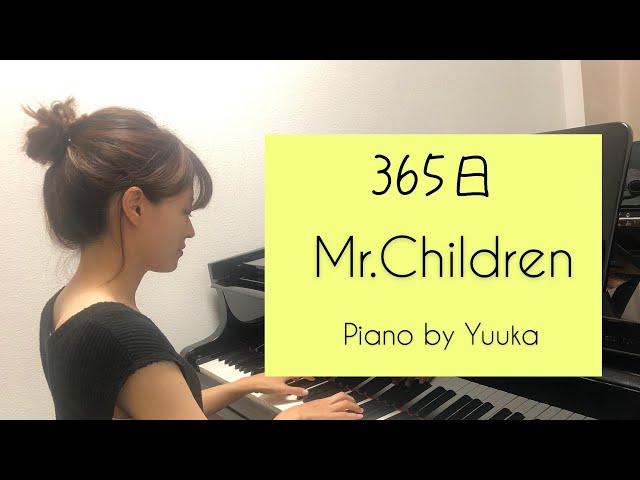

A beloved masterpiece often cited as one of Mr.Children’s signature songs despite never being released as a single, “365 Nichi” appears on the 2010 album SENSE.
The song, which sings of the preciousness of life and the importance of caring for others, is frequently used at weddings and cherished by listeners across generations.
In the original, the piano’s timbre serves as a key accent, making it perfect for a piano-only performance as well.
Aim for a gentle resonance, and in the chorus, create a moving atmosphere—play with a rich tone, at a relaxed pace, and with plenty of breathing room.

Seesaw Game ~A Brave Love Song~Mr.Children


Released in 1995, the smash hit “Seesaw Game” became a million seller with total sales of 1.812 million copies.
Many listeners can’t help but relate to vocalist Kazutoshi Sakurai’s lyrics, which convey the feeling, “Even though I know better, I repeat the same mistakes—life is like a seesaw game.” It might be nice to blow away the haze of romance and relationships by playing this bright, lighthearted song on the piano, as if laughing off your own tendency to fall in love again after a painful breakup.
If you emphasize the right hand triplets with a slightly heavier touch, it adds contrast and makes for a more interesting performance!
Nameless PoemMr.Children


Released in 1996, the single “Namonaki Uta,” which became a massive hit with total sales of 2.309 million copies, is one of Mr.
Children’s signature songs, beloved by a wide range of generations.
Its wistful melody and lyrics—where Kazutoshi Sakurai’s flair for word choice truly shines—linger in your mind, making it a memorable and deeply satisfying piece.
The contrast between the breezy, humming-like sound and the strongly message-driven lyrics is characteristic, so it’s ideal to express that through dynamic range and tonal color on the piano.
[Mr. Children] A roundup of piano sheet music for their blockbuster hit classics! (11–20)
Live.Mr.Children


“Ikirō (Live On)” is included on the 2022 best-of album Mr.Children 2015 – 2021 & NOW, and was produced for the film Kingdom II: To the Far Land, starring Kento Yamazaki.
It’s like an anthem for life that urges you on: “Even when things are hard, don’t give up hope—believe in yourself and live on!” When playing it on piano, you’ll want to capture the “strength” that comes through in the title, lyrics, and sound.
Keep the left-hand accompaniment, which marks the beats, solid and precise, and play the right-hand melody carefully, making sure each note is articulated so the quick passages don’t get muddled.
GIFTMr.Children


GIFT, which was chosen as the theme song for NHK’s Beijing Olympics and Paralympics and as the CM song for Shiseido’s MAQuillAGE, is a track where Kazutoshi Sakurai’s vocals—combining gentleness and strength—match beautifully with the unpretentious melody and lyrics that give you a push, saying “Your possibilities are limitless.” To convey the heartwarming melodic line on piano and the conversational feel of the lyrics, the key is to play with a soft, rounded tone.
Even in the more intense sections, be careful not to let the sound get harsh; try practicing with thoughtful pedal work.
HEROMr.Children


Released in 2002, “HERO” is a song told from the perspective of parents watching over their child.
During the aftermath of the 9/11 attacks in the United States, vocalist Kazutoshi Sakurai felt uneasy about the uniquely American tendency to idolize someone as a hero at every turn.
From his feeling that “parents who stay by their child’s side and watch over them warmly are far more of a hero to that child,” this song was born.
Try expressing the warm, heartfelt atmosphere conveyed by the lyrics and sound with gentle piano tones.
sign; mark; symbol; omenMr.Children


Released in 2006, “Shirushi,” which was used as the theme song for the drama 14-Year-Old Mother starring Mirai Shida, still resonates with many listeners.
Many people say, “I remember scenes from the drama and it makes me cry,” or “Just the opening melody makes my eyes well up.” Its gentle, beautiful melody and lyrics that are both heartrending and warm have remained with many people even more than 15 years after its release.
The slow, calm tempo pairs perfectly with the soft sound of the piano.
Don’t just play the notes—add dynamics and subtle tempo changes to perform it with rich emotion.