

[Children’s Song] Easy Even for Piano Beginners! Introducing Nursery Rhymes with Simple Chords


Familiar nursery rhymes that everyone sang at least once in childhood.
With simple melodies, easy-to-remember lyrics, and straightforward chords, nursery rhymes are perfect for piano beginners to practice! So this time, we’re introducing easy, playable nursery rhymes recommended for children who have just started piano lessons and adults who are beginning to learn on their own.
We’ve selected songs that meet the following conditions: a relatively narrow range, few notes in the melody, and simple chords.
Give them a try!
- [For Kids] Play Piano with One Finger! Recommended Songs Collection
- [Piano Etudes] Recommended for Beginners! A Curated Selection of Easy, Playable Pieces
- How to play piano accompaniment using simple chords
- Beginner Piano: Carefully Selected Easy and Famous Pieces You Can Play with One Octave
- [Piano Pieces] Easy for Children to Play! A Roundup of Simple Classical Works
- [With Piano Sheet Music] Easy to Play! Introducing Free Performance Videos of Children’s Songs and School Songs
- Get pumped with kids’ favorite songs! A memorable collection of classics that will make you want to sing along
- Piano is easy! A selection of sheet music that beginners can play with both hands
- [For Piano Beginners] Play Right Now with Free Sheet Music! A Roundup of Recommended Practice Pieces
- Ranking of Popular Children's Songs [2026]
- [For 3-year-olds] Songs to sing at nursery schools and kindergartens! Popular and recommended songs
- [Christmas Songs] Christmas songs to sing with children
- A must-see for anyone who wants to try piano-and-vocal performances through code! From nostalgic oldies to the latest hits, all introduced at once.
[Children's Songs] Easy for Piano Beginners! Introducing Simple-Chord Nursery Rhymes (21–30)
Mountain MusiciansDoitsu min’yō
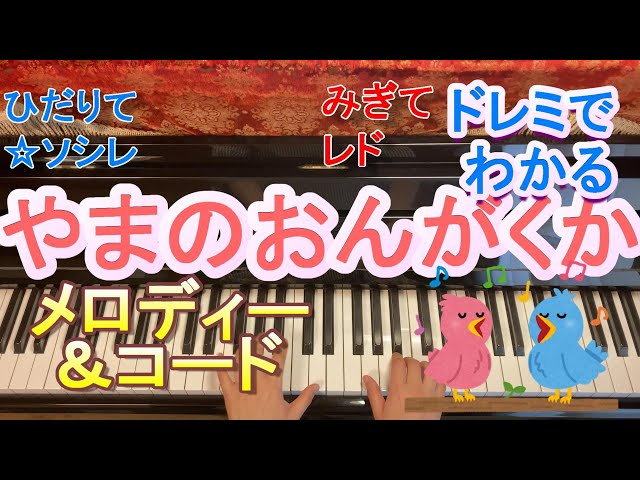
Learn the names of instruments and the characteristics of their sounds while singing! The children’s song “Yama no Ongakuka” (The Mountain Musicians), based on a German folk tune, is perfect for beginner piano practice because of its narrow range and frequent repetition of the same phrases, and it’s actually included in many piano method books.
It’s also very popular as a piece to perform at recitals! At first, it may be difficult to coordinate the bouncy rhythm in the right hand with the accompaniment, but since the piece is built on just two chords, you should be able to master it smoothly if you start with an arrangement using only the bass line and the melody.
Gradually add chords and rhythm, and aim to express the animals enjoying their instruments.

aye-ayeUno Seiichirō

There are many nursery rhymes that feature animals as the main characters, and among them, “Ai Ai” is probably the first that comes to mind for many people.
This song, which is almost always sung in preschools and kindergartens, has a narrow vocal range and uses few chords, making it an ideal piece for beginning piano learners.
Being able to read notes fluently is an important element in improving at the piano, but to keep learning enjoyable, it’s also very important to experience the joy of being able to play a song you already know! While reading the sheet music, try practicing by relying on the melody and harmony of “Ai Ai” that you remember.
The Spinning SongKomori Akihiro

Originally based on a Danish folk song, “Itomaki no Uta” was composed by Akihiro Komori, a composer known for creating numerous children’s songs.
Many people may remember singing it while doing hand-play as a child.
With its easy-to-remember melody and rhythm—and being built on just three chords—it’s also recommended as a practice piece for piano or for singing with self-accompaniment.
Try getting used to playing with both hands by changing up the accompaniment: hold one chord per measure, keep time with quarter notes, or use broken chords, and so on.
Piglet-raccoon dog-fox-catYamamoto Naozumi

‘Kobutanukitsuneko,’ whose title strings together familiar animal names in a word-chain, is a popular children’s song that’s also loved as a hand-play song.
In fact, with the simplest arrangement, you can play it using just two repeating chords! For example, if you play it in C major, you only need to repeat the progression “C–G–G–C.” It’s perfect not only as a practice piece for young children and piano beginners, but also for practicing singing while playing.
Once you’re somewhat comfortable with two-handed playing, try adding touches like turning the accompaniment into arpeggiated chords.
Toy Cha-Cha-ChaKoshibe Nobuyoshi

“Omocha no Cha Cha Cha” is, of course, beloved by children, and is also supported by adults as a song they want kids to listen to.
With its friendly melody and easy-to-follow rhythm, this piece is one of the easiest children’s songs to play thanks to its simple chord progression.
The “Cha Cha Cha” in the title comes from the well-known social dance rhythm of the same name! Once you’ve become reasonably comfortable playing it, try adding more movement to the accompaniment or arranging the rhythm yourself to aim for an even more rhythmic performance.