

I’ve prepared a perfect piece for practicing quintuplets on the piano, complete with audio and sheet music.
Please make the most of it in your practice.
- Tips for increasing your piano playing techniques
- Difficult Piano Pieces | Even Pros Can't Play Them!? Classical Works Requiring Virtuosic Technique
- Self-Study Piano Lessons! A Complete Introduction to Easy and Recommended Sheet Music for Adults
- [For Piano Beginners] 7 Tips to Move Your Fingers the Way You Want
- How to play piano accompaniment using simple chords
- [Master it in 1 Month] Learn to Play Gen Hoshino's 'SUN' on Piano! Rhythm Practice Edition
- [For 5-year-olds] A curated selection of recommended pieces for a piano recital!
- [For Piano Beginners] Play Right Now with Free Sheet Music! A Roundup of Recommended Practice Pieces
- [Piano Sheet Music] Free downloads available! A roundup of easy-to-play pieces
- [Piano Etudes] Recommended for Beginners! A Curated Selection of Easy, Playable Pieces
- [Free Piano Sheet Music] Beginner-Friendly! Carefully Selected Pieces Available for Immediate Download
- [Piano Recital for 5-Year-Olds] Play Disney’s Beloved Classics! A Curated Selection of Recommended Pieces
- Piano is easy! A selection of sheet music that beginners can play with both hands
The Rain Of May
I think it was around this time last year.
When I woke up, the morning sun was streaming in through the east-facing window, and when I looked outside, a gentle rain was falling.
Despite the brightness all around, a gentle, quiet rain was falling, and it felt so very pleasant.
Without even washing my face, I went straight to the piano and composed a piece.
I wrote it all in one go, so I think it probably didn’t even take 30 minutes.
That is this song, “The Rain of May.”
As if the comfort of that day were sealed inside the song, when I play it I can vividly recall even the scent of that day.
In that sense, I think composing can be a wonderful tool for preserving the scenes of a given moment.
Master quintuplets
STEP 1: Get used to the feel of quintuplets Difficulty: ★
This piece is written in quintuplets from start to finish.
When you hear “quintuplets,” they might sound difficult, but once you get used to them, they’re actually very easy to play.
For example, this is how the song starts.
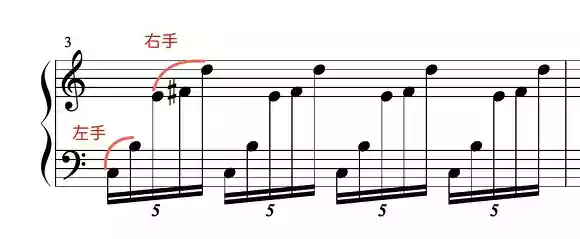
It’s written to play it by splitting it into three notes with the right hand and two with the left, but if you divide it between both hands like this, it’s surprisingly easy.
With this, you’ll first get used to the feel of quintuplets.
STEP 2: 5 = 2 + 3 Difficulty: ★★
Next, divide the quintuplet of five sixteenth notes into groups of 2 + 3.
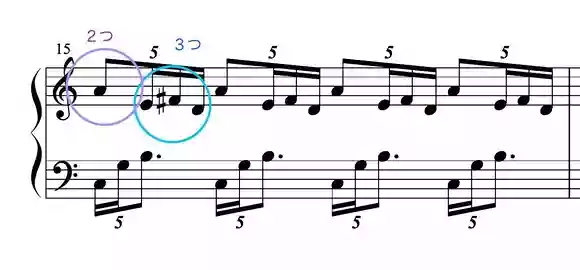
It’s the length of two sixteenth notes, so I’m using an eighth note, but if I don’t consciously count both sixteenth-note beats in my head, the rhythm falls apart.
To make it less likely for the rhythm to fall apart, I’m adding sixteenth notes with the left hand in the sections where the right hand plays eighth notes, so when played with both hands it becomes a clean 5-tuplet of 2+3.
STEP 3: 5 = 3 + 2, 5 = 2 + 3 Difficulty: ★★★
As before, this time divide them into groups of 3 and 2.
And then try connecting it to the 2+3 group as well.
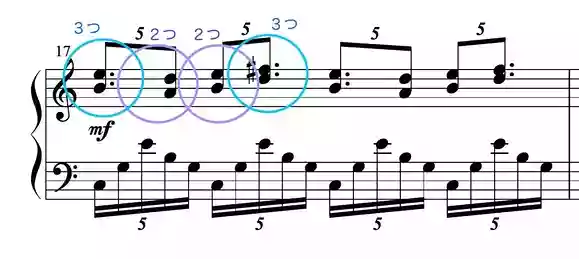
The melody consists only of dotted eighth notes, each equal to three sixteenth notes, and plain eighth notes, each equal to two sixteenth notes.
If you’re not internally feeling the quintuplets, the rhythm will fall apart, so the trick is to line up with the sixteenth notes in the left hand and play accordingly.
If you can play up to this point, you should have mastered quintuplets, so definitely try taking on “The Rain Of May”!
You can download the sheet music (PDF) for “The Rain Of May” for free from here.DownloadI can.